
Sequencing data are easier to generate than ever, but analyzing them correctly remains difficult.
Many research groups now receive FASTQ files, count tables, genome assemblies or metagenomic datasets from sequencing facilities, but do not always have the time, computational resources or specialized expertise to process them into reliable biological results.
This is where a bioinformatics service provider can help.
The right provider can turn raw sequencing data into reproducible workflows, interpretable figures, clear reports and publication-ready results.
The wrong provider can produce generic outputs, poorly documented methods, unclear files, weak interpretation or results that are difficult to defend in a manuscript or thesis.
In this article, we explain how to choose a bioinformatics service provider for genomics, metagenomics, microbiome analysis, transcriptomics and related microbial data analysis projects.
Start with your research question
Before choosing a provider, define what you need.
A good bioinformatics project does not start with a tool. It starts with a biological question.
For example:
- Do you need to assemble and annotate bacterial genomes?
- Do you need to compare microbial communities?
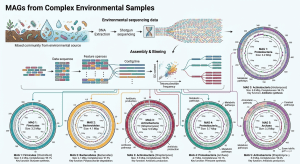
- Do you need MAG recovery from shotgun metagenomes?
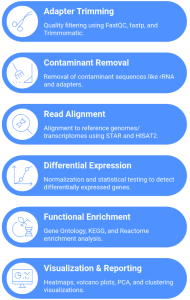
- Do you need RNA-seq differential expression analysis?
- Do you need taxonomic profiling or functional annotation?
- Do you need publication-ready figures?
- Do you need help interpreting confusing results?
A provider should be able to translate your research question into an appropriate analysis plan.
Be cautious if the provider immediately recommends a fixed pipeline without asking about your samples, metadata, sequencing strategy, organism, study design or downstream objective.
Look for relevant domain expertise
Bioinformatics is broad.
A provider may be excellent for human variant calling but not ideal for microbial metagenomics. Another may be strong in single-cell analysis but less experienced with bacterial genome annotation or environmental microbiomes.
For microbial research, relevant expertise may include:
- bacterial genome assembly;
- genome annotation;
- comparative genomics;
- shotgun metagenomics;
- microbiome diversity analysis;
- MAG recovery;
- functional annotation;
- microbial RNA-seq;
- pathway interpretation;
- sequencing technology differences.
This matters because microbial datasets have specific complications:
- compact genomes;
- operons;
- plasmids;
- strain variation;
- incomplete references;
- environmental diversity;
- poorly annotated genes;
- host contamination;
- complex community structure.
A good provider should understand both the computational workflow and the biological context.
At Tailoredomics, the focus is specifically on microbial genomics, metagenomics, microbiome data analysis and transcriptomics for research projects.
Check whether the workflow is reproducible
A bioinformatics analysis should not be a black box.
You should know:
- which tools were used;
- which versions were used;
- which databases were used;
- which parameters were changed;
- which samples were excluded;
- how quality control was performed;
- how final figures and tables were generated.
This is especially important for publication.
Reviewers may ask about:
- software versions;
- reference genome version;
- annotation source;
- database release;
- filtering thresholds;
- statistical model;
- normalization method;
- multiple-testing correction.
If these details are missing, the analysis may be difficult to defend.
A strong provider should deliver not only results, but also documentation.
Ask what deliverables you will receive
Before starting a project, clarify what the final deliverables include.
Depending on the project, useful deliverables may include:
- QC reports;
- trimmed or filtered reads;
- assembly files;
- annotation tables;
- taxonomic profiles;
- abundance tables;
- differential expression tables;
- pathway analysis;
- figures;
- scripts or workflow documentation;
- methods text for publication;
- summary report;
- interpretation notes.
The exact deliverables should match your goal.
A PhD student preparing a manuscript may need figures, tables and methods text.
A research group exploring a new dataset may need a broader report with recommendations.
A company may need reproducible outputs and clear summary files for internal decision-making.
Do not assume that a “bioinformatics analysis” automatically includes interpretation. Some providers deliver only processed files. Others include biological interpretation and reporting.
Evaluate communication style
Communication is often underestimated.
A good provider should be able to explain:
- what they will do;
- why they chose a method;
- what the limitations are;
- what the results mean;
- what cannot be concluded from the data.
This is particularly important if you are not a bioinformatician yourself.
You should not receive only a folder full of files with no explanation.
Clear communication can save a project when unexpected problems appear, such as:
- poor read quality;
- low mapping rate;
- contaminated assemblies;
- fragmented metagenomes;
- low-quality MAGs;
- weak differential expression signal;
- missing metadata;
- batch effects.
A useful provider does not just run commands. They help you understand the dataset.
Make sure the provider asks for metadata
Metadata are essential for many analyses.
For RNA-seq, metadata define the experimental design.
For microbiome studies, metadata define groups, treatments, time points, locations, host variables and covariates.
For metagenomics, metadata can help interpret community differences, environmental gradients and functional patterns.
Useful metadata may include:
- sample ID;
- condition;
- treatment;
- time point;
- replicate;
- batch;
- sequencing run;
- location;
- host;
- environmental variable;
- phenotype;
- extraction method.
If a provider does not ask for metadata, that is a warning sign.
Without metadata, analysis may become a generic technical report rather than a biological interpretation.
Beware of unrealistic promises
Bioinformatics cannot fix every dataset.
A provider should be honest about limitations.
For example:
- poor sequencing quality may reduce analysis reliability;
- low sequencing depth may limit MAG recovery;
- confounded experimental design may limit RNA-seq conclusions;
- missing metadata may weaken interpretation;
- short-read data may not resolve all repeats or plasmids;
- low biological replication may reduce statistical power;
- reference database limitations may affect taxonomic classification.
Be cautious with promises such as:
- “complete genome reconstruction from any metagenome”;
- “publication-ready results guaranteed”;
- “strain-level resolution from all samples”;
- “significant genes guaranteed”;
- “full interpretation without metadata”.
A trustworthy provider should explain what is realistic before the project starts.
Compare price in relation to value, not only hours
Bioinformatics pricing can vary widely.
A very cheap analysis may be tempting, but the main question is not only cost. The question is what you receive.
For example, two providers may both offer “RNA-seq analysis”, but one may deliver only a count table and DESeq2 output, while another may include QC, exploratory plots, statistical design, pathway interpretation, figures, methods text and a written report.
Similarly, a metagenomics analysis may include only taxonomic profiling, or it may include preprocessing, host filtering, assembly, binning, MAG QC, annotation and interpretation.
When comparing quotes, ask:
- What exactly is included?
- Are revisions included?
- Is interpretation included?
- Are figures included?
- Is documentation included?
- Are methods sections included?
- Will the workflow be reproducible?
- What happens if data quality is poor?
The cheapest option is not always the most efficient if you later need to redo the analysis.
Look for transparency about tools and limitations
A good provider should be comfortable discussing tools.
For example:
- Why use Kraken2, Kaiju or MetaPhlAn?
- Why use DESeq2 for differential expression?
- Why use Prokka, PGAP or RAST?
- Why use MEGAHIT or metaSPAdes?
- Why use CheckM or CheckM2?
- Why choose individual assembly or co-assembly?
They do not need to overexplain every technical detail, but they should be able to justify key choices.
If the provider refuses to disclose methods or treats the pipeline as completely proprietary without explanation, that may be a problem for academic research, where reproducibility and methods reporting are essential.
Choose a provider aligned with your project type
Different projects need different support.
For bacterial genome projects
Look for experience with:
- assembly;
- polishing;
- annotation;
- contamination screening;
- taxonomic placement;
- comparative genomics;
- gene mining.
See: Microbial Genomics Services
For metagenomics projects
Look for experience with:
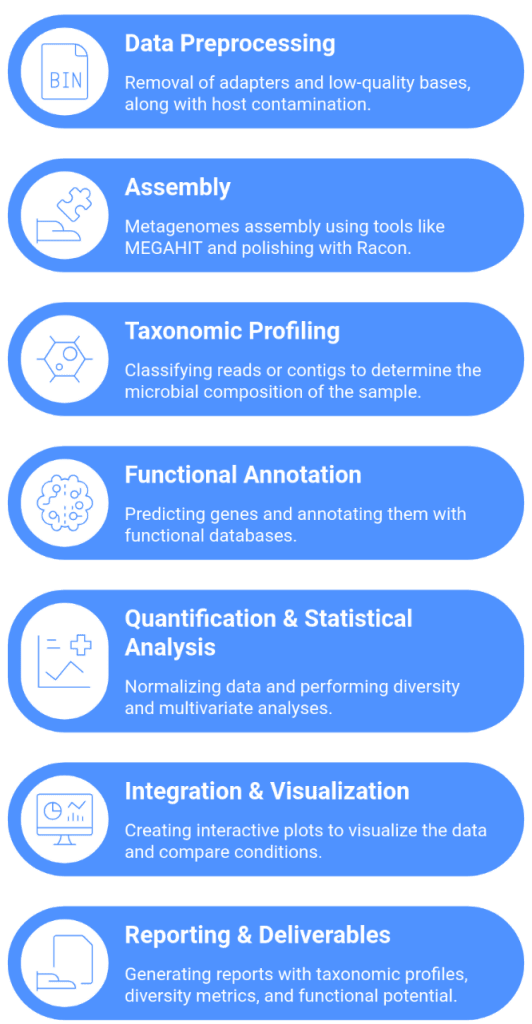
- read QC;
- host removal;
- taxonomic profiling;
- metagenome assembly;
- binning;
- MAG quality assessment;
- functional annotation;
- pathway interpretation.
For microbiome projects
Look for experience with:
- 16S/ITS workflows;
- QIIME2 or DADA2;
- alpha diversity;
- beta diversity;
- differential abundance;
- metadata-aware interpretation;
- publication-ready figures.
See: Microbiome Data Analysis Services
For RNA-seq projects
Look for experience with:
- raw read QC;
- alignment or quantification;
- count matrices;
- DESeq2 or related methods;
- batch effects;
- pathway analysis;
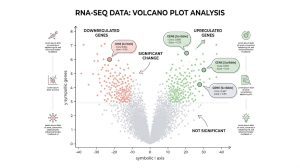
- volcano plots, PCA and heatmaps;
- interpretation.
Practical checklist before hiring a bioinformatics provider
Before choosing a provider, ask:
- Do they understand my biological question?
- Do they have experience with my data type?
- Do they ask for metadata?
- Do they explain the workflow clearly?
- Do they provide reproducible methods?
- Do they report software and database versions?
- Do they include quality control?
- Do they explain limitations?
- Do they provide interpretable deliverables?
- Do they offer publication-ready figures or reports if needed?
- Do they communicate clearly?
- Do they avoid unrealistic guarantees?
The best provider is not necessarily the biggest or cheapest. It is the one that can generate reliable, interpretable and useful results for your specific research question.
Final thoughts
Choosing a bioinformatics service provider is not only about outsourcing technical work.
It is about finding someone who can help transform sequencing data into reliable biological insight.
For research projects, especially in microbial genomics, metagenomics, microbiome analysis and transcriptomics, the most valuable provider is one who combines technical competence with biological understanding, reproducibility and clear communication.
Good bioinformatics should make your project easier to interpret, easier to publish and easier to defend.
If you need support with microbial sequencing data, Tailoredomics provides tailored bioinformatics services for researchers working with microbial genomics, metagenomics, microbiome data analysis and transcriptomics.
FAQ
What does a bioinformatics service provider do?
A bioinformatics service provider analyzes biological sequencing data and produces results such as QC reports, genome assemblies, annotations, taxonomic profiles, differential expression tables, figures and interpretation reports.
When should I outsource bioinformatics analysis?
Outsourcing can be useful when you lack time, computational resources, specialized expertise or need publication-ready outputs for sequencing data.
What should I ask before hiring a bioinformatician?
Ask about experience with your data type, workflow reproducibility, deliverables, quality control, metadata requirements, reporting, interpretation and limitations.
Are bioinformatics services useful for academic researchers?
Yes. Academic researchers often use bioinformatics services when they need support processing complex datasets, preparing figures, interpreting results or finalizing analyses for publication.
What files do I need to provide?
This depends on the project, but common inputs include FASTQ files, count matrices, metadata tables, reference genomes, annotation files and information about the experimental design.