
Transcriptomics & RNA-seq bioinformatics
Transcriptomics Services: RNA-Seq Data Analysis for Microbial and Host Transcriptomes
From raw FASTQ files to differential gene expression, functional enrichment, and publication-ready figures. Analysis shaped around your organism, experimental design and research question.
We work with existing RNA-seq reads, suitable BAM files or count matrices. Sequencing and sample preparation are arranged separately.
Analysis capabilities
Our RNA-Seq Data Analysis Services
Choose a complete workflow or selected analyses for microbial, host or environmental transcriptomes. We agree the starting data, comparisons and deliverables before beginning.
Quality control & preprocessing
Assess read quality with FastQC, inspect adapters and select trimming or filtering with fastp or Trimmomatic where appropriate. Review library strandedness, rRNA content and potential contamination in the context of the experiment.
Differential gene expression analysis
Compare expression between conditions using DESeq2, edgeR or limma-voom. Define contrasts, account for supported design factors and report effect sizes alongside multiple-testing-adjusted p-values.
Functional enrichment & pathway analysis
Interpret expression changes with gene sets and annotations suited to your organism. Approaches include clusterProfiler, GSEA, KEGG and Reactome, where reference coverage supports them. Enrichment identifies patterns for biological interpretation.
Visualization & reporting
Receive heatmaps, PCA plots, MA or volcano plots, expression summaries and an explanation of the findings. Figure selection, labels and formats follow the study question and your manuscript or reporting needs.
Custom comparisons & metadata integration
Plan suitable contrasts for paired, multifactorial or time-course experiments. Incorporate relevant metadata and batch variables where the design permits. Existing results can also be assessed for focused troubleshooting or further analysis.
Research outcomes
What can you achieve with RNA-Seq analysis?
Compare expression across conditions
Identify genes with supported expression changes between treatments, time points or environments, with effect sizes and statistical uncertainty made clear.
Investigate candidate regulatory responses
Explore transcription factors, stress-response genes and other candidates relevant to your question. Expression patterns can prioritize follow-up experiments; they do not by themselves demonstrate regulatory causality.
Explore functional and pathway patterns
Assess which functional categories are enriched among changing genes or across ranked results. Interpret these patterns alongside annotation coverage and the biology of your system.
Support hypotheses and communicate findings
Connect expression results with your experimental question, generate testable hypotheses and present the evidence through clear figures, tables and interpretation.
Starting your project
Data and supported organisms
Reads, alignments or count matrices
Raw FASTQ/FASTQ.gz files, primarily Illumina single-end or paired-end RNA-seq. Suitable BAM files or unnormalized count matrices can support later workflow stages after reviewing their processing history. Other platforms are assessed before agreeing the scope.
References & library information
Provide the genome or transcriptome and matching annotation if available, plus library preparation, strandedness and read layout. If no suitable reference exists, we can assess de novo transcriptome assembly or an alternative reference strategy.
Sample metadata & experimental design
A sample sheet linking files to groups, biological replicates, batches and relevant covariates. Include pairing, repeated sampling or time points, and specify the comparisons you want to make.
Organisms & biological systems
Bacterial and archaeal transcriptomics are central to our work. Eukaryotic and host transcriptomes can also be assessed. Host–microbe and environmental community RNA projects require methods suited to mixed organisms, references and coverage.
Start with your organism, number of samples, available files and research question. No raw-data upload is needed at first contact.
Analytical workflow
RNA-Seq Analysis Workflow
Existing BAM files or count matrices enter at the appropriate stage. The workflow is adapted to the data; not every project requires every step.
01 · Study design & input review
Confirm samples, references and contrasts
View step details
Review the question, biological replicates, sample metadata, reference versions and processing already performed. Check whether the requested comparisons are estimable from the experimental design.
02 · Read quality & preprocessing
Assess quality, adapters and library properties
View step details
Inspect sequencing quality and library characteristics. Trim adapters or filter reads where needed, and assess rRNA or other unwanted sequence content according to the study. FastQC reports quality; trimming is performed by separate tools.
03 · Mapping & quantification
Measure gene or transcript abundance
View step details
Select genome alignment and counting or a transcript quantification route. Check mapping or assignment summaries, annotation compatibility and strandedness. A de novo route, if agreed, requires assembly and assessment before downstream quantification.
04 · Differential expression
Fit models and evaluate contrasts
View step details
Filter unsuitable low-count features and use method-appropriate normalization and statistical models. Account for relevant covariates where possible, apply multiple-testing correction and assess effect sizes.
05 · Functional interpretation
Relate results to genes and pathways
View step details
Use appropriate annotations, tested-gene backgrounds or ranked gene-set methods. Interpret enrichment and candidate responses in biological context, with limitations for poorly annotated organisms made explicit.
06 · Figures & reporting
Deliver interpretable results and methods
View step details
Prepare the agreed matrices, comparison tables, figures and report. Document references, methods and relevant parameters, and discuss the main findings and limitations.
For a detailed walkthrough, see RNA-Seq Data Analysis Pipeline: From FASTQ Files to Differential Gene Expression.
Project outputs
RNA-Seq Analysis Deliverables
Your quotation specifies the outputs included. A complete FASTQ-to-results project and a focused analysis of an existing count matrix have different deliverables.
Quality control & mapping summaries
Relevant HTML or PDF quality reports, preprocessing statistics and mapping or quantification summaries. These outputs depend on the starting files and analysis route.
Expression matrices & optional alignments
CSV/TSV count or abundance tables, with raw, normalized and transformed values clearly distinguished. BAM files are optional where alignments are generated and included in the agreed scope.
Differential expression results
Tables for the agreed contrasts, including log2 fold changes, p-values, adjusted p-values and stated filtering or significance criteria. Results are supplied with feature identifiers and annotations where available.
Functional enrichment results
Where included: GO or pathway tables, tested gene sets and relevant visual summaries. Annotation resources and the analysis background or ranking method are documented.
Publication-ready figures
Suitable heatmaps, PCA, MA/volcano plots and custom expression figures in agreed formats such as SVG, PNG or PDF, with clear sample labels and comparison definitions.
Summary report & methods
A PDF report describing the methods, software and reference versions, key findings and interpretation. Additional scripts, intermediate files or methods text can be agreed explicitly.
Working with Tailoredomics
Why choose our RNA-Seq analysis services?
Experience in microbial research
Biological interpretation informed by research on microbial physiology, gene expression and integration of transcriptomics with proteomics.
Design-aware analysis
Comparisons and statistical models are selected around your replicates, metadata and research question. Limitations in the existing design are discussed before analysis.
Methods and results you can assess
Receive organized outputs and documented analytical choices, with clear explanations of the evidence and its limitations.
Direct communication & agreed timing
Discuss analytical decisions and findings directly. Scope, cost and timing are agreed for your dataset, with updates during the project.
Published research
RNA-seq analysis in Fervidobacterium research
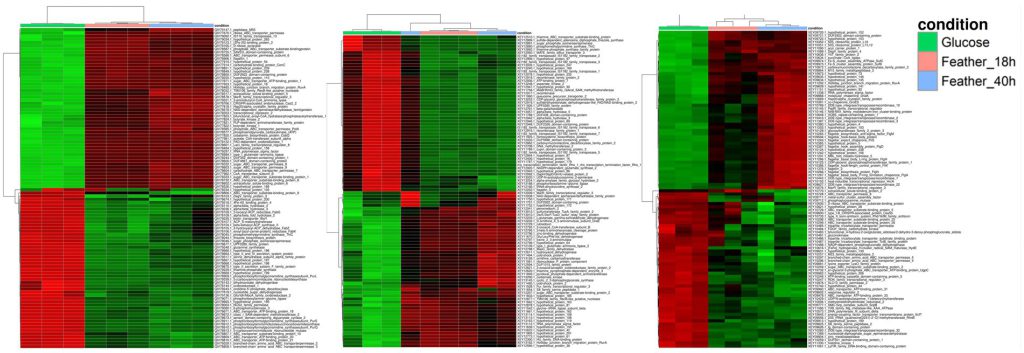
Research by Rubén Javier-López and co-authors combined transcriptomic and proteomic analyses to investigate feather keratin degradation. The heatmaps below illustrate expression differences across growth conditions in three Fervidobacterium strains.
Research contexts
Applications of our RNA-Seq data analysis services
Functional genomics & comparative transcriptomics
Explore expression differences across conditions or related strains, complementing genome annotation and comparative genomics. Cross-species comparisons require appropriate orthology and feature matching.
Host–microbe interaction studies
Investigate host responses or dual RNA-seq datasets where the library preparation, coverage and references support them. For community composition questions, see our microbiome analysis services.
Treatment & environmental responses
Study transcriptional responses to antibiotics, temperature, salinity, pH or nutrient limitation. Environmental community transcriptomics requires a community-specific approach; candidate biomarkers need further validation.
Integration with other omics
Combine expression evidence with metagenomics or proteomics results to investigate biological responses. Integration with other available data, including metabolomics, is assessed according to sample matching and project scope.
Before you enquire
Frequently asked questions
Do you provide sequencing or sample preparation?
We provide downstream bioinformatics analysis of existing data. RNA extraction, library preparation and sequencing are arranged separately through your institution or sequencing provider.
Which data formats and sequencing platforms do you support?
We primarily work with Illumina RNA-seq FASTQ files, including single-end and paired-end reads. Suitable BAM files, count matrices or transcript quantification outputs can be assessed for downstream analysis. Share the processing history and reference information; other platforms are scoped separately.
Can you analyse eukaryotes, host–microbe samples or environmental RNA?
Yes, these projects can be assessed alongside our bacterial and archaeal work. Methods depend on the organism, library preparation, reference quality and biological question. Mixed-community and dual RNA-seq projects need suitable assignment of reads to the organisms or features being studied.
What if I do not have a reference genome?
We assess available genome or transcriptome resources first. De novo transcriptome assembly can be considered when appropriate, with additional work to evaluate the assembly, annotate features and quantify expression. Feasibility depends on the organism and sequencing data.
Can you help with study design, and do I need biological replicates?
We can help define conditions, contrasts and metadata before sequencing or review an existing design. Biological replicates are needed to estimate biological variability for standard differential expression inference. Unreplicated datasets can support descriptive exploration, but additional sequencing reads do not replace independent biological replication.
How do you handle normalization and batch effects?
Normalization and modelling follow the selected method. In DESeq2, differential testing uses count-based models; variance-stabilizing transformations are used for exploration and visualization. Batch factors can be included when the design supports their estimation. A treatment effect cannot be separated from a completely confounded batch effect using modelling alone.
Can you troubleshoot low mapping rates or reanalyse existing results?
Yes. We can assess reference and annotation compatibility, read quality, library strandedness, contamination and the processing workflow. Share the reports and available files first so we can agree a focused investigation. Improved mapping or significant findings cannot be guaranteed.
Which tools do you use, and can I request custom analyses?
Tools may include FastQC, fastp, Trimmomatic, STAR, HISAT2, Salmon, DESeq2, edgeR, limma and clusterProfiler. We select methods for the dataset and can discuss specific tools, comparisons or figure styles before agreeing the scope.
How long does analysis take, and what does it cost?
Timing and price depend on sample number, starting data, reference availability and requested analyses. We agree the deliverables and schedule after reviewing your project. Let us know about manuscript, grant or thesis deadlines when you enquire.
Further reading
RNA-Seq workflows and troubleshooting
From FASTQ to differential expression
From FASTQ to Differential Gene Expression: RNA-Seq Analysis Pipeline Step by Step — follow the main stages from reads to statistical results.
Troubleshoot low mapping rates
Why Is My RNA-Seq Mapping Rate Low? Causes and Fixes — explore reference, library and read-quality issues.
Avoid common DESeq2 mistakes
Most Common DESeq2 Mistakes and How to Avoid Them — review common pitfalls in the design and analysis.
Interpret your expression results
How to Interpret RNA-Seq Results: From DEGs to Biological Meaning — connect result tables with biological questions.
Already have results but need help with the next step? Discuss a focused analysis or troubleshooting project.
Background reading
What is transcriptomics?
Transcriptomics examines the RNA transcripts present in cells under particular conditions. RNA-seq measures transcript abundance and supports comparisons of expression across samples. Read our introduction to what transcriptomics is.
For related background, explore microbial genomics, metagenomics and microbiome profiling.
Discuss your project
Need help analysing your RNA-seq data?
Tell us about your organism, available files, sample groups and research question. We can define an analysis plan and quotation for a complete workflow or selected steps.
Prefer email? info@tailoredomics.com