
Submitting proteomics data to the PRIDE repository is a mandatory requirement for publication in most journals — yet it is one of the most common bottlenecks that delays manuscript submission in proteomics groups. The science is done. The paper is written. And then everything stalls at data deposition.
This post explains what PRIDE submission involves, why it fails more often than it should, and what your options are when you need it done quickly and correctly.
Note: Tailoredomics provides downstream proteomics bioinformatics and PRIDE data deposition services. We do not perform mass spectrometry or wet-lab work — we work with the LC–MS/MS data you already have.
What Is PRIDE and Why Do Journals Require It?
PRIDE (PRoteomics IDEntifications database) is the primary public repository for mass spectrometry–based proteomics data, hosted by the European Bioinformatics Institute (EMBL-EBI). It is part of the ProteomeXchange Consortium, alongside repositories like MassIVE, jPOST and iProX.
A successful PRIDE submission gives you a PXD accession number — the identifier you place in your manuscript’s Data Availability statement. Without it, most journals will not accept your paper for publication. Nature, Cell, Molecular & Cellular Proteomics, PLOS and most society journals now enforce this as a non-negotiable condition of peer review.
Beyond the publication requirement, depositing in PRIDE means your dataset is:
- Citable with a permanent identifier
- Findable and reusable by the broader proteomics community
- Compliant with FAIR data principles increasingly required by funders

What a PRIDE Submission Actually Requires
Most researchers underestimate how many moving parts a PRIDE submission involves. It is not simply uploading files to a server. A valid submission requires:
- Raw instrument data files in accepted formats (.raw, .wiff, .d, .mzML, etc.) — one per sample, consistently named
- Search engine result files in standardised formats (mzIdentML, mzTab, or PRIDE XML) — not your native MaxQuant, Proteome Discoverer or DIA-NN output directly
- Sample metadata using controlled vocabulary (CV) terms from established ontologies — not free text
- Correct file-to-sample mappings — every result file must be linked to its corresponding raw file(s) within the submission tool
- A project description that accurately reflects your experimental design, conditions, replicates and search parameters
Each of these components has its own validation rules. The PRIDE Submission Tool runs a built-in validator before upload — and if any check fails, the submission is blocked until the issue is resolved.
Why PRIDE Submissions Fail — The Most Common Problems
These are the issues we see most often when proteomics groups attempt PRIDE deposition on their own:
Incompatible result file formats
The output files from MaxQuant, Proteome Discoverer, FragPipe, DIA-NN or Spectronaut are not directly accepted by PRIDE as result files. They need to be converted to mzIdentML or mzTab — a conversion step that is different for every software package and version, and that often produces errors of its own.
Invalid controlled vocabulary terms
Every organism, instrument model, enzyme, and modification in your metadata must be entered using specific CV term accessions from PSI-MS, NCBI Taxonomy, BRENDA and other ontologies. Free-text entries — even obviously correct ones like “human” or “trypsin” — fail validation. Finding and correctly applying CV terms for less common organisms, instruments or modifications can be surprisingly time-consuming.
Mismatched file names and sample mappings
File names in the metadata must match raw file names exactly — character for character, including capitalisation and underscores. If raw files were renamed at any point after data collection (a very common occurrence), the mappings will be wrong and the validator will block the submission.
Upload failures for large datasets
Large proteomics datasets — commonly 50–300 GB — are transferred via FTP. Interrupted connections, institutional firewall restrictions, VPN timeouts, and unstable networks all cause partial uploads that appear successful but leave corrupt or missing files on the server. Diagnosing and recovering from a failed large upload is not straightforward.
Reviewer requests after submission
Even after a successful upload, reviewers or the PRIDE curation team may request corrections: additional files, clarified metadata, corrected sample counts, or fixed discrepancies between the PRIDE project and the manuscript. These corrections require re-accessing the submission and sometimes re-uploading files.
We Upload Your Proteomics Dataset to PRIDE for You
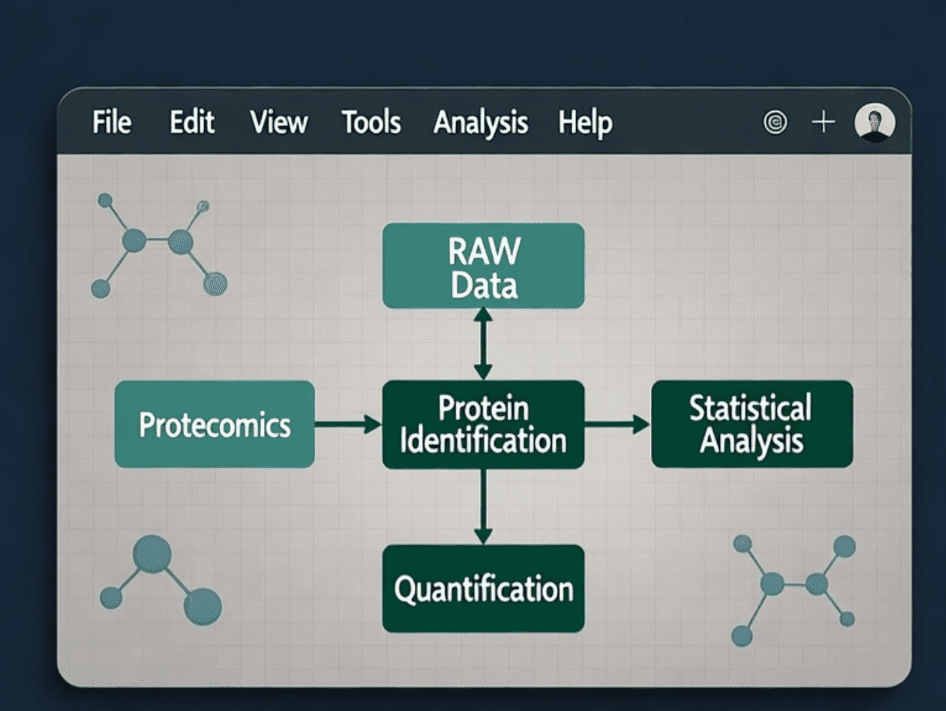
If you have a proteomics dataset ready and need it deposited in PRIDE — without spending days troubleshooting file formats, CV terms and FTP transfers — Tailoredomics can handle the entire process on your behalf.
The process is straightforward: we receive your files and metadata, manage the full PRIDE submission, and transfer the completed project to your own PRIDE account. You receive the PXD accession number ready to include in your manuscript.
This service is particularly useful when:
- You are approaching a manuscript submission deadline and cannot afford delays
- Your group does not have bioinformatics support experienced with PRIDE submission workflows
- Your result files are in a format that requires conversion before submission
- A previous submission attempt failed validation and you are not sure why
- You have a large dataset (>50 GB) and need a reliable upload from a stable infrastructure
➜ Explore our Proteomics Bioinformatics Services or get in touch to tell us about your dataset and we will come back with a plan and timeline.
Frequently Asked Questions
Do I need to provide processed results or only raw files?
PRIDE distinguishes between complete submissions (raw data + standardised result files) and partial submissions (raw data only). Complete submissions are required by most journals. Whether your current result files can be used for a complete submission depends on your search software and version — this is one of the first things we assess when a new project comes in.
Can the dataset stay private until the paper is published?
Yes. After deposition the project remains private under your PRIDE account until you choose to make it public. You receive the accession number immediately for use in the manuscript, and the dataset goes live when you are ready — typically at acceptance or first online publication.
Does Tailoredomics perform mass spectrometry or sample preparation?
No. We provide downstream bioinformatics analysis and data management only. We work with LC–MS/MS data generated by your mass spectrometry facility or external provider. If you have the data files and need help with PRIDE deposition, quantitative analysis, or statistical interpretation, that is where we start.
What data do you need from us to start?
The quickest way is to contact us with a brief description of your dataset: how many samples, what instrument and software were used, approximate total data size, and your target submission date. We will tell you what we need from there.
Related Reading