Introduction
Microbial genomics is the branch of genomics that focuses on the complete DNA sequences of microorganisms — including bacteria, archaea, fungi, and viruses. By studying microbial genomes, scientists can uncover how microbes function, adapt, and interact with their environment. This information is essential to understand microbial evolution, antibiotic resistance, biogeochemical cycles, and biotechnological applications.
In this article, we explain what microbial genomics is, describe the typical workflow from sequencing to annotation, highlight its most common applications, and show what you can expect when working with a microbial genomics service like Tailoredomics.
Why microbial genomics matters
Every microorganism carries a genetic blueprint that defines its metabolic capacity, ecological niche, and potential role in health, disease, or industry.
By analyzing microbial genomes, researchers can:
- Discover new enzymes, secondary metabolites, and biosynthetic gene clusters.
- Identify virulence and antibiotic resistance genes.
- Compare strains to track outbreaks or understand microbial evolution.
- Design microbial consortia for bioremediation or synthetic biology.
With the rapid progress of next-generation sequencing (NGS) and long-read sequencing technologies such as Oxford Nanopore and PacBio, microbial genomics has become accessible to labs of any size. Today, generating a complete genome is faster, more accurate, and more affordable than ever before. You can learn more about NGS technologies reading our dedicated post on Next Generation Sequencing.
Typical microbial genomics workflow
1. Sample Preparation and Sequencing Strategy
The process begins with high-quality DNA extraction from a pure culture or environmental sample.
Depending on your goals, you may choose:
- Short-read sequencing (e.g., Illumina) for high accuracy and cost efficiency.
- Long-read sequencing (e.g., Nanopore or PacBio) for resolving complex regions and closing genomes.
- Hybrid sequencing, which combines both for optimal accuracy and contiguity.
2. Quality Control (QC)
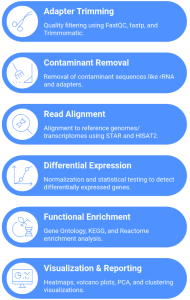
Raw reads undergo strict quality checks and trimming to remove low-quality bases, adapters, and contaminants. Tools such as FastQC, fastp, or Trimmomatic are commonly used. If the sample includes host DNA or multiple species, filtering steps remove unwanted sequences.
3. Genome Assembly
The cleaned reads are then assembled into contiguous sequences (contigs or scaffolds).
Depending on the data type, tools like SPAdes, Flye, or Unicycler are used to reconstruct the genome. For complex datasets or metagenomes, specialized assemblers may be applied.
4. Polishing and Quality Assessment
Assembly polishing improves accuracy by correcting errors with tools like Racon, Pilon, or Medaka. The resulting assemblies are evaluated for completeness and contamination using CheckM, QUAST, or BUSCO.
5. Genome Annotation
Annotation adds biological meaning to the assembled genome. You can learn more about genome annotation in our dedicated post on genome annotation.
Structural annotation identifies genes, rRNAs, and tRNAs, while functional annotation predicts gene functions and metabolic pathways. Commonly used tools include Prokka, PGAP and databases such as eggNOG/KEGG, or COG.
6. Downstream and Comparative Analyses
Once annotated, the genome can be analyzed in many ways:
- Comparative genomics and pan-genome studies to assess diversity among strains.
- Phylogenomics to infer evolutionary relationships.
- Functional profiling to identify metabolic capabilities or resistance genes.
- Genome mining to detect biosynthetic gene clusters (e.g., with antiSMASH).
Outputs you can expect
A typical microbial genomics project generates several deliverables, all ready for publication or downstream bioinformatics analyses:
- High-quality genome assembly in FASTA format (draft or complete).
- Annotation files, including GFF3, GenBank, and protein FASTA files.
- Quality control reports, summarizing genome completeness, contamination, and N50 metrics.
- Functional summaries of gene content, KEGG pathways, and protein families.
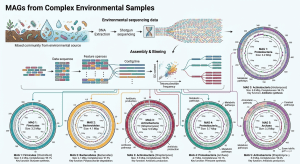
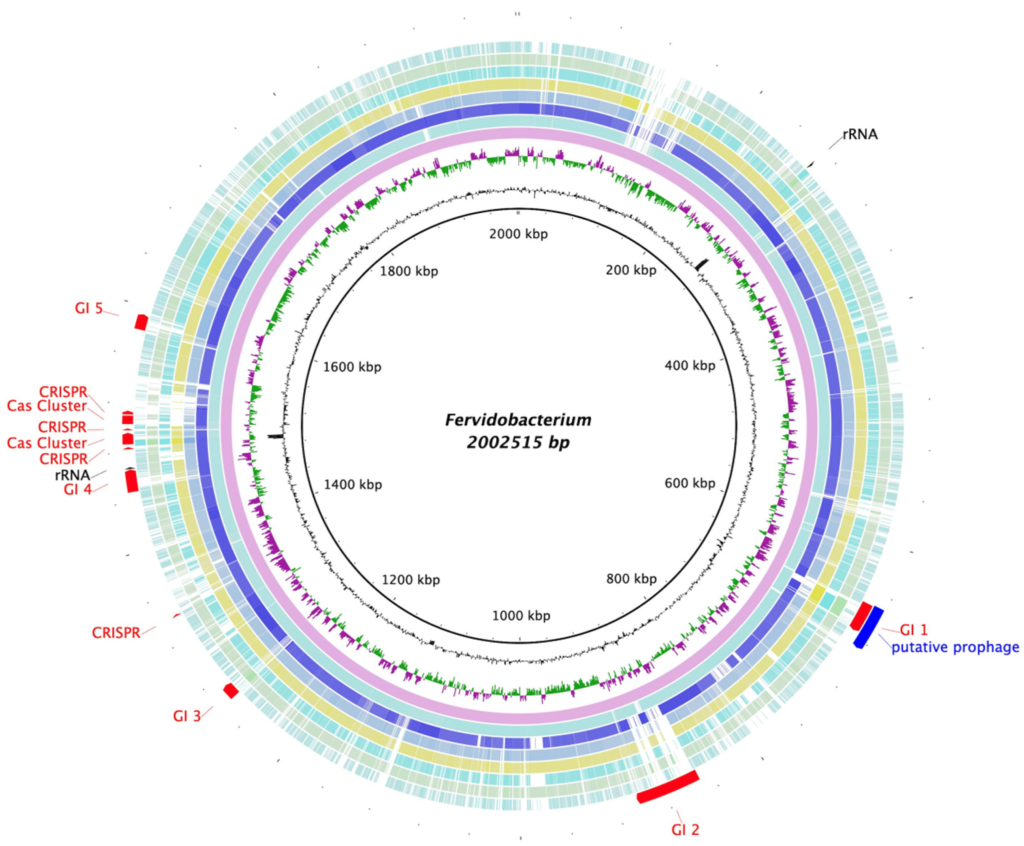
- Optional visualizations, such as circular genome maps or phylogenetic trees.
(Example: Circular representation of Fervidobacterium species genomes.)
Use cases of microbial genomics analyses & examples
Microbial genomics supports a wide range of scientific and industrial applications, including:
- Environmental microbiology: uncovering microbial diversity and functional potential in soil, water, or extreme habitats.
- Medical microbiology: identifying pathogenic strains, antimicrobial resistance genes, and outbreak sources.
- Food and industrial biotechnology: optimizing microbial strains for fermentation, enzyme production, or bioconversion.
- Synthetic biology: engineering microbial genomes for novel metabolic pathways.
- Academic research: discovering new taxa or investigating microbial evolution through comparative genomics.
For example:
- Detecting secondary metabolite gene clusters in novel environmental isolates.
- Comparing clinical strains during epidemiological investigations.
- Characterizing industrial strains for biofuel or pharmaceutical production.
How Tailoredomics helps
At Tailoredomics, we combine expertise in microbial genomics, bioinformatics, and molecular biology to deliver high-quality genome analyses tailored to your project’s goals.
We don’t use one-size-fits-all pipelines — instead, we adapt assembly and annotation strategies based on your organism, sequencing technology, and research objectives. You receive a complete report detailing each step, from quality control to functional interpretation, ensuring transparency and reproducibility.
Whether you’re sequencing a novel isolate, characterizing a consortium, or preparing data for publication, Tailoredomics provides:
- Expert guidance throughout your project.
- Reliable, reproducible, and publication-ready results.
- Flexible deliverables that integrate seamlessly into your workflows.
See our Microbial Genomics services for details and deliverables.
Conclusion
Microbial genomics is transforming our understanding of microbial life, enabling discoveries in ecology, medicine, and biotechnology. By combining advanced sequencing technologies with robust bioinformatics, researchers can now decode microbial genomes faster and more accurately than ever before.
If you’re ready to uncover the full potential of your microorganisms, Tailoredomics is here to help — from raw reads to insight-driven results.