Introduction
Transcriptomics is the study of the entire collection of RNA molecules—known as the transcriptome—produced by cells or microbial communities under specific conditions. While genomics tells us which genes exist, transcriptomics shows which ones are active and to what extent.
This distinction is crucial. A bacterium’s genome may encode thousands of genes, but only a fraction are expressed at any given time. By studying RNA, scientists can capture a snapshot of cellular activity, revealing how organisms respond to stress, antibiotics, nutrient shifts, or host interactions.
Modern transcriptomics is powered by RNA sequencing (RNA-Seq), which has replaced microarrays as the gold standard for gene expression studies. With today’s technologies, researchers can perform whole transcriptome analyses across hundreds of samples—or even resolve gene expression in single cells, providing an unprecedented view of microbial and host biology. Already in a transcriptomics project? Check our Transcriptomics services page and contact us!

1. What Is Transcriptomics and Whole Transcriptome Analysis?
A whole transcriptome analysis quantifies all RNA transcripts expressed in a sample, rather than focusing on a few target genes. This comprehensive approach captures mRNAs, non-coding RNAs, and sometimes small RNAs, offering a global perspective on gene regulation.
In microbial systems, whole transcriptome sequencing can reveal which metabolic pathways are active, which genes are silenced, and how microbes adapt to environmental changes. It is especially useful for comparing gene expression between conditions, such as aerobic vs. anaerobic growth, exposed vs. control samples, or wild-type vs. mutant strains.
Because the transcriptome is highly dynamic, this approach enables scientists to identify differentially expressed genes (DEGs)—genes that change significantly in activity under specific conditions. This type of study is often called bulk RNA-Seq differential expression analysis.
2. Bulk RNA-Seq Differential Expression Analysis
Bulk RNA-Seq differential expression analysis compares RNA expression profiles between groups of samples (for example, treated vs. untreated, or disease vs. healthy). Each sample represents a population of cells, so expression levels reflect average behavior.
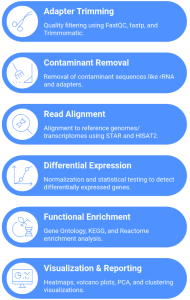
The standard workflow includes:
- RNA extraction and quality control – High-quality RNA is critical; degraded samples yield biased results.
- Library preparation and sequencing – RNA is converted to cDNA libraries and sequenced, typically using Illumina or Nanopore platforms.
- Read QC and trimming – Tools like FastQC, Trimmomatic, or fastp remove low-quality sequences.
- Alignment or pseudo-alignment – Reads are mapped to a reference genome or transcriptome using HISAT2, STAR, Salmon, or Kallisto.
- Quantification and normalization – Expression levels are calculated as raw counts, TPM, or FPKM, enabling cross-sample comparisons.
- Differential expression analysis – Statistical models implemented in DESeq2 or edgeR identify genes with significant fold changes.
- Functional and pathway analysis – Enrichment tools like ClusterProfiler, GOseq, or GSEA connect DEGs to biological functions, GO terms, or KEGG pathways.
These analyses help identify regulatory mechanisms and biomarkers, validate hypotheses from genomic data, and guide experimental design in microbial genomics, biotechnology, and environmental microbiology. You can read more about RNA-Seq Data Analysis reading our dedicated post on this topic!
3. Single-Cell Transcriptomics Analysis
While bulk RNA-Seq reveals average expression across populations, single-cell transcriptomics analysis dissects gene expression at the level of individual cells (do you want to learn more about single-cell sequencing? read our dedicated post!
This approach has revolutionized our understanding of microbial heterogeneity, uncovering rare subpopulations that drive adaptation, resistance, or symbiosis. Single-cell RNA-Seq (scRNA-Seq) can, for example:
- Identify metabolic or stress-response subgroups within microbial communities.
- Reveal how individual cells transition between growth states.
- Resolve host–microbe interactions at a fine scale.
For complex or mixed microbial ecosystems, combining single-cell and bulk transcriptomic data offers both high resolution and robust statistical power, creating a comprehensive portrait of gene activity.
4. Integrating Whole Transcriptome Data With Other Omics
The true power of transcriptomics emerges when it’s integrated with other omic layers:
- Metagenomics tells us which genes are present.
- Transcriptomics reveals which are expressed.
- Proteomics and metabolomics show how this expression translates into function.
This multi-omics integration is particularly valuable in microbiome studies. For instance, coupling metagenomic and transcriptomic data allows researchers to determine not only which species are in a sample but also what they are doing—whether producing secondary metabolites, fixing nitrogen, or degrading pollutants.
Tailoredomics specializes in these integrative analyses, combining robust pipelines with biological interpretation to ensure data are both reliable and meaningful.
5. Why Transcriptomics Matters
Transcriptomics goes beyond static genomic information. It provides:
- Functional insights – which genes are turned on or off under certain conditions.
- Dynamic responses – how cells adapt to stress, antibiotics, or environmental changes.
- Validation of genomic predictions – linking gene presence to function.
- Improved annotation – refining genome predictions with expression evidence.
- Systems-level understanding – when combined with other omics.
In microbial genomics, transcriptomics bridges the gap between potential and activity. It transforms lists of genes into functional networks that explain how microbes behave and interact.
6. How Tailoredomics Supports Transcriptomics Projects
At Tailoredomics, we provide complete RNA-Seq and transcriptomics services designed for microbial, environmental, and host-associated systems.
Our expertise includes:
- Experimental design consultation – helping you avoid common pitfalls such as insufficient replicates or batch effects.
- Customized, reproducible RNA-Seq pipelines – built on open-source tools and transparent workflows.
- Comprehensive differential expression analysis – with statistical rigor and functional interpretation.
- Publication-ready visualizations – including volcano plots, heatmaps, and GO/KEGG pathway enrichment charts.
- Multi-omics data integration – to connect transcriptomic results with genomic and metagenomic insights.
Whether your goal is to characterize microbial communities, identify functional biomarkers, or compare gene expression across experimental treatments, Tailoredomics offers end-to-end analytical support.
7. Key Takeaways
- Whole transcriptome analysis provides a comprehensive picture of RNA expression across all genes.
- Bulk RNA-Seq differential expression analysis identifies genes that change between conditions.
- Single-cell transcriptomics analysis captures cellular diversity at unprecedented resolution.
- Integration with other omics creates a systems-level understanding of microbial and host–microbe interactions.
- With expert guidance, RNA-Seq data can transform descriptive studies into mechanistic insights.