The human body, soils, oceans, and even extreme environments all host vast and diverse microbial communities. These collections of bacteria, archaea, fungi, and viruses—collectively called the microbiome—play fundamental roles in health, disease, and ecosystem balance. To study them, scientists use a set of techniques known as microbiome profiling or microbiome data analysis.
Defining Microbiome Profiling
But what exactly is microbiome profiling? How does it work, and why has it become one of the fastest-growing areas in life sciences? In this article, we’ll explore the concept, methods, applications, and future directions of microbiome profiling—and how microbiome analysis services as the ones Tailoredomics offers, are helping researchers translate complex data into actionable insights.
Microbiome profiling refers to the process of identifying, characterizing, and quantifying the microorganisms present in a given environment. It aims to answer fundamental questions:
- Who is there? (the taxonomy of microbial species)
- What are they doing? (functional genes and metabolic potential)
- How do they interact? (networks, dynamics, and host relationships)
Depending on the study goals, profiling may focus on taxonomic diversity (e.g., dominant gut bacteria), functional capacity (e.g., antibiotic resistance genes), or ecological interactions (e.g., cross-feeding in microbial consortia).
Why Study the Microbiome?
The microbiome influences nearly every biological system:
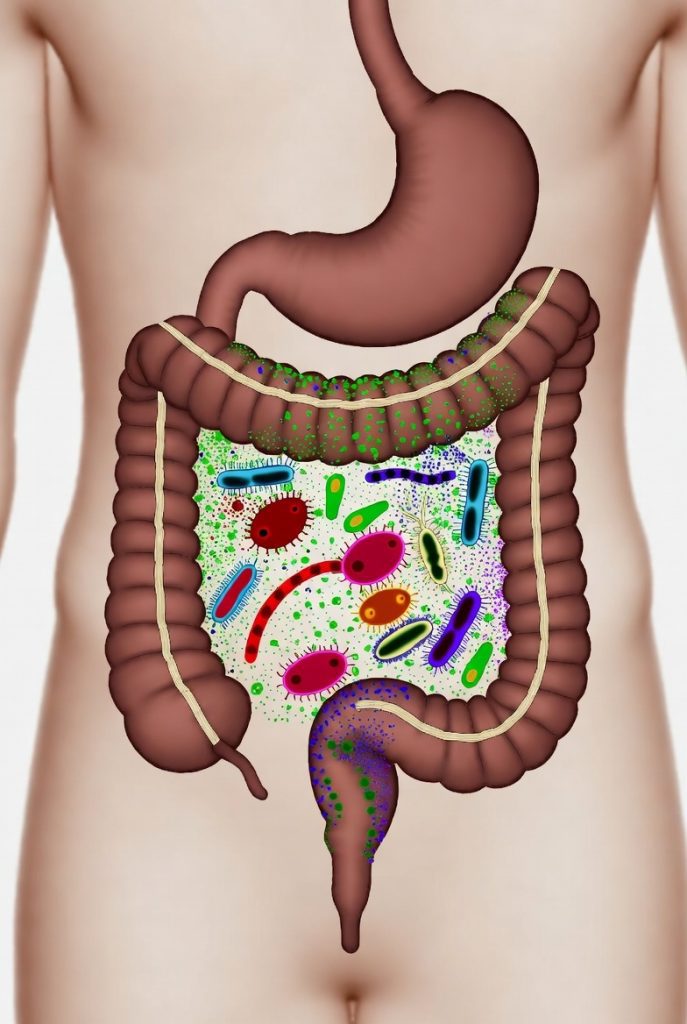
- Human health: Gut microbes are linked to digestion, immunity, metabolic balance, and even neurological function.
- Agriculture: Soil and plant microbiomes affect crop yield, disease resistance, and nutrient cycling.
- Environmental science: Microbial communities drive biogeochemical cycles, pollution remediation, and carbon sequestration.
- Biotechnology: Microbiomes serve as a source of enzymes, biomolecules, and novel metabolic pathways for industrial innovation.
Profiling connects microbial diversity to biological outcomes, revealing correlations and potential causative mechanisms. This enables new opportunities for precision medicine, microbial-based therapies, and sustainable biotechnology..
Methods of Microbiome Profiling
There’s no single method for microbiome profiling. Researchers choose among several techniques depending on resolution, cost, and research questions. In this dedicated post we explore the differences between shotgun metagenomics vs 16S rRNA gene sequencing.
1. 16S rRNA Gene Sequencing
- Targets the 16S ribosomal RNA gene, universal in bacteria and archaea.
- Provides taxonomic identification at genus or species level.
- Advantages: Cost-effective, standardized, and ideal for large-scale microbiome studies.
- Limitations: Does not provide direct functional information and has limited resolution for closely related species.
2. Shotgun Metagenomics
- Sequences all DNA fragments in a sample.
- Delivers both taxonomic and functional data.
- Can detect rare species, viruses, and metabolic pathways.
- Best for: Comprehensive microbiome profiling and functional inference.
- Drawback: More expensive and computationally intensive.
3. Metatranscriptomics
- Focuses on RNA sequencing to reveal which microbial genes are actively expressed.
- Links community structure to activity in real time.
- Useful for detecting dynamic responses to environmental or host changes.
4. Metaproteomics and Metabolomics
- Metaproteomics identifies microbial proteins to measure actual enzymatic activity.
- Metabolomics detects metabolites and small molecules, showing functional outcomes.
- Combining these with metagenomics creates multi-omics profiling for a complete picture of microbial ecosystems.
5. Culture-Based and Microscopy Techniques
- Classical methods like culturing, FISH, and microscopy remain important for validation.
- Help visualize microbes and confirm hypotheses from sequencing data.
Workflow of a Typical Microbiome Profiling Study
- Sample Collection
Careful collection of stool, soil, water, plant tissue, or skin swabs is essential to avoid contamination. - DNA/RNA Extraction
High-quality nucleic acids are extracted from microbial cells. Different kits and protocols can bias results. - Library Preparation & Sequencing
Depending on the method (16S vs. shotgun metagenomics), DNA or RNA is prepared for high-throughput sequencing. - Bioinformatics Processing
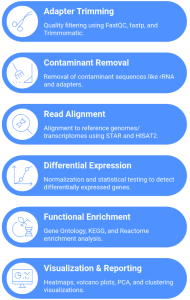
Raw sequences are filtered for quality, trimmed, and aligned. Key steps include: - Statistical & Ecological Analysis
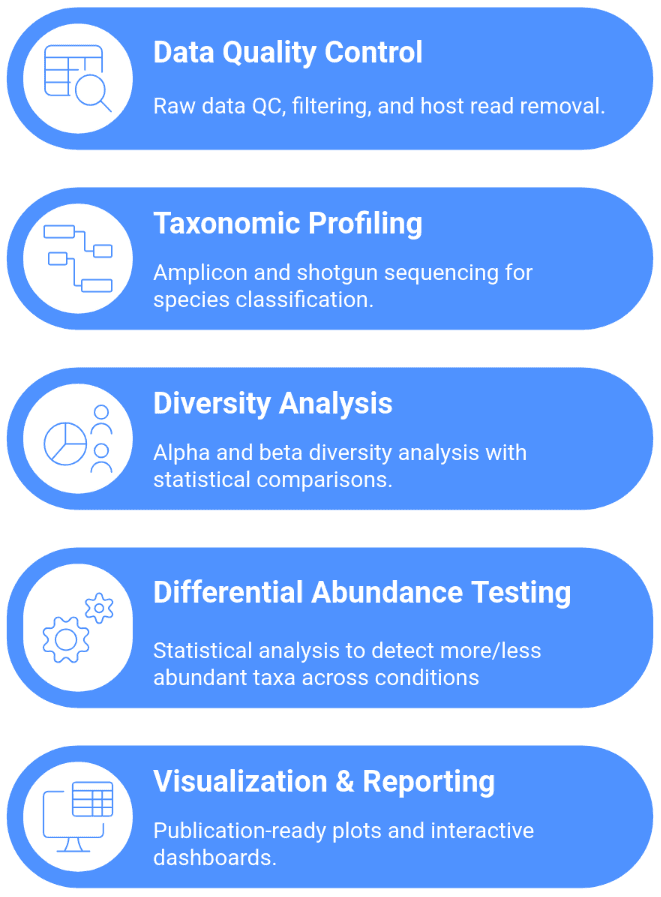
Researchers calculate diversity metrics (alpha/beta diversity), relative abundance, co-occurrence networks, and functional predictions. - Visualization & Reporting
Graphs, heatmaps, and ordination plots (PCA, PCoA, NMDS) help interpret microbial community structure and differences between groups.
Applications of Microbiome Profiling
1. Human Health and Medicine
- Understanding gut microbiome signatures of diseases like IBD, obesity, and diabetes.
- Developing probiotics, prebiotics, and microbiome-based therapies.
- Personalized nutrition and precision medicine.
2. Agriculture and Plant Science
- Mapping beneficial microbes that enhance crop growth and resistance.
- Using soil microbiome profiling to monitor field health and fertility.
- Supporting sustainable farming through microbial inoculants.
3. Environmental Microbiology
- Tracking microbial communities in oceans, lakes, and extreme environments.
- Bioremediation (e.g., oil spills, heavy metal contamination).
- Monitoring climate-related microbial processes (methanogenesis, carbon cycling).
4. Industrial Biotechnology
- Mining microbial enzymes for pharmaceuticals, biofuels, and bioplastics.
- Profiling fermentation systems for food, beverages, and bio-products.
Challenges and Limitations
Despite its power, microbiome profiling faces challenges:
- Biases in Sampling & DNA Extraction: Different methods capture different community subsets.
- Incomplete Reference Databases: Many microbes remain unclassified (“microbial dark matter”).
- Resolution Limits: 16S cannot always distinguish species or strains.
- Cost & Complexity: Shotgun metagenomics and multi-omics require advanced bioinformatics infrastructure.
- Causality vs. Correlation: Many studies show associations, but proving causation is harder.
Future Directions
The field of microbiome profiling is evolving rapidly. Trends include:
- Long-Read Sequencing (Nanopore, PacBio HiFi) for better genome resolution.
- Single-Cell Genomics to study individual microbes within communities.
- Integrated Multi-Omics (genomics, transcriptomics, proteomics, metabolomics).
- AI and Machine Learning for predictive microbiome modeling.
- Clinical Translation into diagnostics, personalized medicine, and therapeutic interventions.
Conclusion
Microbiome profiling provides an unprecedented view into the microbial world that shapes health, agriculture, and the environment. By combining cutting-edge sequencing with advanced bioinformatics, it reveals not just who’s there, but what they’re doing and why it matters.
As technologies evolve, microbiome analysis services like the ones Tailoredomics offer will become indispensable tools for precision medicine, sustainable agriculture, and biotechnology innovation.
At TailoredOmics, we offer comprehensive microbiome profiling services — from sample design and sequencing to in-depth microbiome data analysis and visualization — helping researchers uncover the full potential of microbial communities. You can learn more about microbiome profiling metrics on our post on Alpha and Beta diversity, check it out!