Introduction
Shotgun metagenomics has exploded over the last decade, transforming how we understand health, ecology, and biotechnology. Whether you’re studying the gut microbiome, soil microbial communities, marine environments, or industrial bioreactors, two sequencing approaches dominate the field: 16S rRNA gene sequencing and shotgun metagenomic sequencing.
Both aim to characterize microbial diversity — yet they differ profoundly in their scope, resolution, and biological insight. In this guide, we’ll explore what each approach measures, how they compare, and which one best fits your scientific or applied goals. We’ll also discuss workflow steps, cost considerations, and analysis pipelines, with practical examples from microbial ecology and host-associated microbiomes. If you are interested, we suggest to explore our dedicated “What is metagenomics?” post.
What Is 16S rRNA Gene Sequencing?
16S rRNA sequencing (or amplicon sequencing) targets the 16S ribosomal RNA gene, a genetic marker conserved across bacteria and archaea. This gene contains both highly conserved and hypervariable regions (V1–V9), allowing researchers to distinguish microbial taxa while amplifying the same locus from all community members.
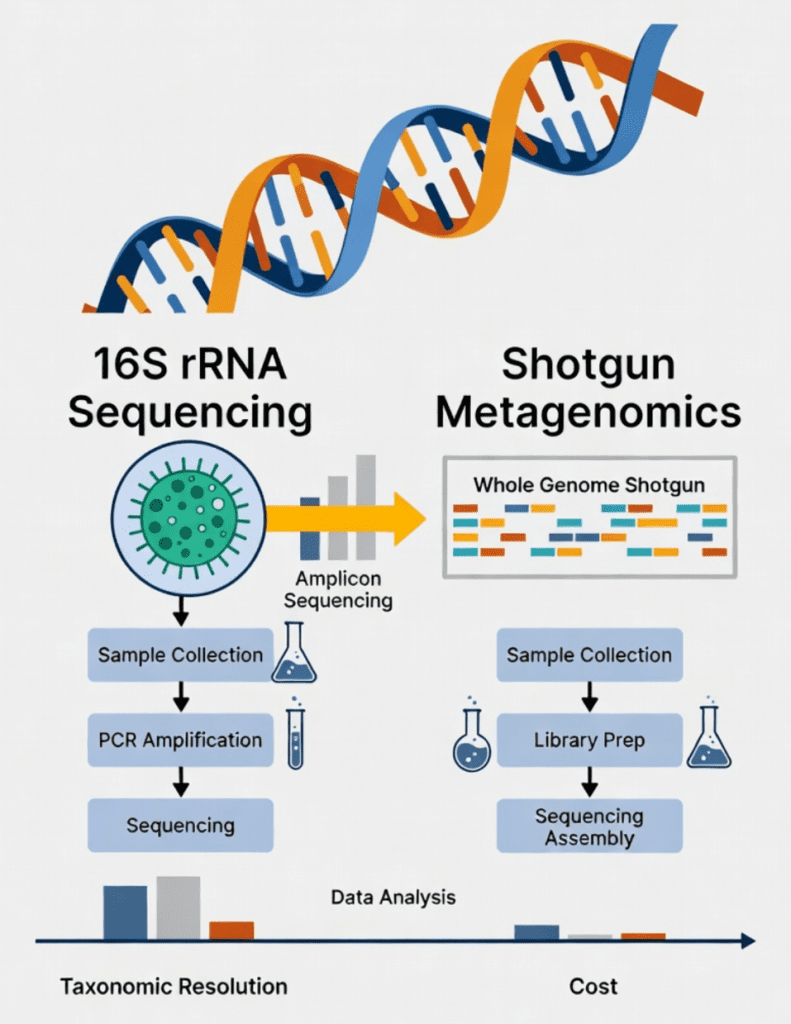
A 16S workflow typically involves:
- DNA extraction from environmental or biological samples.
- PCR amplification of one or more 16S variable regions using universal primers.
- Library preparation and sequencing (commonly on Illumina platforms).
- Bioinformatics processing — denoising, clustering, and taxonomic assignment via databases like SILVA, Greengenes, or GTDB.
- Downstream analysis — alpha/beta diversity, relative abundance, and differential composition analysis.
Advantages of 16S Sequencing
- Cost-effective: Lower sequencing and analysis costs make it ideal for studies with many samples.
- Simpler workflow: Straightforward library prep and manageable computational needs.
- Taxonomic overview: Excellent for detecting bacterial/archaeal community shifts across conditions.
Limitations
- Limited resolution: Typically classifies at genus level; species-level accuracy is often uncertain.
- No direct functional data: Functional inference relies on predictive tools like PICRUSt2, which estimate pathways from taxonomy.
- Bias from primers and PCR: Amplification efficiency varies by taxon, potentially skewing results.
- Restricted scope: Cannot detect viruses, fungi, or plasmids, which play crucial ecological roles.
In short, 16S sequencing answers “who is there?” but not “what are they doing?”
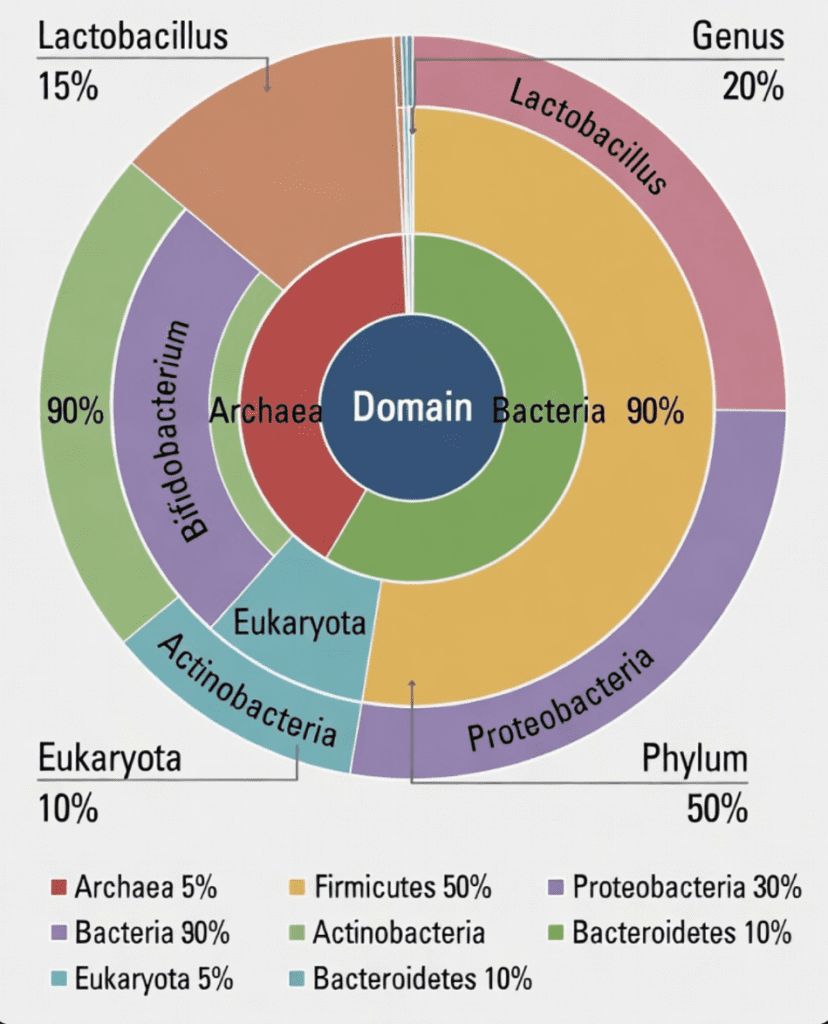
What Is Shotgun Metagenomics Sequencing?
In contrast, shotgun metagenomics sequencing captures all genomic DNA within a sample. Instead of amplifying one gene, it fragments the total DNA and sequences everything — microbial, viral, fungal, and even host-associated fragments.
This unbiased, high-resolution approach provides a comprehensive view of both taxonomy and function, revealing what microbial genes are present and how metabolic pathways are distributed across the community.
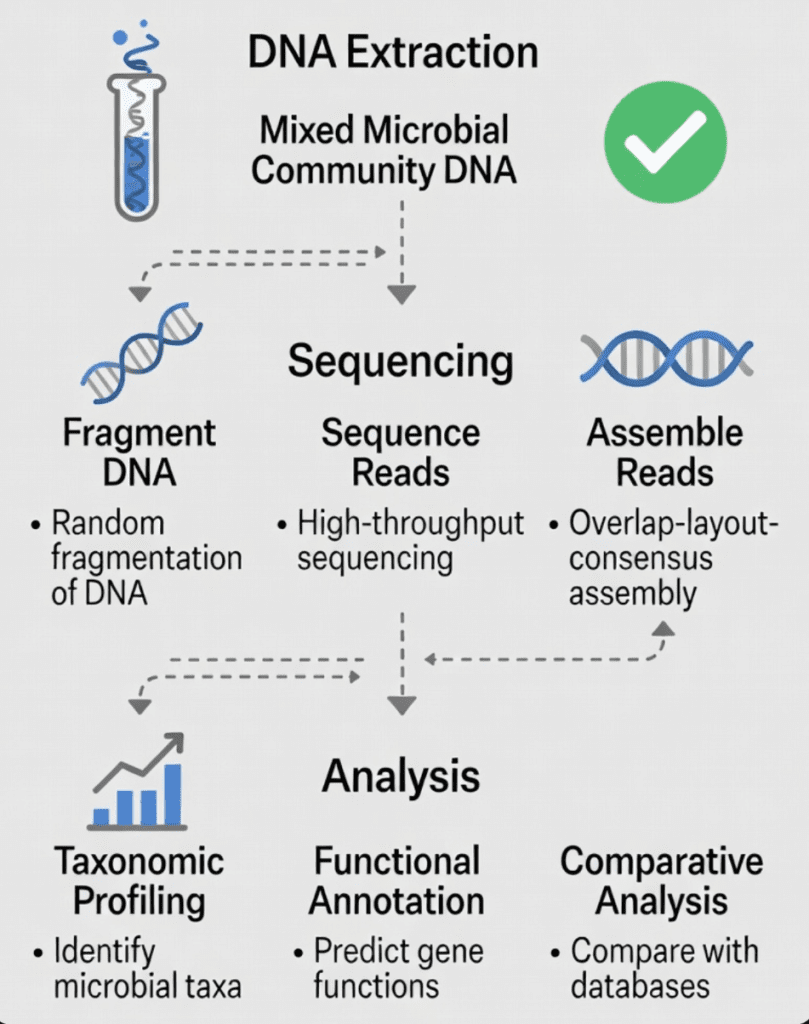
Typical Shotgun Workflow
- DNA extraction ensuring even recovery across taxa.
- DNA fragmentation and library construction (no PCR bias).
- High-throughput sequencing (e.g., Illumina NovaSeq, Oxford Nanopore, PacBio).
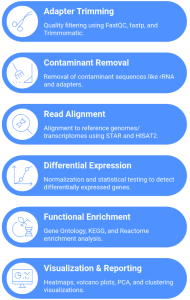
- Quality control and trimming (FastQC, fastp, Trimmomatic).
- Taxonomic profiling using Kraken2, MetaPhlAn, or Centrifuge.
- Functional annotation via HUMAnN3, eggNOG-mapper, or KEGG Mapper.
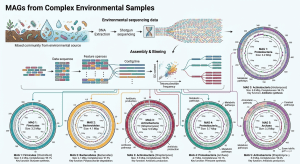
- Assembly and binning into metagenome-assembled genomes (MAGs) with MEGAHIT or MetaBAT2.
Key Advantages
- Multi-kingdom coverage: Detects bacteria, archaea, fungi, and viruses simultaneously.
- Functional insight: Directly identifies genes, pathways, and metabolic potential.
- Higher resolution: Enables species- and strain-level classification.
- Novel discovery: Facilitates recovery of previously unknown species or plasmids through assembly.
Limitations
- Cost and data volume: Requires deeper sequencing and larger storage capacity.
- Computational demand: Complex analyses, often requiring high-performance computing.
- Host contamination: Samples rich in host DNA (e.g., human biopsies) may need depletion or deeper sequencing.
In short, shotgun metagenomics reveals both “who is there” and “what they can do.” If you are planning to start, or are already involved in, a metagenomics project, you should check our metagenomics services page. Don’t hesitate to contact us!
Shotgun Metagenomics vs 16S: A Head-to-Head Comparison
| Feature | 16S rRNA Gene Sequencing | Shotgun Metagenomics Sequencing |
|---|---|---|
| Microbial types detected | Bacteria, archaea | Bacteria, archaea, fungi, viruses, plasmids |
| Taxonomic resolution | Genus-level (sometimes species) | Species- and strain-level |
| Functional information | Indirect (predictive) | Direct (genes, pathways, metabolism) |
| Cost & data volume | Low | High |
| Bioinformatics complexity | Moderate | Advanced |
| Ideal for | Broad microbial surveys | Functional, strain-level, or multi-kingdom studies |
Studies repeatedly show that shotgun metagenomics sequencing detects more taxa and can differentiate between closely related species that appear identical in 16S data. For example, in gut microbiome research, 16S may collapse multiple Bacteroides species into one genus, while shotgun sequencing can separate them and identify their distinct metabolic capacities.
When Should You Use Each Approach?
Choosing between 16S and shotgun metagenomics depends on your research goals, budget, and data needs.
Choose 16S if:
- You need a cost-efficient survey across hundreds of samples.
- Your focus is mainly on bacterial/archaeal diversity patterns.
- You’re performing an exploratory or pilot study.
- You don’t require functional or strain-level resolution.
Choose Shotgun Metagenomics if:
- You want to characterize functional potential (genes, enzymes, pathways).
- Your community includes non-bacterial members like fungi or viruses.
- You need species or strain-level precision (e.g., resistome or virulome studies).
- You aim for multi-omics integration (metatranscriptomics, metabolomics, proteomics).
- You have computational support for assembly and annotation workflows.
In some cases, a hybrid approach works best: use 16S for initial community screening and shotgun for a subset of representative samples to explore function and genome structure.
Cost, Depth, and Practical Considerations
Budget and sequencing depth are often decisive.
- 16S sequencing typically costs $50–100 per sample, depending on read depth and region coverage.
- Shotgun metagenomics can range from $150 to $500+ per sample, depending on sequencing depth, host contamination, and analysis scope.
If your samples have high host DNA contamination, shotgun sequencing may need deeper coverage or host DNA depletion methods (e.g., Molzym kits, enzymatic digestion). Conversely, 16S PCR amplification bypasses this issue by targeting bacterial DNA directly.
Another consideration is study scale: for large clinical cohorts (>200 samples), 16S remains practical. For smaller datasets or mechanistic experiments, shotgun’s additional resolution often justifies its cost.
Bioinformatics and Analysis Workflows
16S rRNA Data Analysis
The 16S pipeline is well-established, with user-friendly tools such as:
- QIIME 2 or Mothur for processing and diversity analyses.
- DADA2 for denoising and generating exact sequence variants (ASVs).
- Phyloseq, Vegan, and Microbiome R packages for diversity visualization.
- MicrobiomeAnalyst or Mia for web-based or interactive workflows.
- Functional inference via PICRUSt2 or Tax4Fun.
Shotgun Metagenomics Data Analysis
A typical shotgun pipeline includes:
- Quality control: FastQC, fastp, Trimmomatic.
- Taxonomic profiling: Kraken2, MetaPhlAn3, or Kaiju.
- Functional annotation: HUMAnN3, eggNOG-mapper, KEGG Orthologs.
- Assembly and binning: MEGAHIT, MetaSPAdes, MetaBAT2, or MaxBin2.
- MAG quality assessment: CheckM, BUSCO.
- Downstream exploration: Anvi’o, DRAM, or custom R/Python scripts.
4. Alpha and Beta Diversity Tools
For ecological interpretation, diversity metrics remain essential. Tools like Phyloseq, MicrobiomeAnalyst, and Mia can compute:
- Alpha diversity (Shannon, Simpson, Chao1) — measuring within-sample richness and evenness.
- Beta diversity (Bray-Curtis, UniFrac) — comparing community dissimilarities between samples.
These tools integrate seamlessly with both 16S and shotgun outputs and support visualizations like ordination plots, heatmaps, and differential abundance analyses.
Choosing the Right Service for Your Project
At Tailoredomics, we help researchers and biotech partners navigate these choices by designing custom microbial sequencing strategies.
Our services include:
- Experimental design support to match sequencing depth with your biological question.
- End-to-end pipelines for both 16S or microbiome data analysis and shotgun metagenomics, including QC, assembly, and annotation.
- Interactive reports with publication-ready figures and data interpretation.
- Integration with transcriptomics, proteomics or metabolomics datasets for a systems-level perspective.
Whether you need a quick microbial survey or a complete functional metagenome reconstruction, our experts ensure scientifically robust and cost-effective workflows.
Summary and Final Thoughts
16S rRNA sequencing remains the workhorse for large-scale, cost-sensitive microbiome studies, offering a rapid and reliable overview of bacterial and archaeal communities.
However, shotgun metagenomics sequencing goes far beyond — uncovering the functional landscape, viral and fungal members, and strain-level differences that 16S cannot capture.
Ultimately, the best approach depends on your research goals, budget, and desired level of detail.
For ecological surveys or longitudinal studies, start with 16S. For mechanistic insights, metagenomic assembly, or industrial applications — go shotgun.
At Tailoredomics, we guide you through both worlds. If you’re unsure which strategy best fits your study, contact us for a free consultation — and let’s design the most powerful and efficient microbiome sequencing workflow for your project.