Metagenome Assembly Pipeline: From Raw Reads to MAGs

Estimated reading time: 3 min

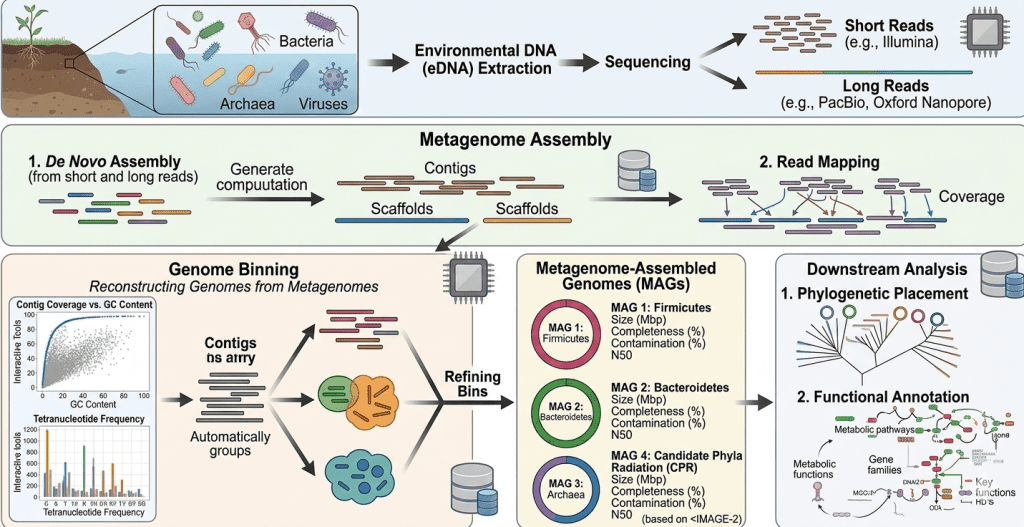
Metagenome assembly pipeline reconstructing microbial genomes from environmental sequencing data

Table of Contents

Introduction

Metagenomics has transformed the study of microbial communities by enabling researchers to analyze DNA directly from environmental samples. Instead of isolating organisms in culture, sequencing environmental DNA allows scientists to explore the genomic diversity of entire microbial ecosystems.

A central step in many studies is the metagenome assembly pipeline, which reconstructs genomes from mixed sequencing data. These reconstructed genomes are known as metagenome-assembled genomes (MAGs).

MAGs provide insights into the metabolic capabilities and ecological roles of previously uncultured microorganisms.

If you need support analyzing environmental sequencing data, our Metagenomics Services provide end-to-end analysis from raw sequencing reads to genome bins and functional interpretation.


Overview of a Metagenome Assembly Pipeline

A typical metagenomics assembly workflow includes the following steps:

  1. quality control of sequencing reads
  2. metagenome assembly
  3. contig binning
  4. MAG quality assessment
  5. genome annotation
  6. functional and taxonomic analysis

Each step contributes to reconstructing genomes from complex microbial communities.
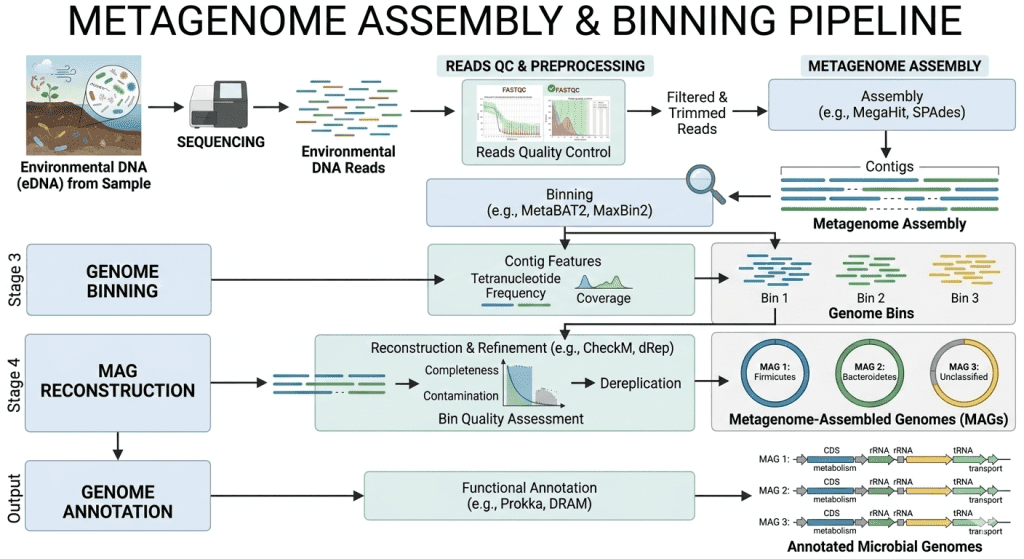
Metagenome assembly pipeline from environmental DNA sequencing reads to metagenome assembled genomes

Step 1: Quality Control of Metagenomic Reads

Metagenomic sequencing generates large datasets containing reads from many organisms. Quality control removes low-quality reads and adapter sequences before assembly.

Common tools include:


Step 2: Metagenome Assembly

Metagenome assembly reconstructs longer DNA sequences from short sequencing reads. Unlike isolate genome assembly, metagenomic datasets contain sequences from many organisms simultaneously.

Popular metagenomic assemblers include:


Step 3: Genome Binning

After assembly, contigs belonging to the same organism must be grouped together. This process is known as binning.

Genome binning algorithms use characteristics such as:

  • sequence composition
  • GC content
  • coverage patterns across samples

Common binning tools include:

  • MetaBAT2
  • MaxBin2
  • CONCOCT

The result of binning is a set of draft genomes known as metagenome-assembled genomes.
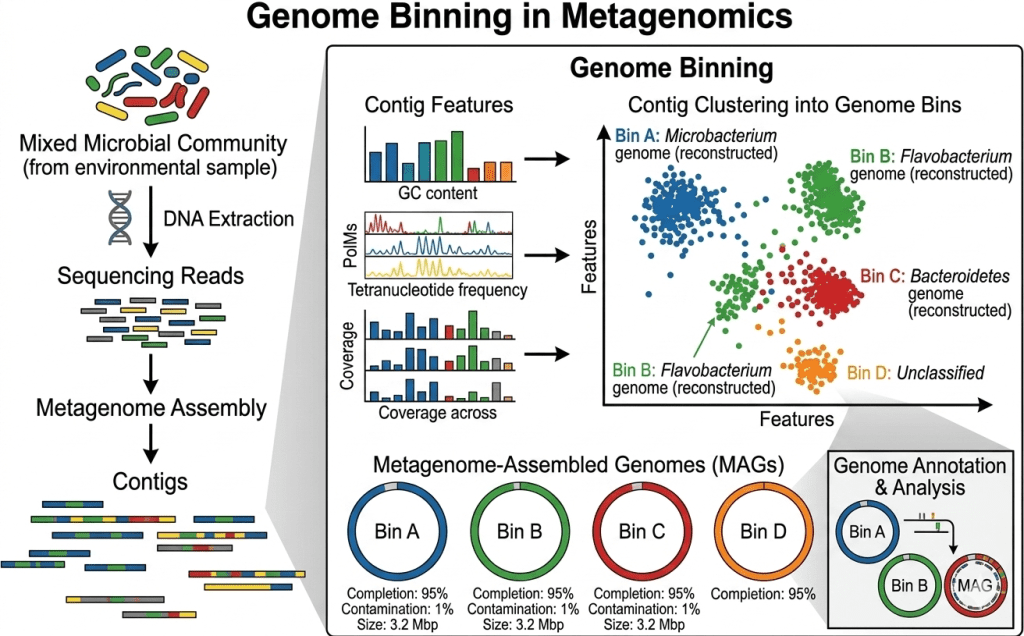
Genome binning process grouping assembled contigs into metagenome assembled genomes

Step 4: MAG Quality Assessment

MAGs must be evaluated to determine their completeness and contamination levels.

Standard metrics include:

  • genome completeness
  • contamination estimates
  • number of contigs

Tools such as CheckM are commonly used to evaluate MAG quality.
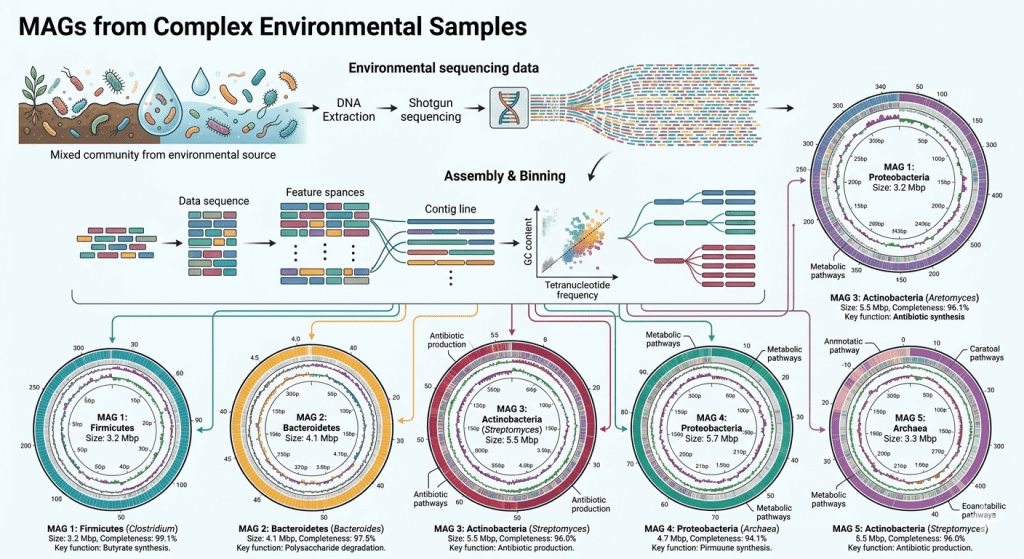
Metagenome assembled genomes reconstructed from environmental sequencing data

Step 5: Genome Annotation

Once MAGs are reconstructed, genes and functional elements must be identified through genome annotation.

Annotation tools such as Prokka or Bakta can be used to predict genes and assign biological functions.

If you are unfamiliar with this process, see our article What Is Genome Annotation?.


Applications of Metagenome-Assembled Genomes

MAGs have become essential tools in microbial ecology and environmental genomics.

Applications include:

  • discovering uncultured microbial species
  • reconstructing metabolic pathways
  • studying microbial evolution
  • identifying novel enzymes and biosynthetic pathways

Final Thoughts

The metagenome assembly pipeline enables researchers to reconstruct microbial genomes directly from environmental sequencing data. By combining assembly, binning, and annotation, scientists can uncover the hidden diversity and functional potential of microbial communities.

As sequencing technologies continue to improve, metagenome-assembled genomes will play an increasingly important role in microbiome research and microbial ecology.

Rubén Javier López Avatar

Rubén Javier López

Founder and Bioinformatician PhD in Microbiology

Rubén holds a microbiology PhD degree granted by the University of Bergen (Norway). He is proficient in bacterial metagenomics, genomics, transcriptomics and transcriptomics. He has hands-on experience and data analysis expertise in Illumina, Nanopore and PacBio sequencing technologies and has collaborated with scientists and labs all over the world. Moreover, he has been associated with biomedicine research groups, analyzing microbiome and mycobiome data.

Areas of Expertise: Microbiology, Extremophiles, NGS, Microbial Genomics, Transcriptomics, Differential Gene Expression, Metagenomics, Microbiome studies.
Fact Checked & Editorial Guidelines
Reviewed by: Subject Matter Experts

Ready to uncover the functional landscape of your microbial samples?

Explore our services at Tailoredomics. Request a quote or contact us for consultation

Leave a Reply

Proteomics
Rubén Javier López

How to Submit Proteomics Data to PRIDE: A Practical Guide

Submitting proteomics data to the PRIDE repository is a mandatory requirement for publication in most journals — yet it is one of the most common bottlenecks that delays manuscript submission in proteomics groups. The science is done. The paper is written. And then everything stalls at data deposition. This post explains what PRIDE submission involves, why it fails more often than it should, and what your options are when you need it done quickly and correctly. Note: Tailoredomics provides downstream proteomics bioinformatics and PRIDE data deposition services. We do not perform mass spectrometry or wet-lab work — we work with

Read More »
Tips
Rubén Javier López

How to Choose a Bioinformatics Service Provider

Sequencing data are easier to generate than ever, but analyzing them correctly remains difficult. Many research groups now receive FASTQ files, count tables, genome assemblies or metagenomic datasets from sequencing facilities, but do not always have the time, computational resources or specialized expertise to process them into reliable biological results. This is where a bioinformatics service provider can help. The right provider can turn raw sequencing data into reproducible workflows, interpretable figures, clear reports and publication-ready results. The wrong provider can produce generic outputs, poorly documented methods, unclear files, weak interpretation or results that are difficult to defend in a

Read More »
Volcano plot showing differentially expressed genes with log2 fold change on the x-axis and statistical significance on the y-axis.
Transcriptomics
Rubén Javier López

How to Interpret Differential Gene Expression Results

Differential gene expression analysis is one of the most common outputs of RNA-seq experiments. After running tools such as DESeq2, edgeR or limma-voom, researchers often receive a table containing gene IDs, expression values, log2 fold changes, p-values and adjusted p-values. At first glance, this table may look straightforward. Genes with low adjusted p-values are “significant”. Genes with positive log2 fold change are “upregulated”. Genes with negative log2 fold change are “downregulated”. But interpretation is more subtle than that. A differential expression result is not just a list of significant genes. It is a statistical summary of an experiment, shaped by

Read More »