DNA sequencing has transformed modern biology, medicine, and biotechnology. From identifying disease-causing mutations to characterizing entire microbial communities, sequencing technologies are now at the core of life sciences. Two approaches dominate the field: Sanger sequencing, the classical method developed in the 1970s, and Next Generation Sequencing (NGS), a family of high-throughput technologies that revolutionized genomics.
In this article, we explain what Next Generation Sequencing is, how it works, how it compares to Sanger sequencing, and when each approach should be used. We also connect these technologies to real-world applications in genomics, transcriptomics, microbiome research, and bioinformatics — the core focus areas of TailoredOmics.
What Is Next Generation Sequencing? (NGS Definition)
Next Generation Sequencing (NGS) refers to a group of modern DNA and RNA sequencing technologies that can sequence millions to billions of DNA fragments in parallel. Unlike Sanger sequencing, which reads one DNA fragment at a time, NGS enables massively parallel sequencing, drastically increasing throughput while reducing cost per base.
NGS is sometimes called high-throughput sequencing or massively parallel sequencing, and it underpins most modern genomic applications, including:
- Whole genome sequencing (WGS)
- RNA sequencing (RNA-seq, transcriptomics)
- Metagenomics and microbiome profiling
- Targeted gene panels
- Epigenomics and chromatin studies
A Brief History: From Sanger to Next Generation Sequencing
Sanger Sequencing
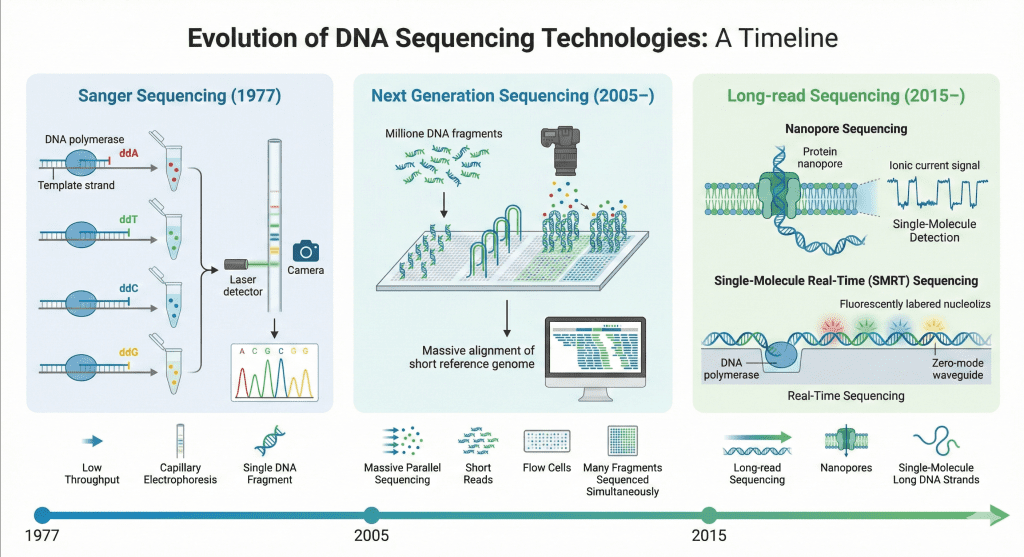
Developed by Frederick Sanger in 1977, Sanger sequencing relies on chain-terminating dideoxynucleotides to generate DNA fragments of different lengths, which are then separated by capillary electrophoresis.
For decades, Sanger sequencing was the gold standard and enabled landmark projects such as the Human Genome Project.
The Rise of NGS
In the mid-2000s, new technologies emerged that replaced electrophoresis with massively parallel sequencing on solid surfaces or in nanostructures. This marked the birth of Next Generation Sequencing, reducing sequencing costs by several orders of magnitude and enabling entirely new scientific questions.
How Does Next Generation Sequencing Work?
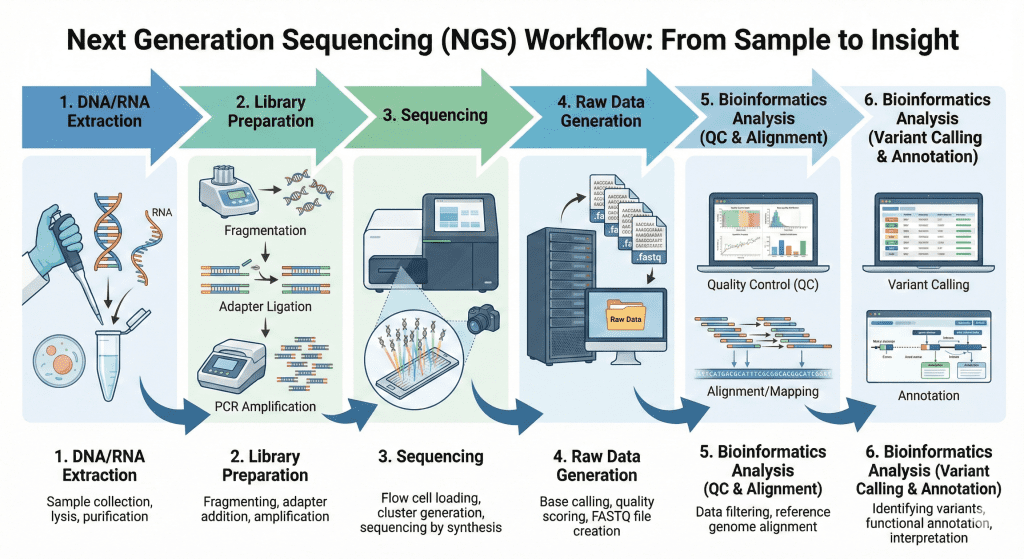
Although platforms differ, most NGS workflows follow the same fundamental steps.
1. Sample Preparation for Next Generation Sequencing
The first step is extracting high-quality DNA or RNA from the sample. Sample type matters:
- Genomic DNA (isolates, tissues)
- Total RNA (transcriptomics)
- Environmental DNA (metagenomics)
- Clinical samples (biopsies, blood)
Purity, integrity, and concentration directly affect downstream results.
2. Library Preparation for Next Generation Sequencing
Library preparation converts DNA or RNA into a format compatible with sequencing.
Key steps include:
- Fragmentation (enzymatic or mechanical)
- End repair and adapter ligation
- Indexing (barcoding samples)
- Amplification (PCR, depending on protocol)
Library preparation is one of the most critical steps in NGS and a major source of bias if not carefully optimized.
3. Target Enrichment (Optional)
For targeted sequencing applications, such as clinical gene panels, target enrichment is used to capture specific genomic regions.
Common strategies:
- Hybrid capture (baits/probes)
- Amplicon-based enrichment
Target enrichment reduces sequencing cost and increases depth over regions of interest.
4. Sequencing
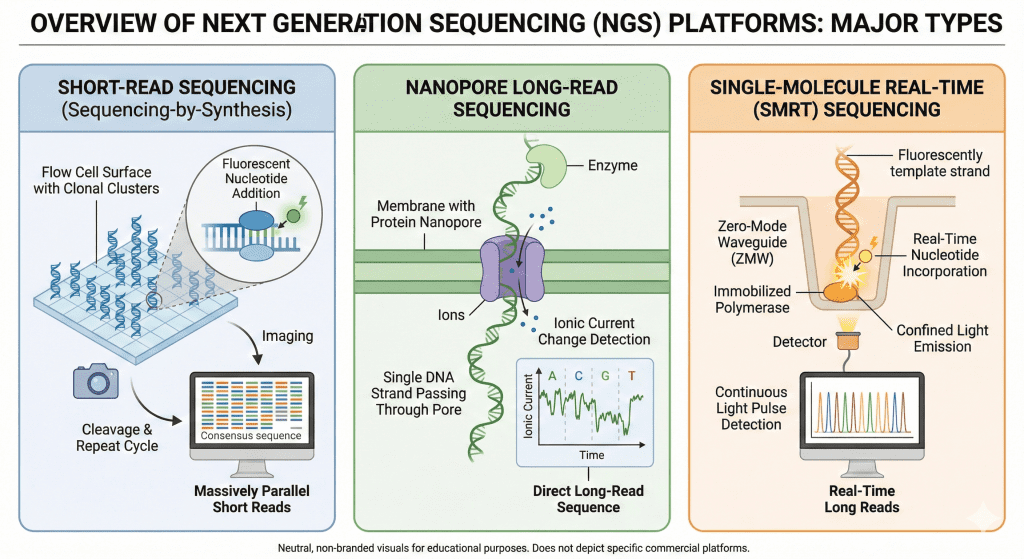
Prepared libraries are loaded onto a sequencing platform. Popular NGS platforms include:
- Illumina (short-read sequencing)
- Oxford Nanopore Technologies (ONT) (long-read sequencing)
- PacBio SMRT sequencing (long-read, high accuracy)
Each platform has different strengths, which we discuss later. For a more detailed comparison, you can read our dedicated post.
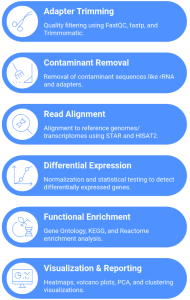
5. Next Generation Sequencing Data Analysis
NGS generates massive amounts of data. Bioinformatics is essential.
Typical steps include:
- Quality control (FastQC, fastp)
- Read trimming and filtering
- Alignment or assembly
- Variant calling, gene quantification, or taxonomic profiling
- Statistical analysis and visualization
At TailoredOmics, this bioinformatics layer is where raw data becomes biological insight.
Sanger Sequencing vs Next Generation Sequencing. Key Differences Between Sanger and NGS
| Feature | Sanger Sequencing | Next Generation Sequencing |
|---|---|---|
| Throughput | Low (1 fragment/run) | Very high (millions) |
| Read length | Long (700–1000 bp) | Short to long (50 bp–Mb) |
| Cost per base | High | Very low |
| Scalability | Limited | Excellent |
| Data volume | Small | Massive |
| Bioinformatics | Minimal | Essential |
When to Use Sanger Sequencing
Sanger sequencing is still relevant for:
- Validating variants discovered by NGS
- Sequencing single genes or plasmids
- Confirmatory diagnostics
- Low-throughput applications
Its accuracy and simplicity make it ideal for targeted questions.
When to Use Next Generation Sequencing
NGS is the method of choice when:
- Studying entire genomes or transcriptomes
- Analyzing microbial communities
- Detecting rare variants
- Working with many samples
- Performing discovery-driven research
Most modern genomics projects rely on NGS.
Next Generation Sequencing Platforms
Illumina Next Generation Sequencing
Illumina dominates short-read sequencing.
Strengths:
- Very high accuracy
- Low error rates
- Ideal for population studies and variant detection
Limitations:
- Short reads (typically 150–300 bp)
- Struggles with repeats and structural variants
Oxford Nanopore Technologies (ONT)
ONT uses nanopores to sequence DNA in real time.
Strengths:
- Very long reads
- Portable devices
- Direct RNA sequencing
Limitations:
- Higher error rate (improving rapidly)
- Requires polishing for high accuracy
PacBio SMRT Sequencing
PacBio HiFi sequencing combines long reads with high accuracy.
Strengths:
- Excellent for genome assembly
- Resolves complex regions
- High consensus accuracy
Limitations:
- Higher cost
- Lower throughput than Illumina
Applications of Next Generation Sequencing
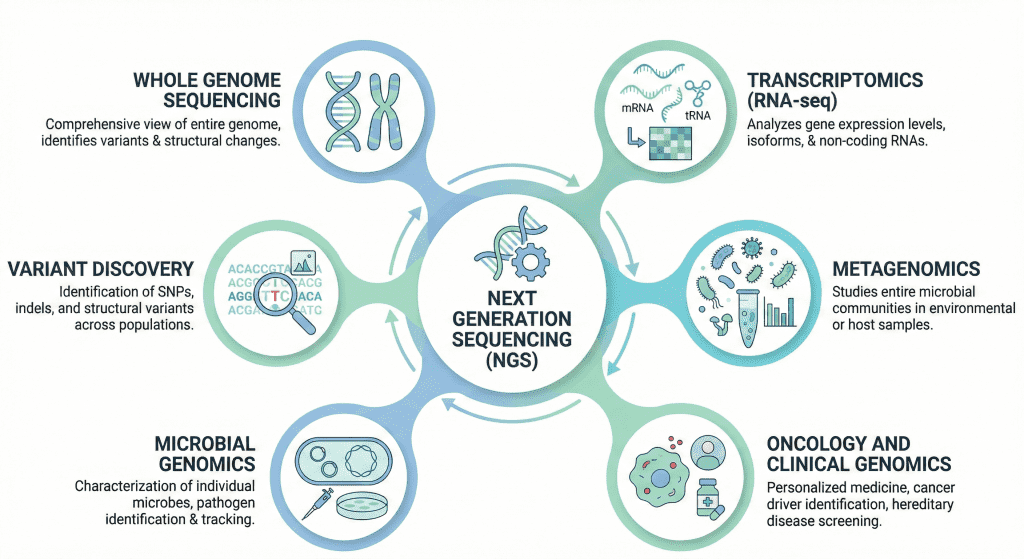
NGS supports nearly all modern omics fields.
Genomics and Whole Genome Sequencing
- Bacterial genome sequencing
- Variant discovery
- Comparative genomics
Transcriptomics (RNA-seq)
- Gene expression profiling
- Differential expression analysis
- Isoform detection
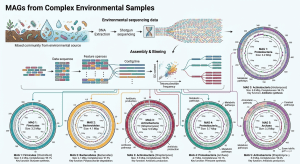
Metagenomics and Microbiome Research
- Shotgun metagenomics
- 16S/ITS profiling
- Functional potential analysis
Clinical and Applied NGS
- Oncology panels
- Infectious disease diagnostics
- Antimicrobial resistance detection
Next Generation Sequencing Services at TailoredOmics
At TailoredOmics, we support NGS projects end-to-end:
- Experimental design
- Sequencing strategy selection
- Library preparation guidance
- Bioinformatics analysis
- Publication-ready reports
Our expertise spans microbial genomics, transcriptomics, metagenomics, and functional annotation — ensuring results that are biologically meaningful, not just technically correct. If you are planning projects on these areas or need bioinformatics support, contact us!
Cost Considerations: Sanger vs NGS
- Sanger sequencing: low setup cost, high cost per base
- NGS: higher upfront cost, but dramatically lower cost per base
For small projects, Sanger may be cheaper. For anything beyond a handful of genes, NGS is far more cost-effective.
Future Trends: Beyond Next Generation Sequencing
The field continues to evolve toward:
- Long-read dominance
- Single-cell sequencing
- Multi-omics integration
- AI-driven bioinformatics
- Real-time clinical sequencing
NGS is no longer “next” — it is the present.
Final Thoughts
Next Generation Sequencing has fundamentally changed biology. While Sanger sequencing remains valuable for validation and small-scale studies, NGS is the backbone of modern genomics, transcriptomics, and microbiome research.
Understanding the strengths and limitations of each approach is essential for designing robust experiments and extracting meaningful insights from sequencing data.
If you’re planning an NGS project and need expert guidance — from sequencing strategy to advanced bioinformatics — TailoredOmics is here to help.