Introduction
Bacterial genome sequencing has become a fundamental tool in modern microbiology. From tracking pathogen evolution to discovering new metabolic pathways, whole-genome sequencing provides a detailed view of microbial genetic potential and allows researchers to move beyond marker genes toward complete genomic characterization.
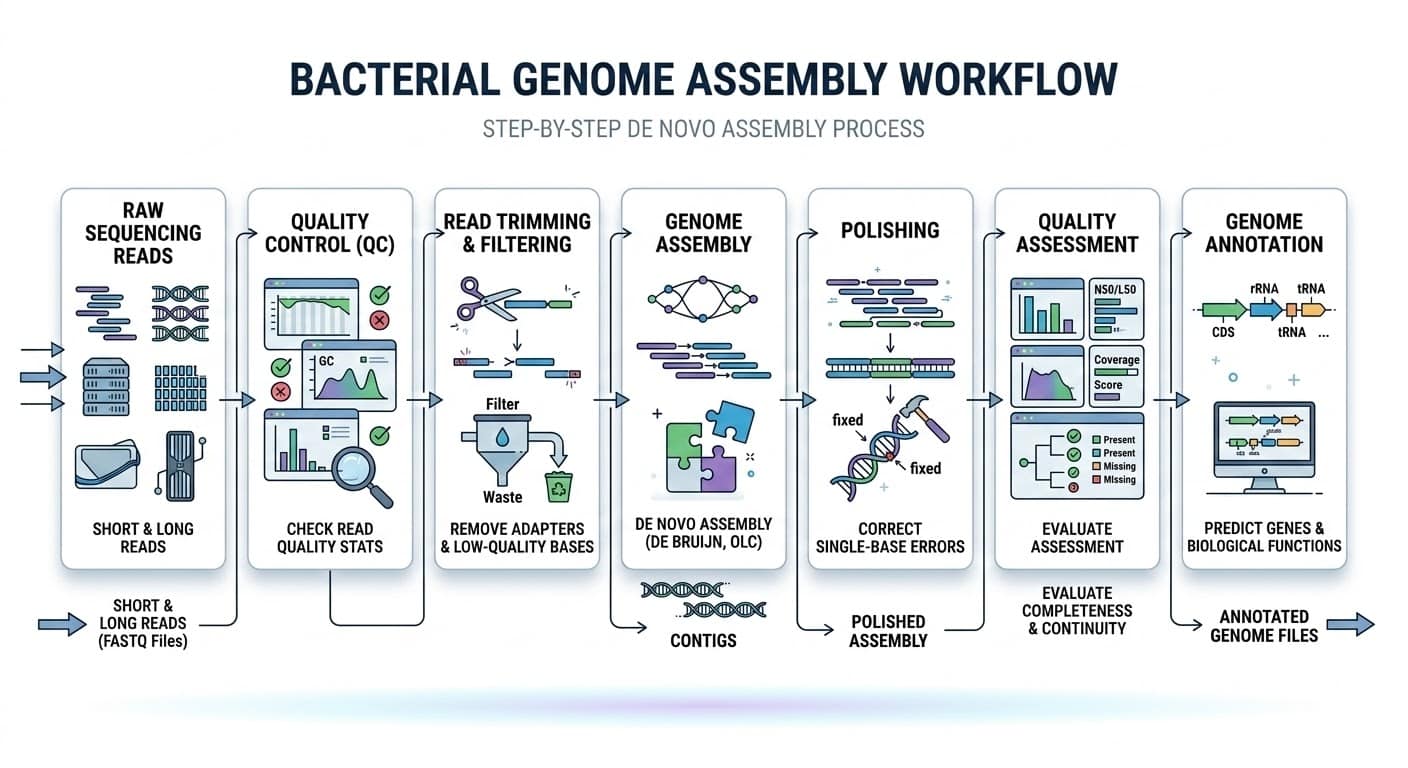
However, raw sequencing data alone do not answer biological questions. To obtain a usable genome, sequencing reads must be processed through a bacterial genome assembly pipeline. This workflow transforms raw reads into contigs, polished assemblies, and finally annotated genomes that can be interpreted biologically.
In this guide, we explain the complete bacterial genome assembly pipeline, from raw sequencing reads to annotated genomes. We cover quality control, assembly, polishing, quality assessment, and genome annotation, with a special focus on microbial genomics applications.
If you need expert support for bacterial genome projects, our Microbial Genomics Services provide end-to-end analysis from raw reads to publication-ready genomes and reports.
Overview of the Bacterial Genome Assembly Pipeline
A typical bacterial genome assembly workflow includes the following stages:
- Raw read quality control
- Read trimming and filtering
- Genome assembly
- Assembly polishing
- Assembly quality assessment
- Genome annotation
- Visualization and reporting
Each step contributes to building an accurate and biologically useful genome sequence. The exact pipeline depends on the sequencing platform used, whether Illumina, Oxford Nanopore, PacBio, or a hybrid approach.
Step 1: Quality Control of Raw Sequencing Reads
The first step in any bacterial genome assembly pipeline is evaluating raw read quality. Sequencing runs can contain adapter contamination, low-quality bases, technical biases, or uneven read distributions. If these problems are not detected early, assembly results can be fragmented or error-prone.
For Illumina short reads, quality control usually focuses on:
- per-base quality scores
- adapter contamination
- GC-content distribution
- sequence duplication levels
- overrepresented sequences
For long-read technologies such as Nanopore or PacBio, the emphasis is often on read length distribution, yield, and error profiles.
Common quality control tools include:
This step allows researchers to decide whether trimming, filtering, or resequencing may be needed before moving to assembly.
Step 2: Read Trimming and Filtering
After quality assessment, sequencing reads should be cleaned. Adapter sequences, low-quality bases, and very short reads can interfere with assembly and lead to poor contiguity or false joins.
Typical preprocessing tasks include:
- adapter removal
- quality trimming at read ends
- removal of ambiguous bases
- filtering of very short reads
Popular preprocessing tools include:
For long-read datasets, read filtering may also involve removing very short or low-quality Nanopore reads before assembly.
Step 3: Genome Assembly
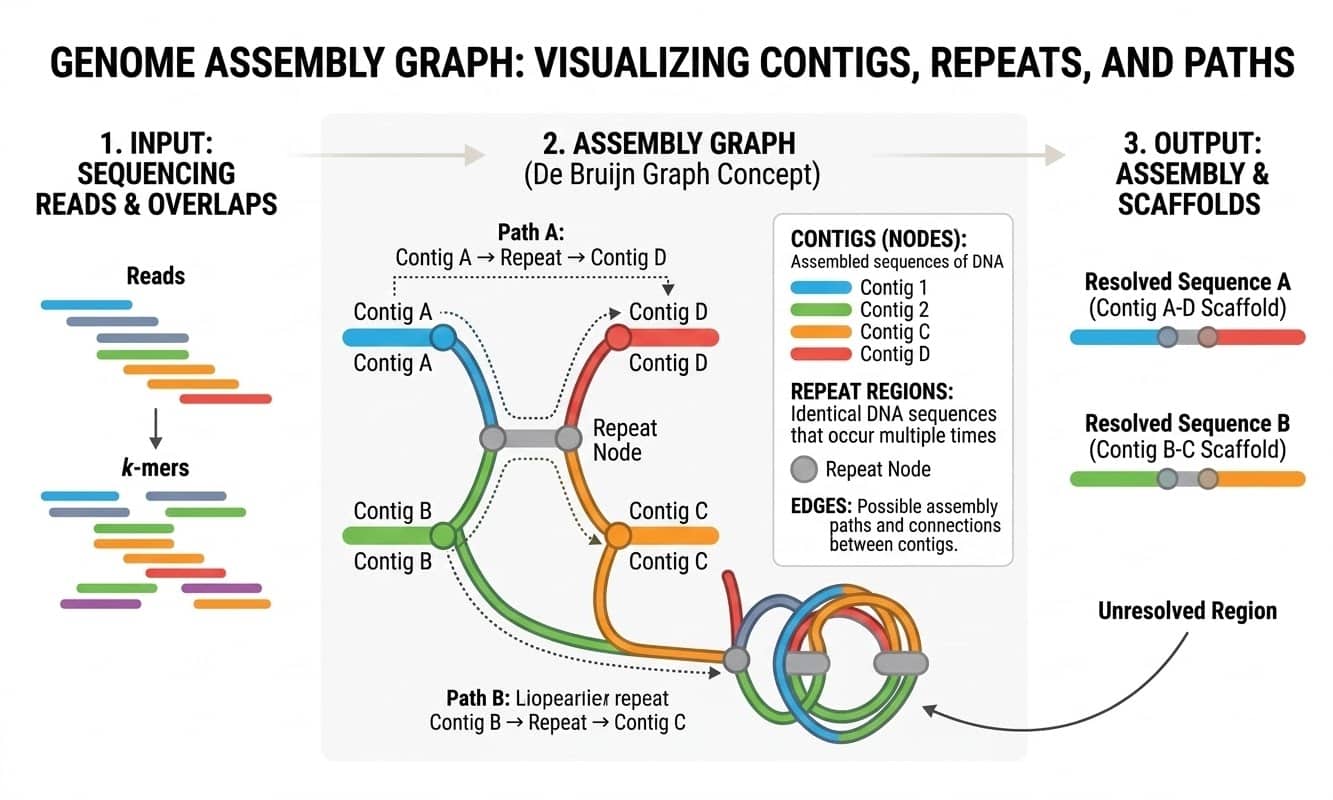
The core step in the workflow is genome assembly. In this stage, overlapping sequencing reads are reconstructed into longer contiguous sequences called contigs. Depending on the technology used, assembly can produce fragmented draft genomes or near-complete circular chromosomes.
Short-read assembly
Short-read assemblers are optimized for Illumina data. They usually rely on de Bruijn graph methods and are highly effective for accurate but fragmented read sets.
Common tools:
Short-read assemblies are often highly accurate but may remain fragmented, especially in genomes with repeats, plasmids, or mobile elements.
Long-read assembly
Long-read sequencing can dramatically improve assembly contiguity because reads span repetitive regions more effectively.
Common long-read assemblers include:
Long-read assemblies often yield closed or nearly complete bacterial genomes, especially when coverage is sufficient and DNA quality is high.
Hybrid assembly
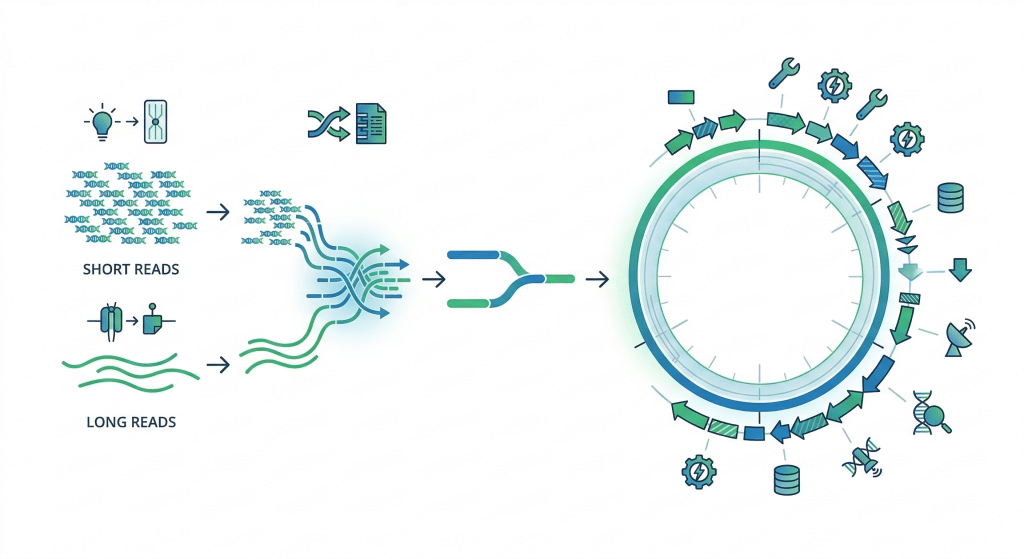
Hybrid assembly combines short-read accuracy with long-read contiguity. This approach is often one of the best strategies for microbial genomics, because it reduces fragmentation while maintaining base-level accuracy.
Unicycler is a widely used hybrid assembler for bacterial genomes and is especially useful for resolving plasmids and repeat-rich regions.
Step 4: Assembly Polishing
Initial assemblies often contain errors such as mismatches, small insertions, or deletions. These errors are especially common in long-read assemblies. Assembly polishing corrects these mistakes and improves the final sequence quality.
Typical polishing tools include:
- Pilon for polishing with Illumina reads
- Racon for long-read polishing
- Medaka for Nanopore consensus improvement
Polishing is essential when the final genome will be used for gene prediction, comparative genomics, or variant analysis.
Step 5: Assembly Quality Assessment
Once polishing is complete, the assembly must be evaluated. A polished genome is not necessarily a good genome if it is incomplete, contaminated, or still fragmented.
Key metrics include:
- N50: a measure of contig contiguity
- number of contigs: fewer is usually better for bacteria
- genome size: compared with expected size
- coverage: average read depth across the assembly
- completeness and contamination
Common quality assessment tools:
For bacterial genomes, an ideal final result is a small number of contigs, minimal contamination, and genome completeness close to 100%.
Step 6: Genome Annotation
Once the genome assembly has passed quality checks, the next stage is genome annotation. This is the process of identifying genes, RNA features, and functional elements in the assembled sequence.
Annotation allows researchers to answer questions such as:
- Which protein-coding genes are present?
- Which tRNAs and rRNAs are encoded?
- What metabolic pathways can the organism perform?
- Are there virulence or antimicrobial resistance genes?
Popular annotation tools include:
Functional annotation may also involve databases such as KEGG, eggNOG, COG, or Pfam, depending on the biological question.
If you want a broader explanation of this stage, see our article What Is Genome Annotation?.
Step 7: Visualization and Reporting
The final outputs of a bacterial genome assembly pipeline should be easy to interpret and ready for downstream analysis or publication.
Common outputs include:
- assembled genome FASTA files
- annotation files in GFF or GenBank format
- assembly statistics reports
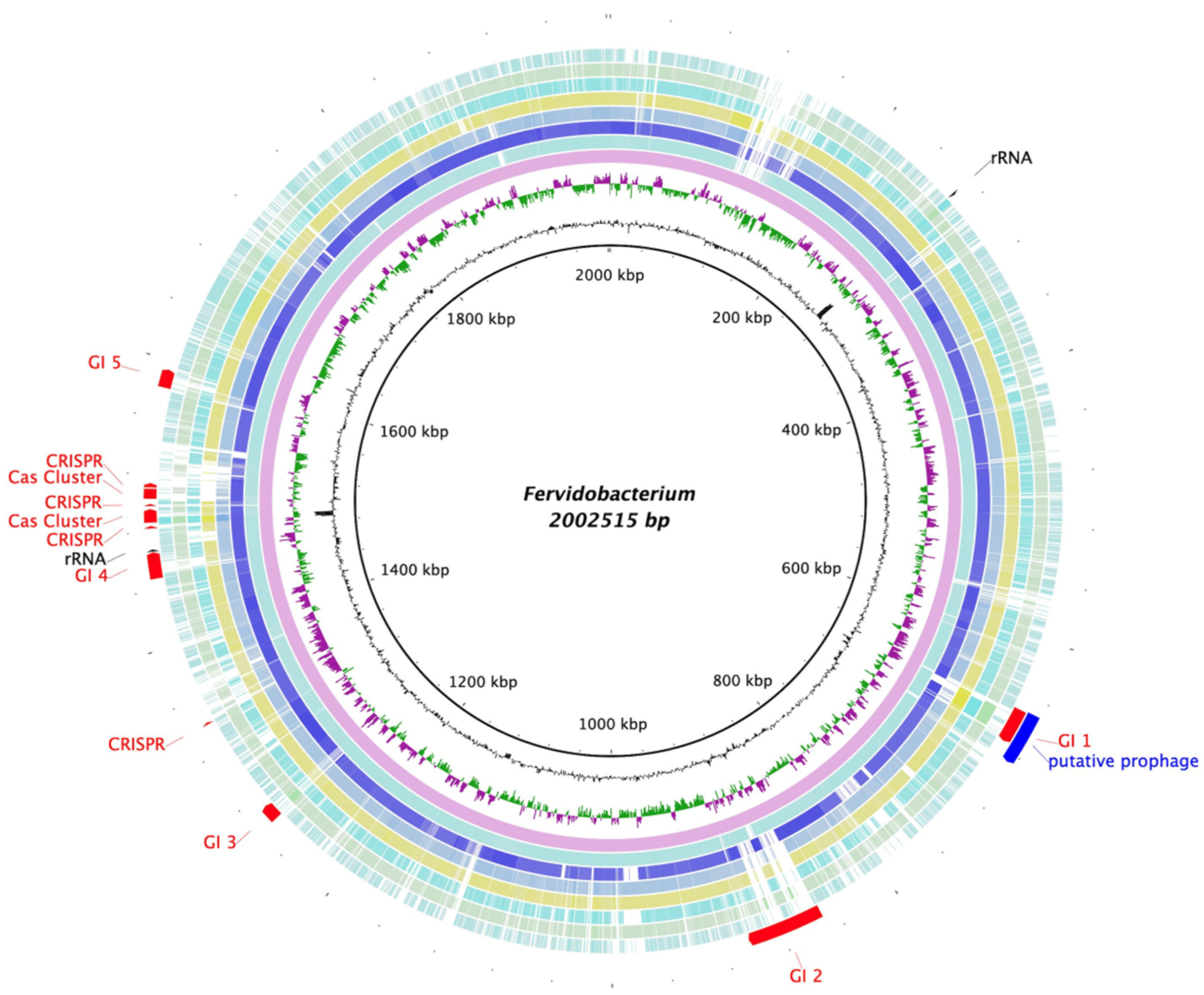
- circular genome maps
- tables of genes, pathways, and functional categories
High-quality reporting is especially important when assemblies will be used in comparative genomics, metabolic reconstruction, or industrial microbiology projects.
Applications of Bacterial Genome Assembly
A robust bacterial genome assembly pipeline supports many applications in microbial research and biotechnology:
- pathogen surveillance and outbreak tracking
- comparative genomics
- discovery of biosynthetic gene clusters
- annotation of resistance and virulence genes
- metabolic pathway reconstruction
- strain characterization for industrial or environmental studies
Genome assemblies can also be integrated with other omics approaches such as transcriptomics and metagenomics for deeper systems-level analysis.
For example, transcriptomic data can reveal which annotated genes are actively expressed under specific conditions, while metagenomics can place a genome in the broader ecological context of a microbial community.
When to Use Professional Genome Assembly Services
Although bacterial genome assembly tools are widely available, building a reliable and reproducible pipeline still requires bioinformatics expertise. This is especially true for hybrid assemblies, low-quality DNA, contaminated samples, or genomes with plasmids and repetitive regions.
Professional microbial genomics services can help with:
- choosing the best assembly strategy for your sequencing data
- polishing and validating draft genomes
- producing publication-ready annotations
- interpreting genome content biologically
At Tailoredomics, our Microbial Genomics Services support genome assembly, annotation, and downstream comparative analyses for bacterial sequencing projects.
Related Resources
To explore related topics, read our guide What Is Microbial Genomics?, compare sequencing technologies in Bacterial Genome Sequencing: Illumina vs Nanopore vs PacBio, or learn about downstream annotation in What Is Genome Annotation?.
Final Thoughts
A robust bacterial genome assembly pipeline transforms raw sequencing reads into accurate, polished, and biologically informative genome assemblies. From quality control and read trimming to polishing and annotation, each step contributes to producing a final genome that can support real biological discovery.
As sequencing technologies continue to improve, genome assembly will remain one of the central workflows in microbial genomics. Whether you are studying pathogens, environmental isolates, or industrial strains, a well-designed assembly pipeline is the foundation for downstream analysis.