Introduction
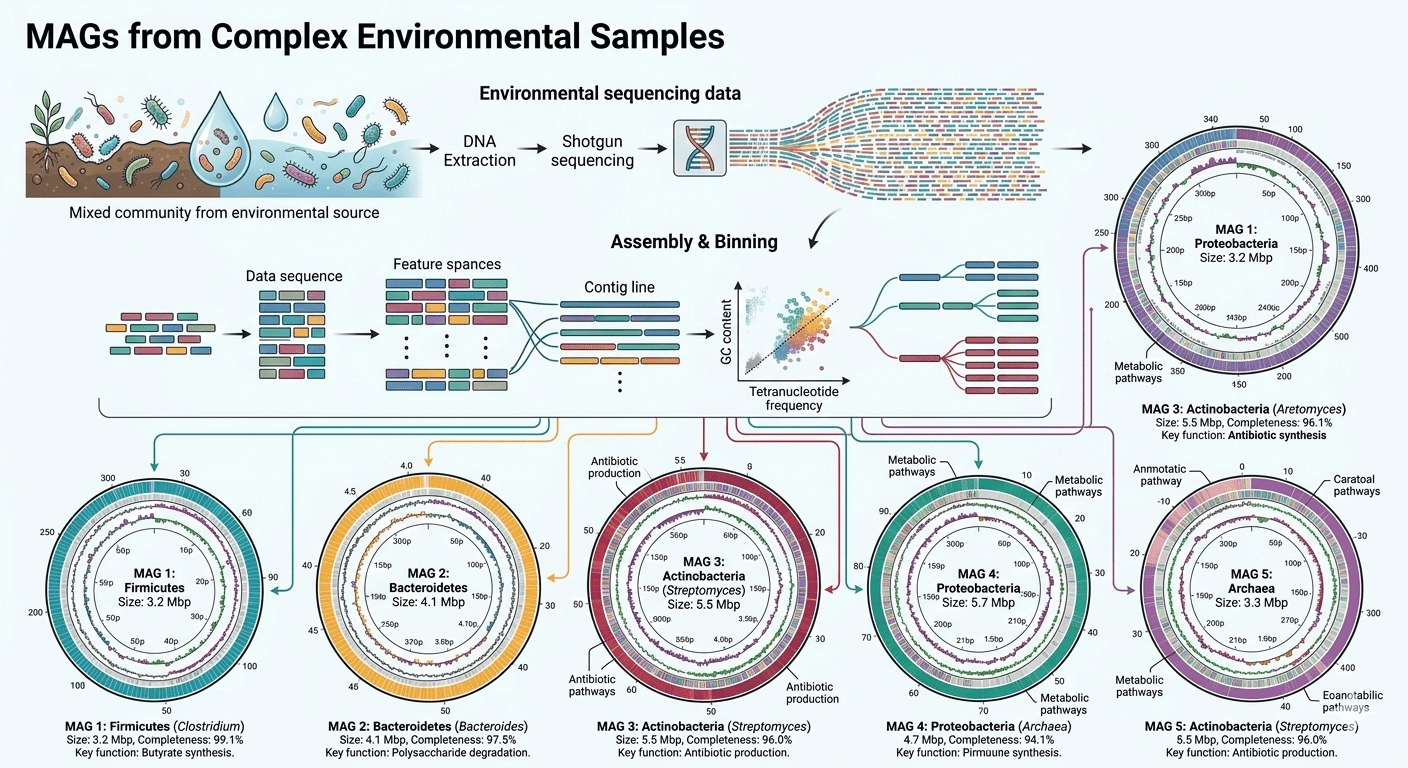
Shotgun metagenomics allows researchers to sequence all genetic material in an environmental sample. However, after assembly, the resulting dataset contains thousands of contigs from multiple organisms.
To reconstruct individual microbial genomes, these contigs must be grouped into bins. This process is known as metagenomic binning.
In this article, we compare the most widely used metagenomic binning tools and explain how to choose the right approach for recovering high-quality metagenome assembled genomes (MAGs).
If you are new to metagenomics workflows, see our guide: Metagenome Assembly Pipeline.
What Is Metagenomic Binning?
Metagenomic binning is the process of grouping assembled contigs into clusters that represent individual genomes.
These clusters, known as bins, can be refined into metagenome assembled genomes (MAGs).
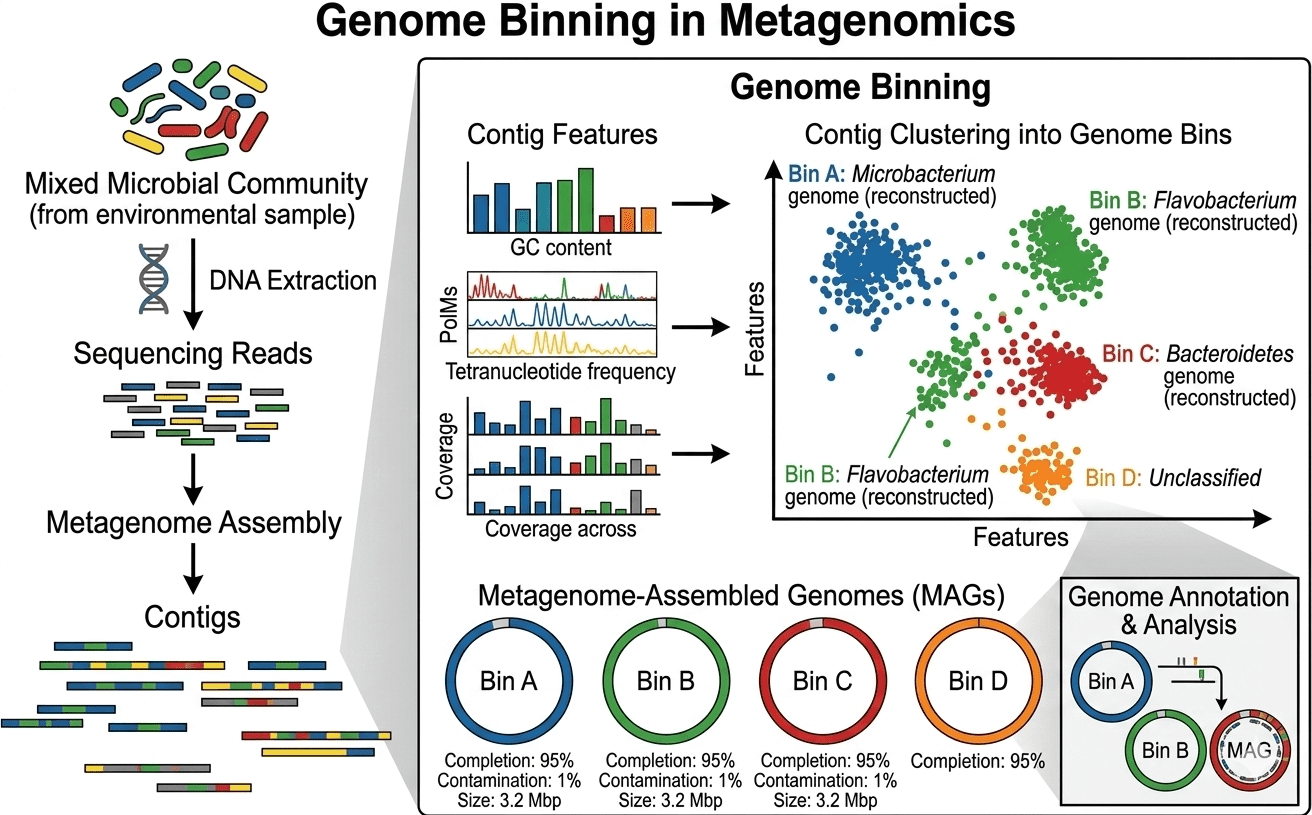
Binning relies on multiple signals:
- sequence composition (GC content, k-mers)
- coverage patterns across samples
- phylogenetic markers
Main Metagenomic Binning Tools
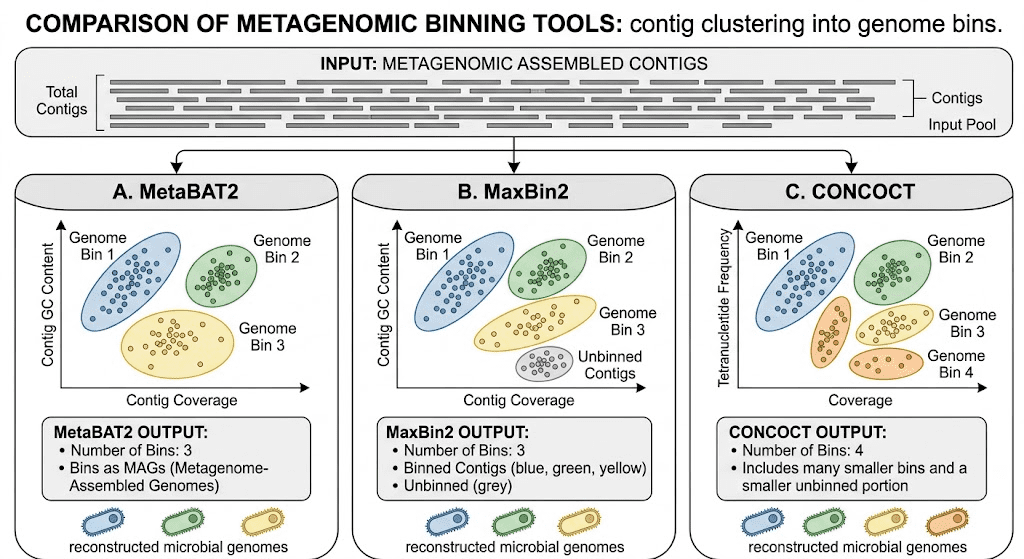
MetaBAT2
MetaBAT2 is one of the most widely used binning tools.
It uses probabilistic distances based on tetranucleotide frequency and coverage depth to group contigs.
Advantages:
- high accuracy
- fast execution
- works well with complex communities
Limitations:
- requires sufficient sequencing depth
MaxBin2
MaxBin2 uses an Expectation-Maximization algorithm combined with marker genes.
Advantages:
- robust for low-abundance genomes
- uses marker genes for improved classification
Limitations:
- slower than MetaBAT2
- may produce more fragmented bins
CONCOCT
CONCOCT clusters contigs based on coverage across multiple samples and sequence composition.
Advantages:
- effective for multi-sample datasets
- captures strain-level variation
Limitations:
- requires multiple samples
- more complex setup
Comparison of Binning Tools
| Tool | Best Use Case | Strength | Limitation |
|---|---|---|---|
| MetaBAT2 | General-purpose binning | Fast and accurate | Needs good coverage |
| MaxBin2 | Low-abundance genomes | Marker gene support | Slower |
| CONCOCT | Multi-sample studies | Coverage-based clustering | Complex workflow |
Combining Multiple Binning Tools
In practice, many researchers combine multiple binning tools to improve genome recovery.
Tools such as DASTool integrate results from different binning methods to produce higher-quality bins.
This approach often improves completeness while reducing contamination.
Quality Assessment of Bins
After binning, genome quality must be evaluated.
Key metrics include:
- completeness
- contamination
- strain heterogeneity
Common tools include:
How to Choose the Right Binning Tool
The choice of binning tool depends on your dataset:
- Single sample: MetaBAT2
- Low abundance genomes: MaxBin2
- Multiple samples: CONCOCT
- Best results: combine tools with DASTool
For complex microbiomes, combining multiple approaches is often the best strategy.
Final Thoughts
Metagenomic binning is a critical step in reconstructing microbial genomes from shotgun sequencing data.
Choosing the right binning tools and combining methods when appropriate can significantly improve the quality of recovered MAGs.
If you need support with metagenomics data analysis and genome reconstruction, explore our Metagenomics Services.