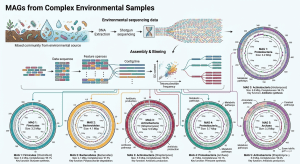
Metagenome assembly is one of the most useful steps in shotgun metagenomics, but it is also one of the most frustrating.
You may start with millions of high-quality reads, run a standard assembler, and still obtain an output with thousands or millions of short contigs, a low N50, poor genome recovery, and few usable metagenome-assembled genomes.
This does not always mean that the analysis failed.
Metagenomes are intrinsically difficult to assemble because they contain DNA from many organisms at different abundances, often with closely related strains, repeated regions, mobile genetic elements, plasmids, viruses, and uneven sequencing depth. In other words, a metagenome is not one genome. It is a mixed and uneven collection of genomes.
However, a highly fragmented metagenome assembly can seriously affect downstream analysis, especially if your goal is to recover MAGs, annotate genes, reconstruct pathways, or compare functional potential between samples.
In this article, we explain why metagenome assemblies become fragmented, how to diagnose the problem, and what you can do to improve the assembly.
If you are planning a full shotgun metagenomics workflow, you may also find this related guide useful: Metagenome Assembly Pipeline: From Raw Reads to MAGs.
What does a fragmented metagenome assembly look like?
A fragmented assembly usually contains many short contigs instead of fewer, longer, more continuous sequences.
Common signs include:
- a very high number of contigs;
- low N50 or low N90 values;
- few contigs above 10 kb, 50 kb, or 100 kb;
- low read mapping back to the assembly;
- incomplete genes or broken operons;
- poor recovery of expected marker genes;
- low-quality MAGs after binning;
- incomplete metabolic pathways after annotation.
For example, if you are trying to recover bacterial MAGs from shotgun metagenomic data, a fragmented assembly may lead to bins with low completeness, high contamination, or missing key functional genes.
However, fragmentation must be interpreted carefully. A low N50 is not automatically a failure, and a high N50 is not automatically a good assembly. A metagenome with many low-abundance organisms may produce a fragmented assembly even when the pipeline is technically correct. Conversely, an assembly with artificially long contigs may contain chimeric regions or misassemblies.
The question is not only: “Is my assembly fragmented?”
The better question is:
Is the assembly good enough for my biological objective?
That objective may be taxonomic profiling, MAG reconstruction, functional annotation, antimicrobial resistance gene detection, viral sequence recovery, or comparative metagenomics. Each goal has different quality requirements.
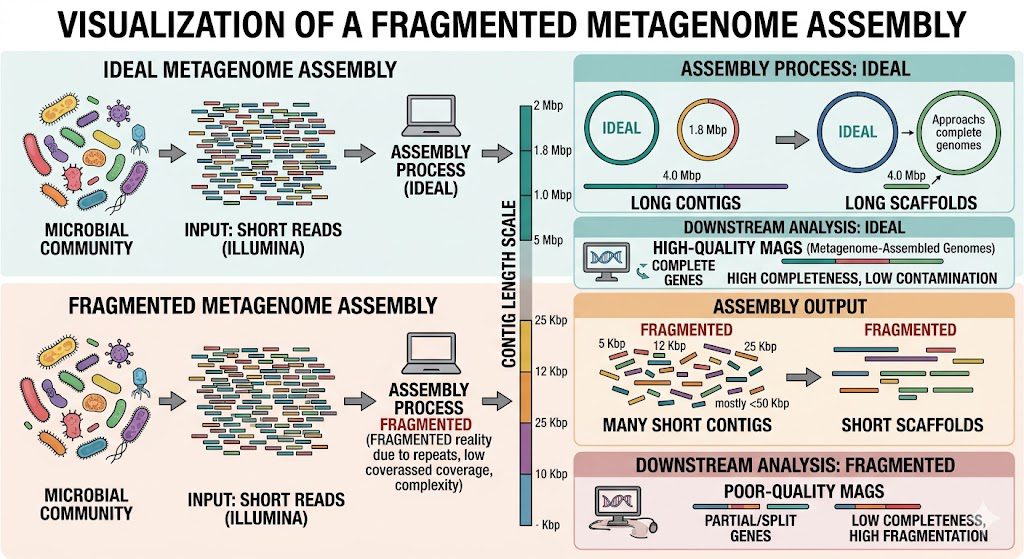
Why metagenome assemblies are often fragmented
Metagenome assembly is harder than isolate genome assembly because the assembler has to reconstruct multiple genomes at once, without knowing in advance how many organisms are present or how abundant they are.
In an isolate genome project, most reads come from one organism. Coverage is usually more uniform, and the assembler can often reconstruct long contigs or even complete chromosomes if the sequencing data are good enough.
In shotgun metagenomics, the situation is different. Reads come from many genomes, and those genomes may differ dramatically in abundance.
A dominant organism may have 100× coverage, while a rare organism may have 2× coverage. The dominant genome may assemble reasonably well, while the rare genome may barely assemble at all.
This unevenness is one of the main reasons metagenome assemblies are fragmented.
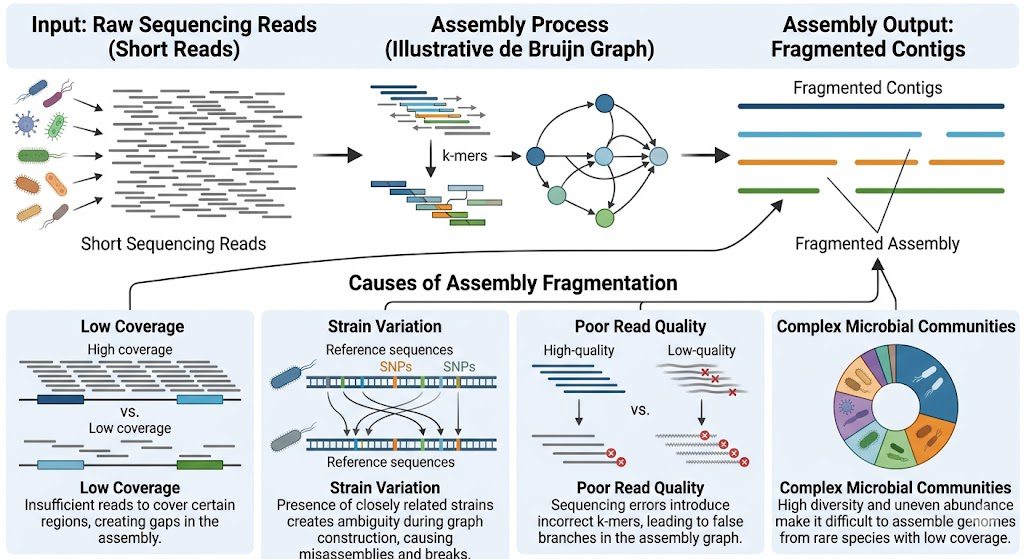
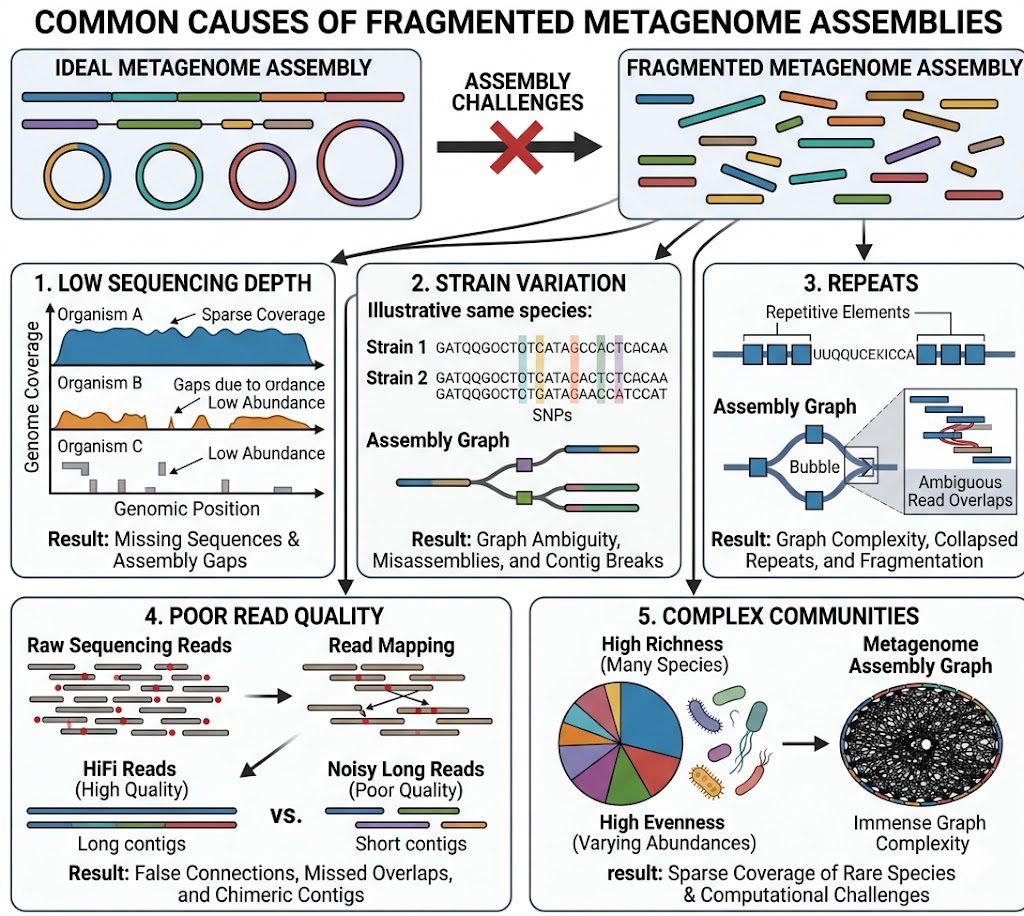
Main causes of fragmented metagenome assemblies
1. Low sequencing depth
Low sequencing depth is one of the most common causes of poor metagenome assembly.
Assembly algorithms need overlapping reads to reconstruct longer sequences. If many organisms in the sample have low coverage, the assembler cannot confidently connect reads into longer contigs.
This is especially problematic in complex environments such as:
- soil;
- sediment;
- wastewater;
- marine samples;
- lake and freshwater samples;
- gut microbiomes with high richness;
- environmental biofilms.
In these cases, sequencing depth is distributed across many organisms. Even if the total number of reads seems high, the effective coverage per genome may be low.
This is why “I sequenced 10 million reads” or “I sequenced 20 Gb” does not automatically mean that the assembly will be good. What matters is how that sequencing depth is distributed across the microbial community.
A simple low-complexity community may assemble well with moderate sequencing depth. A highly complex environmental sample may remain fragmented even with much deeper sequencing.
2. High community complexity
The more complex the microbial community, the harder the assembly.
A sample containing 20 dominant bacterial species is easier to assemble than a sample containing hundreds or thousands of bacterial, archaeal, viral, and eukaryotic genomes at uneven abundance.
High complexity creates several problems:
- fewer reads per organism;
- more shared sequences between related organisms;
- more ambiguous assembly graph structures;
- more rare genomes with insufficient coverage;
- more repeated sequences from different taxa;
- more difficulty separating strain-level variation.
This is one of the reasons why metagenome assembly is often more successful in low-complexity systems, such as enrichment cultures, bioreactors, host-associated microbiomes, or targeted microbial communities, than in highly diverse soil or sediment samples.
If your sample is highly diverse, fragmentation may not be caused by a bad pipeline. It may reflect the biological complexity of the sample.
3. Strain variation and closely related organisms
Strain variation is one of the most important and often underestimated causes of fragmented metagenome assemblies.
Many microbial communities contain closely related strains of the same species. These strains may share most of their genome but differ in specific regions, such as:
- mobile genetic elements;
- prophages;
- plasmids;
- antimicrobial resistance genes;
- secretion systems;
- carbohydrate-active enzymes;
- secondary metabolite gene clusters;
- small indels or SNP-dense regions.
For the assembler, this creates ambiguity. If two strains are very similar in one region but different in another, the assembly graph becomes tangled. The assembler may break contigs at ambiguous regions rather than risk creating incorrect chimeric sequences.
The result is often a fragmented assembly, especially around variable genomic regions.
This is particularly relevant when working with:
- gut microbiomes;
- environmental metagenomes;
- enrichment cultures;
- microbial communities dominated by related strains;
- pathogen surveillance samples;
- strain-resolved metagenomics projects.
In some cases, fragmentation is a protective behavior. The assembler is avoiding false joins between similar but non-identical genomes.
4. Repetitive genomic regions
Repeats are difficult in any genome assembly, but they are even more problematic in metagenomes.
Repeated regions may include:
- rRNA operons;
- transposases;
- insertion sequences;
- prophages;
- plasmid regions;
- duplicated genes;
- conserved housekeeping genes;
- low-complexity sequences;
- repeated protein domains.
Short-read sequencing is especially vulnerable to repeat-related fragmentation. If a repeat is longer than the read length or insert size, the assembler may not know which genomic regions should be connected.
Long-read sequencing can help resolve some repeats, but long-read metagenomics also has its own challenges, including DNA input requirements, read accuracy, host DNA, and uneven taxonomic coverage.
The practical consequence is simple: if your organisms contain many repeats, or if your target genes are located in mobile regions, the assembly may break exactly where you most want continuity.
5. Poor read quality or aggressive trimming
Poor-quality reads can fragment assemblies because sequencing errors create false k-mers. These false k-mers complicate the assembly graph and reduce the ability to reconstruct reliable contigs.
Common read-level problems include:
- low-quality tails;
- adapter contamination;
- poor-quality reverse reads;
- overrepresented sequences;
- PCR duplicates;
- host contamination;
- very short reads after trimming.
However, aggressive trimming can also cause problems.
If trimming removes too much sequence, the reads may become too short to assemble effectively. This is especially relevant for short-read metagenomics, where read length and insert size help resolve repeats and connect contigs.
The goal is not to trim as much as possible. The goal is to remove unreliable sequence while preserving useful information.
A good metagenomics workflow should therefore include quality control before and after trimming, not just automated trimming with default parameters.
For more general examples of problems that affect metagenomic workflows, see Common Metagenomics Mistakes and How to Avoid Them.
6. Host contamination or non-target DNA
Host DNA can reduce the effective sequencing depth available for microbial assembly.
This is especially important in:
- human microbiome samples;
- animal microbiome samples;
- plant-associated microbiomes;
- low-biomass samples;
- clinical or host-associated metagenomics.
If a large fraction of reads comes from the host, the number of microbial reads available for assembly may be much lower than expected.
For example, a dataset may contain 50 million reads, but if 80% are host-derived, only 10 million reads are useful for microbial assembly. That difference can strongly affect contig length, MAG recovery, and functional annotation.
Host read removal is therefore not just a privacy or contamination-control step. It can directly improve microbial assembly by increasing the proportion of informative reads used by the assembler.
7. Inappropriate assembler choice
Different metagenome assemblers behave differently.
Some assemblers are optimized for speed and memory efficiency. Others may be more sensitive but require more RAM and longer runtimes. Some are designed for short reads, while others can use long reads or hybrid strategies.
Common metagenome assembly tools include:
- MEGAHIT;
- metaSPAdes;
- metaFlye;
- IDBA-UD;
- hybrid approaches using short and long reads.
There is no universally best assembler for every dataset.
For large and complex short-read metagenomes, MEGAHIT is often used because it is fast and memory-efficient. metaSPAdes can perform well in many cases but may require more computational resources. Long-read or hybrid assemblers may improve contiguity when high-quality long-read data are available.
The best choice depends on:
- sample complexity;
- sequencing technology;
- read length;
- coverage;
- available RAM;
- whether the goal is gene recovery, MAG recovery, or strain-level analysis;
- whether the dataset contains multiple related samples that can be co-assembled.
If one assembler produces a fragmented result, it may be worth comparing another assembler before concluding that the dataset is unusable.
8. Suboptimal k-mer strategy
Most short-read assemblers rely on k-mers, which are short sequence words used to build assembly graphs.
The choice of k-mer sizes can affect assembly contiguity and sensitivity.
Smaller k-mers may help recover low-abundance organisms because they require less coverage to connect reads. However, they may also increase ambiguity in complex communities.
Larger k-mers may improve specificity and reduce graph complexity, but they can fail in low-coverage regions.
Many metagenome assemblers use multiple k-mer sizes internally, but parameter choices can still affect the result. Default settings are often reasonable, but they are not always optimal for every dataset.
If your assembly is unexpectedly fragmented, testing alternative k-mer settings or assembler presets may be useful, especially when working with unusual samples or uneven coverage.
9. Individual assembly vs co-assembly issues
A common question in metagenomics is whether to assemble each sample separately or perform co-assembly across multiple samples.
Both strategies can work, but both can also cause problems.
Individual assembly may be better when:
- samples are very different;
- each sample has enough sequencing depth;
- you want sample-specific strain resolution;
- co-assembly creates too much graph complexity.
Co-assembly may be better when:
- samples are biologically related;
- the same organisms appear across multiple samples;
- individual samples have low coverage;
- you want to improve recovery of shared genomes.
However, co-assembly can also increase fragmentation if the combined dataset contains many closely related strains or highly heterogeneous populations. In that case, adding more samples increases complexity instead of improving assembly.
This is why co-assembly should not be used automatically. It is a strategy, not a universal upgrade.
How to diagnose a fragmented metagenome assembly
Before trying to fix the assembly, you need to understand why it is fragmented.
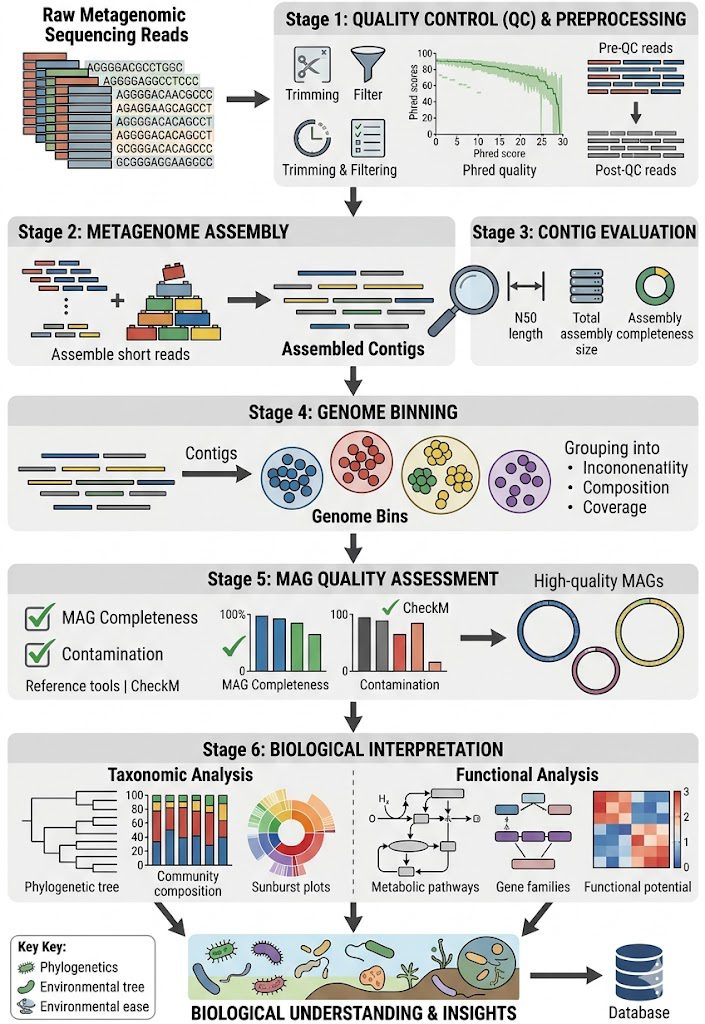
A useful diagnostic workflow includes the following steps.
1. Check read quality before and after trimming
Start with basic read QC.
Look for:
- low-quality cycles;
- adapter contamination;
- poor reverse-read quality;
- abnormal GC content;
- overrepresented sequences;
- unexpectedly short reads after trimming;
- duplicated reads;
- possible host contamination.
Tools such as FastQC and MultiQC are commonly used for this first inspection.
If read quality is poor, assembly quality will usually suffer.
2. Estimate taxonomic complexity before assembly
A taxonomic profiling step can help you understand whether the sample is simple, moderately complex, or extremely complex.
For example, tools such as Kraken2, Kaiju, MetaPhlAn, or similar profilers can give a first approximation of community structure.
If the sample contains a few dominant organisms, good assembly may be realistic.
If the sample contains hundreds of organisms with no clear dominant taxa, fragmentation may be expected.
This does not replace assembly, but it helps interpret the assembly result.
3. Map reads back to the assembly
Mapping reads back to the assembled contigs is one of the most useful diagnostic steps.
Important questions include:
- What percentage of reads map back to the assembly?
- Are the longest contigs well covered?
- Are many reads left unassembled?
- Are contigs supported by consistent coverage?
- Do coverage patterns suggest mixed organisms or strain variation?
Low mapping rates may indicate poor assembly, contamination, insufficient preprocessing, or high sample complexity.
Coverage profiles are also useful for binning, because binning tools often combine sequence composition and coverage information to group contigs into MAGs.
4. Evaluate assembly metrics
Assembly metrics can help summarize the result.
Useful metrics include:
- number of contigs;
- total assembly length;
- largest contig;
- N50 and N90;
- number of contigs above 1 kb, 5 kb, 10 kb, and 50 kb;
- GC distribution;
- read mapping rate;
- predicted gene count;
- taxonomic distribution of contigs.
Tools such as QUAST and MetaQUAST can help evaluate genome and metagenome assemblies.
However, avoid judging the assembly by N50 alone. N50 is useful, but it does not tell the full story. A high N50 assembly can still contain errors, and a low N50 assembly can still contain useful genes or recover meaningful bins.
5. Assess MAG quality after binning
If your objective is MAG reconstruction, the final test is not only the assembly statistics. It is whether you can recover useful genome bins.
After binning, evaluate:
- completeness;
- contamination;
- strain heterogeneity;
- number of recovered MAGs;
- taxonomic consistency;
- GC and coverage profiles;
- presence of expected marker genes;
- functional annotation completeness.
Tools such as CheckM are commonly used to estimate completeness and contamination of microbial genomes recovered from metagenomes.
If the assembly is fragmented but still produces medium- or high-quality MAGs, it may be good enough for your biological question.
If the assembly is fragmented and binning fails, then you likely need to revisit sequencing depth, preprocessing, assembly strategy, or sample design.
For more on binning tools, see Metagenomic Binning Tools Compared: MetaBAT2 vs MaxBin2 vs CONCOCT.
How to improve a fragmented metagenome assembly
1. Improve read preprocessing
Start with the input data.
Before changing assemblers or parameters, check whether your reads are clean and usable.
Useful steps may include:
- adapter removal;
- quality trimming;
- removal of very short reads;
- host read removal;
- contaminant screening;
- duplicate assessment;
- checking quality before and after trimming.
Do not assume that the assembler can compensate for poor input data. In many cases, improving preprocessing gives better results than changing assembly parameters blindly.
2. Increase sequencing depth when possible
If fragmentation is caused by low coverage, the most direct solution is deeper sequencing.
This is especially relevant when the goal is:
- MAG reconstruction;
- low-abundance organism recovery;
- gene cluster reconstruction;
- plasmid analysis;
- viral metagenomics;
- functional pathway reconstruction.
However, deeper sequencing is not always enough.
In highly complex communities, additional reads may still be spread across many organisms. This may improve recovery of dominant and moderately abundant organisms but still leave rare members fragmented.
Before sequencing more, estimate whether low coverage is really the limiting factor.
3. Consider co-assembly carefully
Co-assembly can improve recovery when related samples share organisms.
For example, co-assembly may help in:
- time-series studies;
- depth profiles;
- treatment-control designs;
- replicate samples;
- enrichment cultures;
- related environmental gradients.
By combining reads from related samples, you may increase coverage of shared genomes and improve contiguity.
However, co-assembly can also worsen assembly if it introduces too much strain variation.
A practical approach is to compare:
- individual assemblies;
- grouped co-assemblies;
- full co-assembly.
The best strategy is often project-specific.
4. Try more than one assembler
If the dataset is important, it is often worth comparing at least two assembly strategies.
For short-read metagenomics, this may include MEGAHIT and metaSPAdes.
For long-read or hybrid datasets, other tools may be more appropriate.
Compare the results using:
- contig statistics;
- read mapping rate;
- gene recovery;
- MAG recovery;
- completeness and contamination;
- biological interpretability.
The “best” assembly is not always the one with the highest N50. It is the one that best supports the downstream analysis.
5. Use long reads or hybrid sequencing when appropriate
Long-read sequencing can improve assembly contiguity because long reads can span repeats, structural variants, and complex genomic regions.
This can be useful for:
- closing gaps;
- resolving repeats;
- reconstructing plasmids;
- improving MAG contiguity;
- identifying mobile genetic elements;
- resolving strain-level structures.
However, long-read metagenomics is not automatically superior in every case.
Challenges include:
- DNA extraction requirements;
- host contamination;
- uneven coverage;
- higher input DNA needs;
- cost;
- error correction;
- computational complexity;
- sample-specific biases.
For some projects, a hybrid approach combining short-read accuracy with long-read contiguity can be valuable.
6. Do not optimize only for N50
It is tempting to treat N50 as the main assembly quality metric.
This is risky.
A higher N50 can sometimes result from incorrect joins, chimeric contigs, or over-aggressive assembly. In metagenomics, where closely related organisms are mixed together, false joins can be especially problematic.
Instead of optimizing only for N50, consider:
- read mapping rate;
- gene completeness;
- taxonomic consistency;
- bin quality;
- contamination;
- recovery of expected functions;
- reproducibility across samples;
- suitability for the biological question.
For example, if your goal is differential abundance of functional genes, gene recovery and annotation quality may matter more than very long contigs.
If your goal is MAG reconstruction, completeness and contamination are critical.
If your goal is broad taxonomic profiling, assembly may not even be necessary; read-based profiling may be more appropriate.
When is a fragmented assembly still useful?
A fragmented assembly is not always useless.
It may still be useful for:
- gene prediction;
- functional annotation;
- antimicrobial resistance gene screening;
- taxonomic assignment of contigs;
- pathway reconstruction;
- exploratory analysis;
- recovery of dominant organisms;
- partial MAG reconstruction.
However, it may be insufficient for:
- complete genome reconstruction;
- plasmid reconstruction;
- strain-resolved analysis;
- synteny analysis;
- complete biosynthetic gene clusters;
- high-quality MAG recovery;
- mobile element reconstruction.
The key is to match the analysis to the quality of the assembly.
If the assembly is too fragmented for MAG reconstruction, it may still be good enough for functional profiling. If it is too fragmented for gene cluster analysis, it may still support broad pathway comparisons.
This is why interpretation matters. The same assembly can be “bad” for one objective and “acceptable” for another.
Practical checklist for troubleshooting fragmented metagenome assemblies
If your metagenome assembly is highly fragmented, use this checklist:
- Check raw read quality with FastQC or MultiQC.
- Confirm that trimming did not make reads too short.
- Remove host or contaminant reads when relevant.
- Estimate community complexity with taxonomic profiling.
- Check whether sequencing depth is sufficient for your objective.
- Map reads back to the assembly.
- Inspect coverage distribution across contigs.
- Compare assembly metrics with QUAST or MetaQUAST.
- Try an alternative assembler.
- Compare individual assembly and co-assembly strategies.
- Evaluate bin quality if MAG reconstruction is the goal.
- Interpret the assembly in relation to the biological question.
This process is usually more informative than simply rerunning the same assembler with random parameter changes.
Fragmentation is not always a pipeline failure
Metagenome assembly fragmentation can be caused by technical problems, but it can also reflect real biological complexity.
Low-abundance organisms, strain variation, repeats, uneven coverage, and complex microbial communities all make assembly more difficult.
The goal is not always to obtain the longest possible contigs. The goal is to generate an assembly that is reliable, interpretable, and appropriate for the downstream analysis.
For some projects, that means improving preprocessing and assembly settings.
For others, it means changing the strategy: deeper sequencing, co-assembly, long-read sequencing, targeted binning, or even using read-based profiling instead of assembly.
If you are working with shotgun metagenomic data and need support with assembly, binning, MAG quality assessment, functional annotation, or interpretation, Tailoredomics offers metagenomics analysis services tailored to microbial research projects.
For studies focused on microbial community structure, diversity, and comparative microbiome analysis, you may also be interested in our microbiome data analysis services.
FAQ
Why is my metagenome assembly so fragmented?
A metagenome assembly may be fragmented because of low sequencing depth, high community complexity, uneven abundance, strain variation, repetitive genomic regions, poor read quality, host contamination, or suboptimal assembly strategy.
Is a low N50 always bad in metagenome assembly?
No. N50 is useful, but it should not be interpreted alone. A low N50 may reflect real biological complexity, while a high N50 may still contain misassemblies. Read mapping, gene recovery, MAG quality, and biological interpretability are also important.
Can more sequencing improve a fragmented metagenome assembly?
Yes, if low coverage is the main problem. However, in highly complex communities, additional sequencing may still be distributed across many organisms. More sequencing helps most when the target organisms are present but under-covered.
Should I use MEGAHIT or metaSPAdes for metagenome assembly?
Both are commonly used for short-read metagenome assembly. MEGAHIT is often chosen for large and complex datasets because it is fast and memory-efficient. metaSPAdes may perform well in some datasets but can require more computational resources. The best choice depends on the dataset and downstream objective.
Can co-assembly reduce fragmentation?
Yes, co-assembly can improve genome recovery when related samples share organisms and individual samples have insufficient coverage. However, co-assembly can also increase complexity if samples contain many closely related but distinct strains.
Is assembly necessary for microbiome analysis?
Not always. If the objective is taxonomic profiling or diversity analysis, read-based or marker-gene approaches may be enough. Assembly is more important when the goal is MAG reconstruction, gene recovery, functional annotation, or genome-resolved metagenomics.