A low RNA-seq mapping rate is one of the most common warning signs in transcriptomics analysis. If too many reads fail to align to the reference genome or transcriptome, downstream results such as gene counts, differential expression, and pathway analysis become less reliable.
In practice, low mapping rates can have many different causes. Sometimes the problem is technical, such as poor read quality, adapter contamination, or an incorrect library type. In other cases, the issue is biological or analytical: the wrong reference genome, contamination, incomplete annotation, mixed-species samples, or degraded RNA.
In this guide, we explain the most common causes of low RNA-seq mapping rates, how to diagnose them, and what you can do to fix them before moving on to differential expression analysis.
If you need end-to-end help with RNA-seq data processing, alignment, quantification, and interpretation, you can also explore our Transcriptomics Services.
What is a low RNA-seq mapping rate?
The mapping rate is the percentage of sequencing reads that align successfully to a reference genome or transcriptome.
In general, there is no single universal threshold that defines a “good” or “bad” mapping rate. Expected values depend on factors such as:
- organism and genome quality
- library preparation method
- read length
- presence or absence of contamination
- transcriptome complexity
- whether you are aligning to a genome or transcriptome
That said, consistently low alignment rates should always be investigated.
How low is low?
As a rough rule of thumb:
- Above 80–90% is often considered strong for many well-controlled RNA-seq experiments with a good reference
- Around 60–80% may still be acceptable depending on sample type, organism, and library strategy
- Below 60% usually deserves closer inspection
- Below 40–50% often indicates a substantial technical or analytical problem
These are not rigid cutoffs, but they are useful warning zones.
Why does low mapping rate matter?
Low mapping rates reduce the proportion of reads that contribute to gene or transcript quantification. This can affect:
- statistical power
- accuracy of expression estimates
- detection of differentially expressed genes
- reproducibility across samples
- confidence in pathway enrichment results
Even worse, if some samples map well and others map poorly, the resulting bias can distort comparisons between conditions.
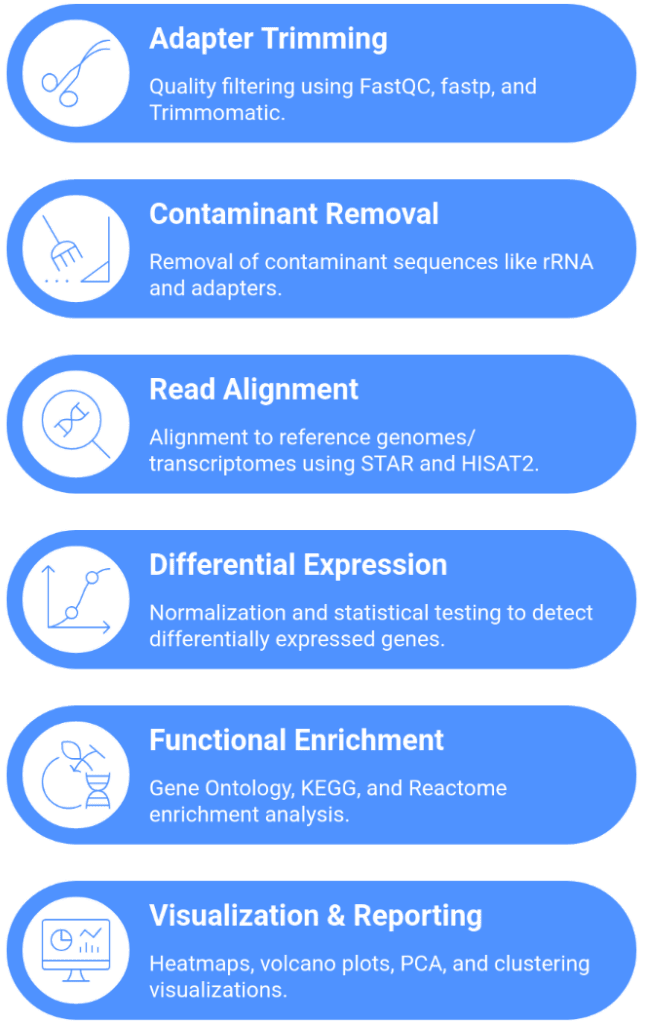
For a broader overview of the full analysis process, see our guide to the RNA-seq data analysis pipeline.
1. Poor read quality
One of the most common reasons for low mapping is simply poor sequencing quality.
Reads with many low-quality bases are harder for aligners to place correctly, especially near the ends of reads. If quality drops sharply, aligners may reject the reads or map them ambiguously.
Common signs
- low Phred scores in FastQC
- poor quality tails at the 3′ end
- overrepresented sequences
- unusually high mismatch rates
Fixes
- trim adapters and low-quality bases using tools such as
fastp,Trimmomatic, orCutadapt - remove reads that are too short after trimming
- re-run FastQC after preprocessing to confirm improvement
In many datasets, a careful trimming step alone can improve mapping noticeably.
2. Adapter contamination or untrimmed technical sequences
Residual adapters can interfere with alignment, especially in short-insert libraries or low-quality runs.
If adapters are still present, part of the read does not belong to the biological sequence, which lowers alignment success.
Common signs
- FastQC flags adapter contamination
- mapping improves after trimming
- large fraction of short, poor-quality reads
Fixes
- perform adapter trimming before alignment
- confirm which adapters were used by the sequencing facility or library kit
- verify trimming effectiveness with FastQC or MultiQC
This is a very common and very fixable cause.
3. Wrong reference genome or transcriptome
A surprisingly frequent cause of low RNA-seq mapping is using the wrong reference.
This can happen when:
- the reference belongs to a different strain or species
- the genome build is outdated
- the annotation does not match the reference assembly
- a transcriptome is used when genome alignment would be more appropriate, or vice versa
Examples
- aligning microbial reads to a related but non-matching strain
- using a host reference for mixed host–microbe samples without separating reads first
- combining a reference FASTA and GTF from different releases
Fixes
- confirm species, strain, and assembly version
- use matched genome and annotation files from the same source and release
- for non-model organisms, consider whether de novo transcriptome assembly may be necessary
- if working with mixed systems, consider sequential or dual-reference approaches
Reference choice is often one of the biggest determinants of mapping success.
4. Wrong library type or strandedness settings
If you use the wrong strandedness or an incorrect alignment/quantification setting, mapping and counting can suffer.
This problem does not always reduce raw alignment dramatically, but it can strongly affect assignment to annotated features and may contribute to apparently poor performance.
Common signs
- low feature assignment despite reasonable alignment
- inconsistent results across samples
- unexpected sense/antisense patterns
Fixes
- confirm whether the library is stranded or unstranded
- determine strand orientation using tools such as RSeQC
- use the correct settings in downstream quantification and counting steps
This is especially important when working with differential expression workflows.
5. rRNA contamination
Even when reads do map somewhere, they may not contribute meaningfully to gene-level expression analysis.
RNA-seq libraries with heavy rRNA contamination often show poor usable mapping to annotated coding transcripts.
Common signs
- strong FastQC duplication or composition bias
- many reads mapping to ribosomal RNA regions
- low percentage of reads assigned to protein-coding genes
Fixes
- verify whether rRNA depletion or poly(A) selection was used
- quantify rRNA contamination
- if necessary, filter or account for rRNA-rich reads during analysis
- improve wet-lab depletion strategy in future experiments
For bacterial and environmental transcriptomics, rRNA contamination can be especially important.
6. Contamination from another organism
Contamination is another major cause of low mapping.
Examples include:
- host contamination in microbial RNA-seq
- microbial contamination in host RNA-seq
- environmental carryover
- reagent contamination
- barcode bleeding or sample mix-up
Common signs
- many unmapped reads despite good quality
- suspicious taxonomic composition
- strong mismatch between expected organism and read content
Fixes
- classify unmapped reads with a taxonomic tool if contamination is suspected
- remove host reads when appropriate
- align to an alternative or combined reference when working with mixed samples
- verify sample identity and metadata
When contamination is suspected, the unmapped fraction is often highly informative.
7. Incomplete or poor annotation
Sometimes reads align to the genome, but many do not get assigned properly because the annotation is incomplete or poorly matched.
This is especially relevant in:
- non-model organisms
- draft genomes
- microbial strains with incomplete annotation
- newly assembled references
Common signs
- alignment is acceptable, but counted reads are low
- many reads fall outside annotated features
- strong mismatch between observed transcription and annotation coverage
Fixes
- use a more complete or updated annotation
- confirm compatibility between FASTA and GTF/GFF files
- consider reannotation if the reference is incomplete
- inspect coverage in a genome browser
Low assignment can look like low mapping if the workflow is not examined carefully.
8. Too many sequencing errors or poor library complexity
If the library itself is poor, mapping can suffer even with the correct reference and a clean pipeline.
This can happen because of:
- degraded RNA
- poor reverse transcription
- PCR artifacts
- low library complexity
- highly duplicated reads
Common signs
- abnormal duplication patterns
- uneven coverage
- unexpected insert size distribution
- strong sample-to-sample inconsistency
Fixes
- inspect library QC metrics carefully
- compare problematic samples against well-performing ones
- flag heavily degraded or technically compromised libraries
- consider excluding failed samples if the damage is severe
At some point, the problem may be biological material or library preparation rather than bioinformatics.
9. Mixed or complex samples
Low mapping can be expected in some complex datasets if the chosen reference does not represent the full biology of the sample.
Examples include:
- host–microbe interaction samples
- environmental RNA
- metatranscriptomics
- mixed clinical specimens
In these cases, mapping to a single reference may be inappropriate.
Fixes
- decide whether the experiment is actually RNA-seq or metatranscriptomics in practice
- use mixed-reference or hierarchical alignment strategies where needed
- interpret “low mapping” in the biological context of the sample
This is why metadata and project design matter so much.
10. Wrong aligner settings or unsuitable analysis strategy
Not every dataset should be handled with identical parameters.
Overly strict mismatch limits, poor splice-aware settings, wrong read orientation, or an inappropriate tool choice can all contribute to low mapping.
Fixes
- confirm that the aligner is suitable for the organism and library type
- use splice-aware aligners for eukaryotic RNA-seq when appropriate
- review mismatch and multimapping settings
- compare alignment-based and quasi-mapping approaches when relevant
Sometimes the issue is not the reads, but the pipeline configuration.
A practical checklist for diagnosing low RNA-seq mapping rate
When mapping is poor, work through the problem systematically:
Step 1. Check raw read quality
Run FastQC or MultiQC and inspect:
- per-base quality
- adapter content
- sequence duplication
- overrepresented sequences
Step 2. Confirm trimming
Make sure adapters and poor-quality ends were removed appropriately.
Step 3. Confirm the reference
Check:
- species
- strain
- genome build
- annotation release
- compatibility between FASTA and GTF/GFF
Step 4. Confirm library type
Verify:
- single-end or paired-end
- stranded or unstranded
- expected insert characteristics
Step 5. Inspect unmapped reads
If needed, classify them taxonomically or align them against alternative references.
Step 6. Compare across samples
If only one or two samples are problematic, the issue may be sample-specific rather than pipeline-wide.
Step 7. Review counting and assignment
Sometimes alignment is acceptable, but feature assignment is poor because of strandedness, annotation, or genome quality issues.
When is low mapping rate still acceptable?
Not every low mapping rate means the experiment failed.
For example, lower alignment can be understandable in:
- non-model organisms
- draft or incomplete references
- mixed-species samples
- environmental or host-associated RNA
- degraded or low-input material
What matters is whether the result is biologically interpretable, technically consistent, and appropriate for the project design.
Still, if mapping is much lower than expected, it should always be explained before trusting downstream conclusions.
Final thoughts
A low RNA-seq mapping rate is not a diagnosis by itself. It is a symptom.
The real task is to determine whether the cause is:
- poor read quality
- contamination
- a wrong or incomplete reference
- incorrect library settings
- biological complexity
- or a pipeline configuration issue
Once the source of the problem is identified, many cases can be fixed with better preprocessing, a more appropriate reference, improved metadata handling, or a more suitable analysis strategy.
If you need help troubleshooting RNA-seq alignment, checking strandedness, improving feature assignment, or moving from raw reads to differential expression analysis, explore our Transcriptomics Services or contact us for a project-specific consultation.
Related reading
- RNA-Seq Data Analysis Pipeline: From FASTQ Files to Differential Gene Expression
- Transcriptomics Services
- Next Generation Sequencing (NGS): Definition, Workflow, and Sanger vs NGS Comparison