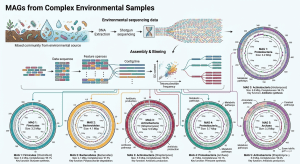

Metagenomics can generate powerful insights into microbial communities, from taxonomic composition to metabolic potential and genome recovery. But it is also one of the easiest omics approaches to get wrong.
Poor experimental design, inappropriate sequencing strategies, weak preprocessing, low-quality assemblies, and overconfident biological interpretation can all compromise the final results. In many cases, the biggest problems do not appear at the end of the workflow. They start much earlier, when samples are collected, metadata is incomplete, sequencing depth is insufficient, or the wrong analytical approach is chosen.
In this guide, we review some of the most common metagenomics mistakes and explain how to avoid them, whether you are working with environmental samples, host-associated microbiomes, or other complex microbial communities.
If you need help with assembly, binning, functional profiling, or project-specific metagenomics workflows, you can also explore our Metagenomics Services.
Why metagenomics projects fail more often than expected
Metagenomics workflows are challenging because they involve multiple layers of complexity at the same time:
- mixed microbial communities
- incomplete or unknown reference space
- variable sequencing depth
- contamination risks
- uneven taxonomic abundance
- computationally demanding analysis steps
- difficult biological interpretation
That means errors made at one stage can propagate through the rest of the analysis. A poor sample or weak sequencing strategy cannot be fully rescued by better downstream bioinformatics.
1. Choosing the wrong sequencing strategy
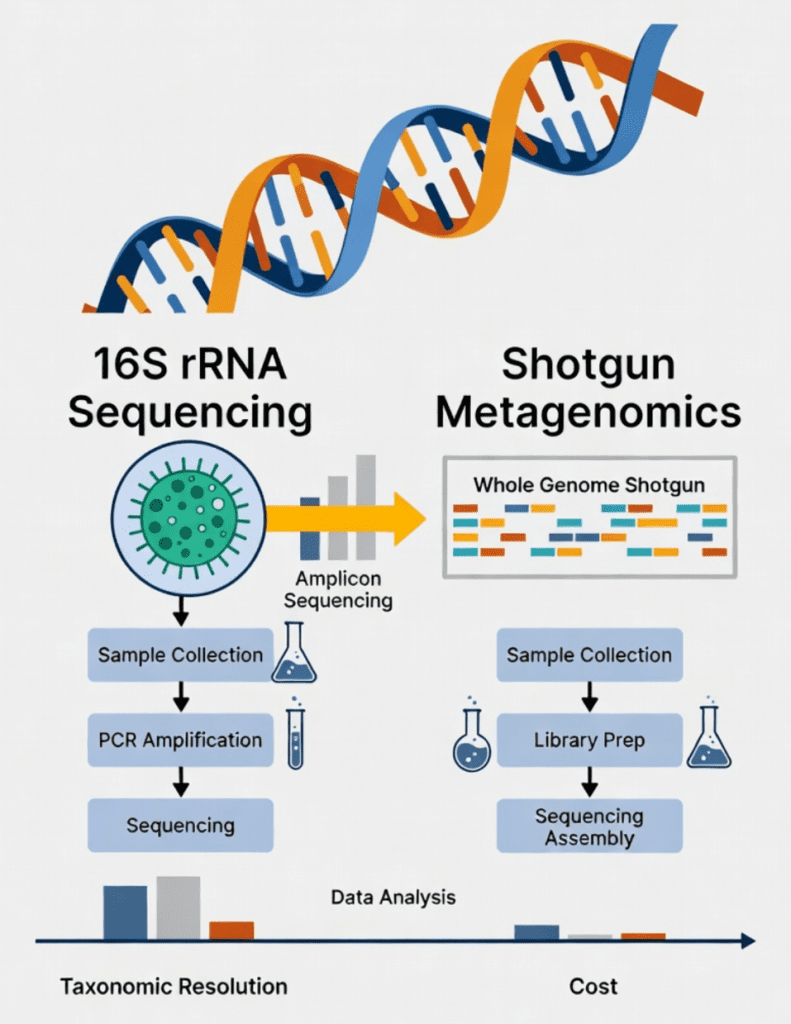
One of the most common mistakes is starting a project without being clear about whether amplicon sequencing or shotgun metagenomics is actually the right choice.
These are not interchangeable methods.
Amplicon sequencing is better when:
- the main goal is community composition
- budget is limited
- taxonomic profiling is the priority
- functional resolution is not essential
Shotgun metagenomics is better when:
- you want functional information
- you want strain-level or genome-level recovery
- you want to explore genes, pathways, and MAGs
- the biological question goes beyond taxonomic composition
A mismatch between research question and sequencing strategy can make the whole project less informative from the start.
If you are unsure which approach fits your goals, see our guide comparing shotgun metagenomics sequencing vs 16S rRNA gene sequencing.
2. Poor experimental design and weak metadata collection
Metagenomics is not only about sequencing. It is also about context.
A common mistake is collecting samples without enough metadata, replication, or a clear contrast structure. This makes interpretation weak even if the sequencing itself is good.
Common design problems
- too few biological replicates
- poorly defined treatment groups
- inconsistent sample collection protocols
- missing environmental or host metadata
- batch effects introduced during extraction or sequencing
Why this matters
Without good metadata, it becomes much harder to explain community shifts, interpret functional differences, or support statistical comparisons.
How to avoid it
- define the biological question clearly before sequencing
- standardize collection and storage conditions
- plan biological replicates in advance
- collect relevant metadata such as location, depth, pH, treatment, host status, time point, or sequencing batch
Good metagenomics starts before the reads exist.
3. Underestimating sequencing depth
Insufficient sequencing depth is a classic source of frustration in metagenomics.
If coverage is too shallow, you may detect dominant taxa but fail to recover low-abundance organisms, assemble contigs properly, or reconstruct metagenome-assembled genomes.
Consequences of low depth
- incomplete community representation
- poor assembly contiguity
- reduced sensitivity for rare taxa
- weak MAG recovery
- unstable functional profiles
How to avoid it
- align sequencing depth with project goals
- plan more depth for complex communities
- remember that assembly and binning usually require more sequencing than simple taxonomic profiling
- avoid assuming that a fixed number of reads is always enough across all sample types
The “right” sequencing depth depends on community complexity, host contamination, and your downstream objectives.
4. Ignoring host contamination
Host contamination is especially important in host-associated metagenomics, including gut, skin, clinical, and other host-derived samples.
A large fraction of host reads can reduce the effective sequencing depth available for microbial analysis and distort downstream results.
Common consequences
- lower microbial read proportion
- worse assemblies
- poorer taxonomic profiling
- more difficult functional interpretation
- wasted sequencing budget
How to avoid it
- include host depletion or enrichment strategies when appropriate
- remove host reads during preprocessing
- evaluate how much of the dataset is actually microbial before moving to assembly or profiling
Ignoring host contamination can make a dataset look much better on paper than it really is.
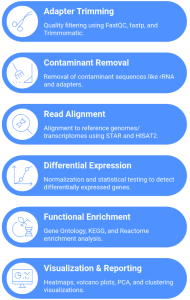
5. Skipping proper quality control and preprocessing
Some projects move too quickly from raw reads to profiling or assembly without a proper QC step.
That is a mistake.
Low-quality bases, adapters, duplicate artifacts, and contamination can all reduce downstream performance.
Basic preprocessing should usually include
- raw read quality assessment
- adapter trimming
- low-quality read filtering
- contaminant review
- optional host read removal
- re-checking QC after filtering
Why this matters
Good preprocessing improves:
- taxonomic assignment
- assembly quality
- binning performance
- confidence in downstream interpretation
This is one of the simplest stages to do correctly, and one of the most important.
6. Overinterpreting taxonomic profiling
Taxonomic profiles are useful, but they do not answer every biological question.
A common mistake is treating relative abundance plots as if they directly explain mechanism, phenotype, or ecosystem function.
Common overinterpretations
- assuming that presence means activity
- treating taxonomic shifts as causal without further evidence
- drawing functional conclusions from taxonomy alone
- ignoring compositionality issues
How to avoid it
- interpret taxonomic results carefully
- distinguish between presence, abundance, and activity
- combine taxonomy with functional analysis where possible
- avoid causal claims unless the study design supports them
Metagenomics can suggest biological hypotheses, but it does not automatically prove them.
7. Expecting perfect assemblies from very complex communities
Assembly is often one of the most demanding parts of metagenomics.
A common mistake is expecting high-quality, genome-like assemblies from samples that are extremely complex, low-depth, or heavily contaminated.
Why assembly fails
- uneven abundance across organisms
- repeated genomic regions
- insufficient coverage
- short-read fragmentation
- very high community complexity
How to avoid it
- set realistic expectations based on sample type
- compare assembly metrics across samples
- use appropriate assemblers and QC workflows
- understand that some samples are better suited for profiling than genome recovery
If assembly is central to the project, the experimental design and sequencing depth need to support that goal from the start.
For a broader workflow overview, see our guide to the metagenome assembly pipeline: from raw reads to MAGs.
8. Trusting binned genomes too easily
MAG recovery is powerful, but it is easy to become overconfident in bins that are incomplete, contaminated, or taxonomically ambiguous.
A common mistake is to treat every bin as if it were a clean genome.
Problems that can affect MAGs
- contamination
- chimeric bins
- incompleteness
- strain heterogeneity
- misleading functional inference
How to avoid it
- evaluate completeness and contamination carefully
- compare binning outputs critically
- use quality-control tools rather than trusting raw binning alone
- interpret low-quality MAGs cautiously
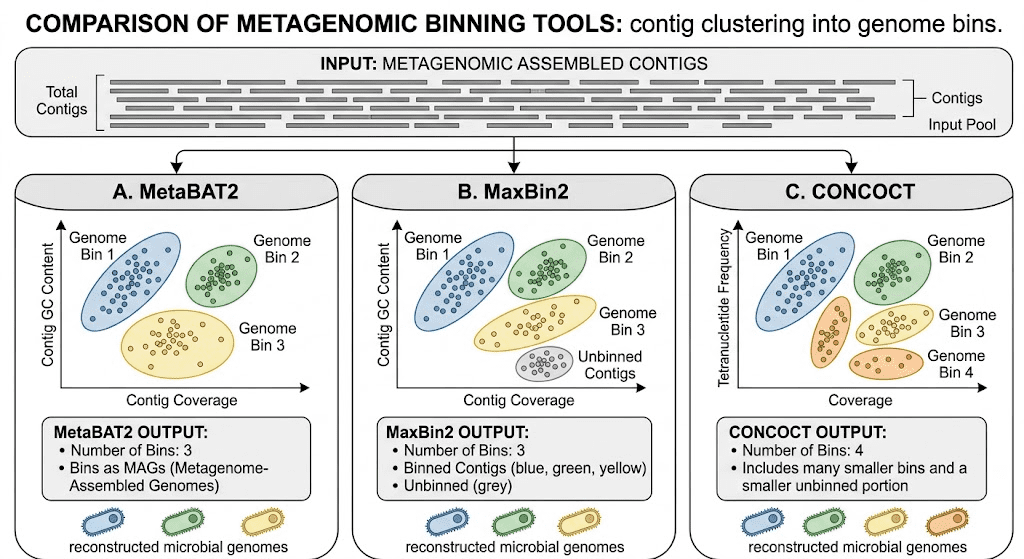
Different binning tools can behave quite differently depending on the sample.
For a practical comparison, see our post on metagenomic binning tools compared.
9. Using the wrong reference database or annotation strategy
Taxonomic and functional conclusions depend heavily on the database and annotation workflow used.
A common mistake is to treat all databases as interchangeable or assume that every annotation is equally robust.
Why this matters
Different tools and databases vary in:
- taxonomic scope
- curation quality
- update frequency
- naming conventions
- functional specificity
How to avoid it
- choose annotation databases appropriate for the project
- report which database and version were used
- avoid overclaiming based on weak annotations
- remember that “predicted function” is not the same as experimentally validated function
Database choice is part of the biological interpretation, not just a technical detail.
10. Ignoring compositionality and statistical limitations
Many metagenomics datasets are compositional by nature. That means abundance values are relative, not absolute.
A common mistake is applying inappropriate statistics or interpreting abundance changes as if they were direct absolute shifts.
Common problems
- inappropriate statistical testing
- no multiple-testing correction
- overinterpretation of marginal differences
- failure to account for compositional structure
- weak handling of metadata and confounders
How to avoid it
- use methods suited to the data type
- include metadata in the analysis where relevant
- correct for multiple testing
- interpret significance in biological context, not only statistical terms
Good metagenomics analysis requires both computational and statistical discipline.
11. Treating metagenomics as if it directly measures activity
This is one of the most important conceptual mistakes.
Metagenomics tells you what genes are present in the community. It does not directly tell you which genes are actively expressed at the time of sampling.
Why this matters
A pathway detected in metagenomic data may be:
- present but inactive
- active only in part of the community
- condition-dependent
- incompletely recovered
How to avoid it
- interpret metagenomics as functional potential, not direct activity
- use metatranscriptomics, proteomics, metabolomics, or targeted assays when activity matters
- avoid conflating potential with expression
This is especially important in papers and reports, where wording can easily become too strong.
12. Failing to define the final biological question
Some metagenomics projects produce a large amount of output but still fail at the interpretation stage because the original biological question was too vague.
Examples:
- “What microbes are there?” with no contrast or context
- “What functions are present?” without defining the biological relevance
- “Can we recover MAGs?” without a downstream purpose
How to avoid it
Ask early:
- what is the main biological question?
- what level of resolution do we need?
- do we need taxonomy, function, MAGs, or all three?
- how will the outputs be interpreted?
A metagenomics workflow should be designed backward from the biological question, not forward from the software.
A practical metagenomics checklist
Before starting analysis, ask:
Experimental design
- Do I have enough biological replication?
- Are sample groups clearly defined?
- Is metadata complete and usable?
Sequencing strategy
- Is shotgun metagenomics actually necessary?
- Would amplicon sequencing answer the question more efficiently?
- Is sequencing depth aligned with project goals?
Preprocessing
- Have I checked quality properly?
- Did I remove adapters and low-quality reads?
- Did I assess contamination and host reads?
Analysis
- Is the assembly quality good enough for binning?
- Are the annotation databases appropriate?
- Are the statistical methods appropriate for the data?
Interpretation
- Am I distinguishing taxonomic presence from functional activity?
- Am I making conclusions that the data type really supports?
That checklist alone can prevent many avoidable mistakes.
Final thoughts
Most metagenomics mistakes are not caused by one catastrophic failure. They come from small decisions made too early, too quickly, or without enough biological context.
Common problems include:
- choosing the wrong sequencing strategy
- weak experimental design
- insufficient sequencing depth
- poor preprocessing
- overconfident assembly or bin interpretation
- inappropriate statistical analysis
- confusing functional potential with real activity
The good news is that most of these problems can be reduced or avoided with better planning, better QC, and a workflow tailored to the actual research question.
If you need help with metagenomics project design, assembly, binning, taxonomic profiling, functional annotation, or downstream interpretation, explore our Metagenomics Services or contact us for a project-specific consultation.
Related reading
- Metagenome Assembly Pipeline: From Raw Reads to MAGs
- Metagenomic Binning Tools Compared: MetaBAT2 vs MaxBin2 vs CONCOCT
- Shotgun Metagenomics Sequencing vs 16S rRNA Gene Sequencing
- Metagenomics Services