Taxonomic profiling is one of the most common tasks in shotgun metagenomics.
After sequencing a microbiome or environmental sample, one of the first questions is usually simple:
Which organisms are present, and in what relative abundance?
To answer that question, many researchers use tools such as Kraken2, Kaiju, or MetaPhlAn. All three are widely used for metagenomic taxonomic profiling, but they do not work in the same way and they do not always answer the same question with the same assumptions.
This matters because different tools can produce different taxonomic profiles from the same dataset.
A sample may look more diverse with one method, more conservative with another, or show different species-level assignments depending on the database, classification strategy, and filtering thresholds.
In this article, we compare Kraken2, Kaiju, and MetaPhlAn, explain how they work, and discuss when each tool is most useful.
For a broader overview of shotgun metagenomics analysis, see our guide: Metagenome Assembly Pipeline: From Raw Reads to MAGs.
What is taxonomic profiling in shotgun metagenomics?
Taxonomic profiling is the process of estimating which organisms are present in a sequencing sample.
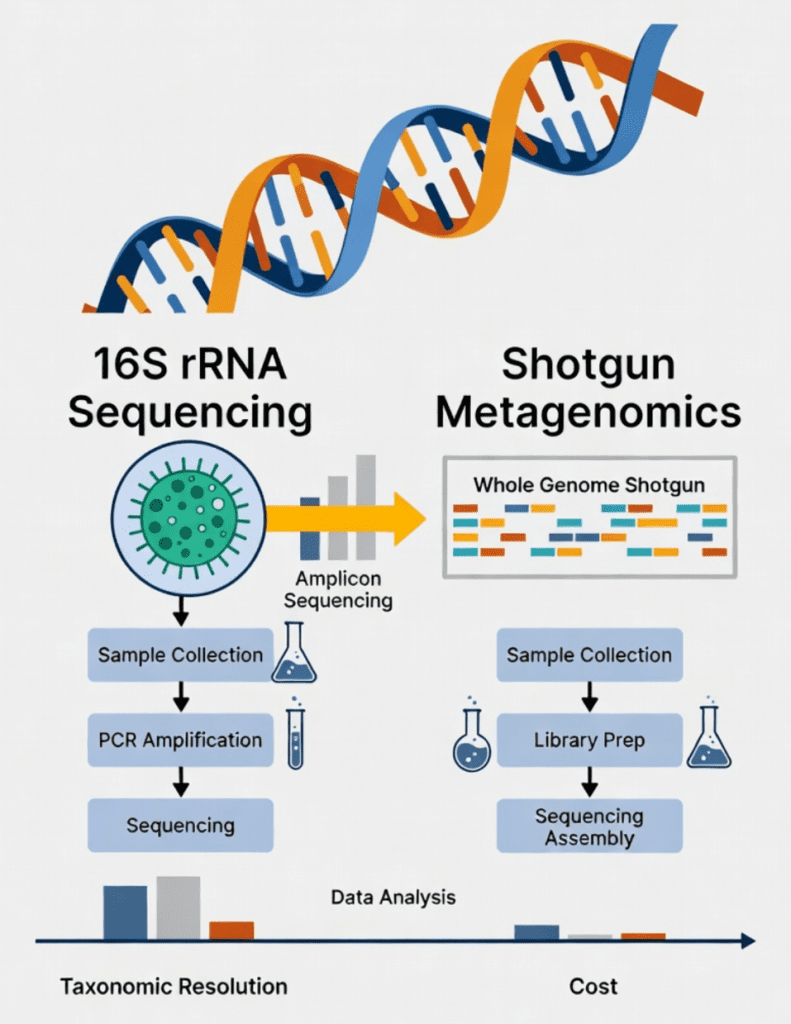
In shotgun metagenomics, DNA from the whole microbial community is sequenced. Unlike 16S rRNA gene sequencing, shotgun sequencing captures reads from across microbial genomes, not only one marker gene.
This means shotgun metagenomics can potentially provide information about:
- bacteria;
- archaea;
- viruses;
- fungi and other microbial eukaryotes;
- strain-level variation;
- genes and pathways;
- antimicrobial resistance genes;
- metabolic potential;
- genome reconstruction.
However, the first step is often taxonomic profiling: assigning sequencing reads, marker genes, or genomic signatures to known taxa.
The goal may be to estimate relative abundance at different taxonomic levels, such as:
- phylum;
- class;
- order;
- family;
- genus;
- species;
- strain or species-level genome bin.
Taxonomic profiling is commonly used in microbiome studies, environmental metagenomics, host-associated microbiomes, clinical microbiology, food microbiology, wastewater surveillance, and microbial ecology.
Taxonomic profiling is not the same as metagenome assembly
Taxonomic profiling and metagenome assembly are related, but they are not the same.
Taxonomic profiling asks:
Which organisms are present?
Metagenome assembly asks:
Can we reconstruct longer genomic sequences from the reads?
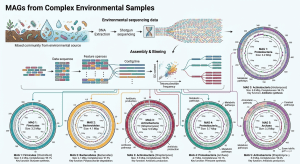
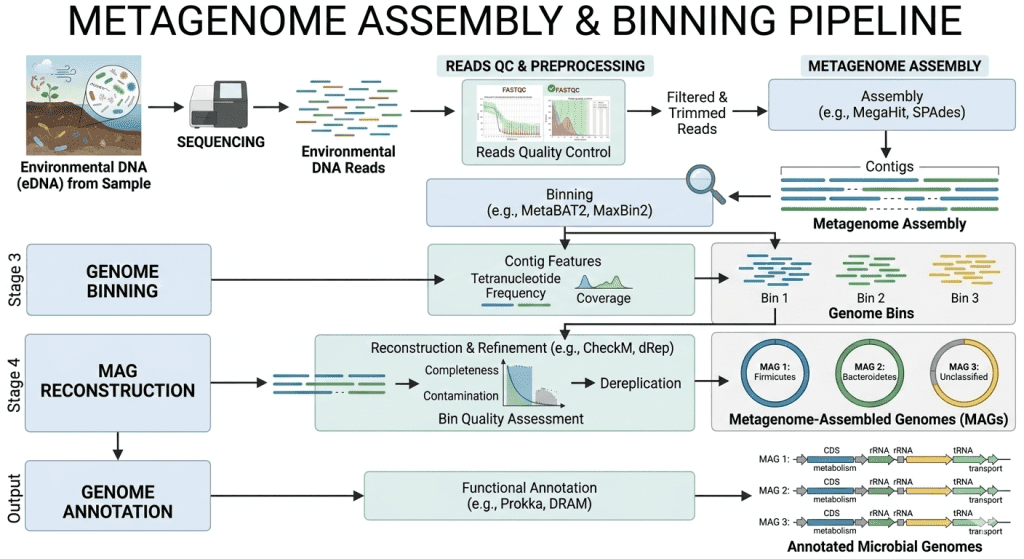
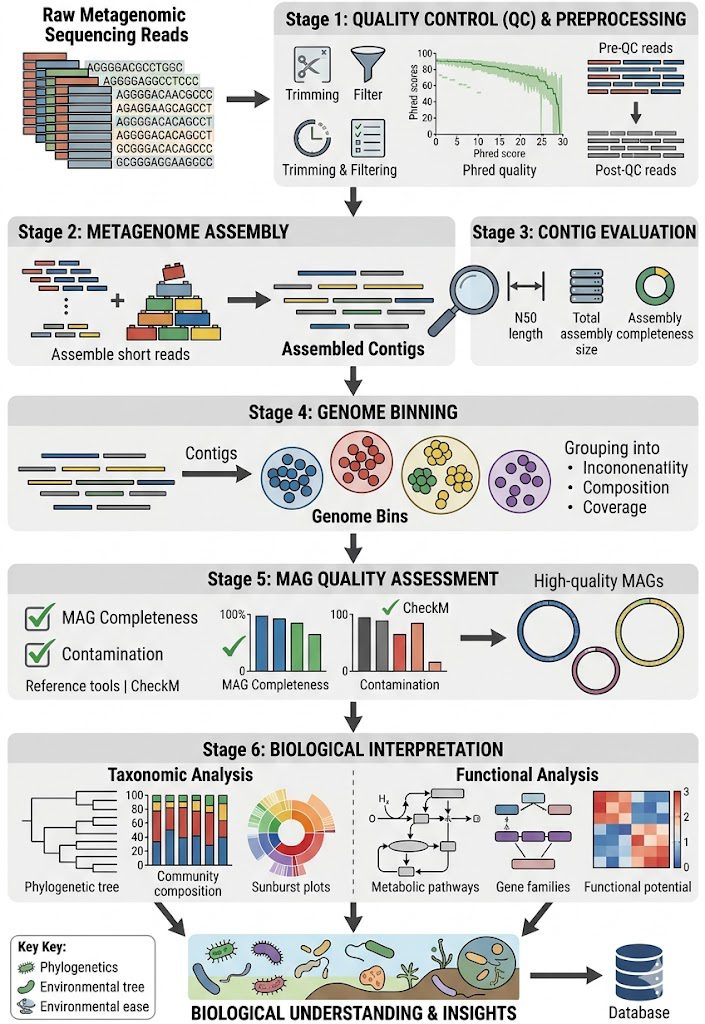
Assembly-based analysis may produce contigs and metagenome-assembled genomes, or MAGs. Taxonomic profiling can be done directly from reads without assembling them.
This distinction is important.
Read-based taxonomic profiling is often faster and simpler than assembly. It is useful when the main objective is to compare microbial community composition across samples.
Assembly is more useful when the objective is to recover genomes, annotate genes, reconstruct pathways, study mobile elements, or investigate functional potential in more detail.
In many projects, both approaches are useful:
- taxonomic profiling gives a quick community overview;
- assembly and binning provide deeper genome-resolved information.
If you are deciding between marker-gene sequencing and shotgun sequencing, see: Shotgun Metagenomics Sequencing vs 16S rRNA Gene Sequencing.
Kraken2: fast k-mer-based taxonomic classification
Kraken2 is one of the most widely used tools for metagenomic taxonomic classification.
It uses a k-mer-based approach. In simplified terms, sequencing reads are broken into short sequence words, and those words are compared against a reference database. Kraken2 assigns reads taxonomically using a lowest common ancestor approach when a sequence pattern is shared by multiple taxa.
Kraken2 is popular because it is:
- very fast;
- suitable for large datasets;
- able to classify many reads;
- flexible with custom databases;
- useful for broad taxonomic surveys;
- commonly paired with Bracken for abundance estimation.
Kraken2 can be especially useful when you want a fast overview of which organisms may be present in a shotgun metagenomics dataset.
Strengths of Kraken2
The main strength of Kraken2 is speed.
For large metagenomic datasets, this can matter a lot. If you have dozens or hundreds of samples, a fast read classifier can make the difference between a practical workflow and an analysis that becomes computationally painful.
Kraken2 is also useful when broad classification is important. It attempts to classify reads across the database, rather than focusing only on a limited marker-gene set.
This can make Kraken2 attractive for:
- environmental metagenomics;
- microbiome screening;
- contamination checks;
- exploratory taxonomic profiling;
- large sample batches;
- projects where speed is important;
- workflows using customized reference databases.
Limitations of Kraken2
Kraken2 is highly dependent on the reference database.
If the database contains many closely related genomes, contaminated assemblies, mislabeled genomes, or uneven representation across taxa, the results can be affected.
Common limitations include:
- false positives if filtering is too permissive;
- overclassification in complex datasets;
- sensitivity to database composition;
- difficulty with poorly represented organisms;
- ambiguity between closely related species;
- need for abundance correction or post-processing.
For this reason, Kraken2 results are often interpreted together with filtering thresholds, confidence settings, Bracken abundance estimation, and biological context.
A Kraken2 result should not be treated as a final truth simply because it assigns many reads.
Kaiju: protein-level classification for sensitive detection
Kaiju is also used for taxonomic classification of metagenomic reads, but its strategy is different from Kraken2.
Instead of comparing reads directly at the nucleotide level, Kaiju translates reads and compares them against protein databases.
This protein-level approach can increase sensitivity when nucleotide sequences are divergent but encoded proteins remain conserved.
That makes Kaiju useful in datasets where organisms may be more distant from available reference genomes, such as some environmental metagenomes.
Strengths of Kaiju
Kaiju can be useful when nucleotide-level tools miss too many reads because the organisms are not closely represented in the database.
Protein sequences evolve more slowly than DNA sequences in many cases, so protein-level classification can sometimes detect more distant relationships.
Kaiju may be especially useful for:
- environmental metagenomics;
- samples with poorly characterized organisms;
- viral or microbial diversity screening;
- metatranscriptomic datasets;
- functional or protein-aware taxonomic exploration;
- cases where nucleotide classifiers leave many reads unclassified.
Kaiju can therefore complement nucleotide-based methods.
If Kraken2 gives a very low classification rate in a complex environmental sample, Kaiju may provide an alternative view of the community.
Limitations of Kaiju
Kaiju is not automatically better than Kraken2.
Protein-level classification has its own limitations.
Potential issues include:
- dependence on protein database quality;
- reduced resolution for some closely related taxa;
- ambiguity among conserved proteins;
- database bias toward well-characterized organisms;
- less direct interpretation of nucleotide-level variation;
- possible differences between taxonomic assignment and abundance estimation.
Kaiju can be sensitive, but sensitivity alone is not always the goal.
For some studies, especially those requiring conservative species-level relative abundance estimates, a marker-based approach such as MetaPhlAn may be more appropriate.
MetaPhlAn: marker-gene-based community profiling
MetaPhlAn takes a different approach from Kraken2 and Kaiju.
Instead of attempting to classify all reads, MetaPhlAn profiles microbial communities using clade-specific marker genes.
The idea is to identify marker genes that are specific to particular microbial clades and use those markers to estimate taxonomic composition.
MetaPhlAn is commonly used in microbiome studies because it provides relatively conservative and standardized community profiles.
Strengths of MetaPhlAn
MetaPhlAn is especially useful when the goal is robust relative abundance profiling across samples.
Because it focuses on clade-specific marker genes rather than all reads, it can reduce some types of false positives and avoid overinterpreting reads from conserved or ambiguous genomic regions.
MetaPhlAn is often well suited for:
- human microbiome studies;
- host-associated microbiomes;
- comparative microbiome profiling;
- species-level relative abundance estimation;
- large cohorts;
- reproducible community composition analysis;
- projects where conservative taxonomic profiles are preferred.
MetaPhlAn 4 expanded its profiling framework by incorporating information from both reference genomes and metagenome-assembled genomes, improving coverage of species-level genome bins compared with earlier approaches.
Limitations of MetaPhlAn
MetaPhlAn does not classify every read.
This is a strength in some contexts, but a limitation in others.
Because MetaPhlAn relies on marker genes, it may be less suitable when you want:
- read-level classification of as many reads as possible;
- broad exploratory detection of unexpected organisms;
- custom database classification;
- detailed classification of non-marker genomic regions;
- detection of genes, pathways, plasmids, or mobile elements.
MetaPhlAn is mainly a taxonomic profiling tool. It is not a complete functional metagenomics pipeline and it does not replace assembly, binning, or gene annotation.
If your question is “which organisms are present and how abundant are they?”, MetaPhlAn may be a strong choice.
If your question is “what genes, pathways, or genomes can I recover?”, you need additional analysis.
Kraken2 vs Kaiju vs MetaPhlAn: main differences
The most important difference between these tools is the type of signal they use.
Kraken2 uses nucleotide k-mers.
Kaiju uses translated protein-level matches.
MetaPhlAn uses clade-specific marker genes.
That difference affects speed, sensitivity, specificity, database dependence, and interpretation.
| Feature | Kraken2 | Kaiju | MetaPhlAn |
|---|---|---|---|
| Main strategy | Nucleotide k-mer classification | Protein-level classification | Clade-specific marker profiling |
| Input | Shotgun reads | Shotgun or metatranscriptomic reads | Shotgun reads |
| Main strength | Very fast broad classification | Sensitive detection of divergent organisms | Conservative relative abundance profiling |
| Common use | Fast taxonomic screening | Environmental or divergent samples | Microbiome composition studies |
| Classifies all reads? | Attempts broad read classification | Attempts broad read classification | No, mainly marker-associated reads |
| Database dependence | High | High | High, but marker-based |
| Species-level profiling | Possible, database-dependent | Possible, but may vary | Strong use case |
| Functional analysis | No | No | No |
| Best paired with | Bracken, Krona, downstream filtering | Kaiju tools, Krona, comparison workflows | HUMAnN, compositional/statistical analysis |
No tool is universally best.
The right choice depends on the biological question, sample type, database, computational resources, and downstream analysis.
Which tool should you choose?
Use Kraken2 when speed and broad classification matter
Kraken2 is often a good first choice when you want fast taxonomic classification across many shotgun metagenomic samples.
It is useful for:
- rapid exploratory profiling;
- checking unexpected organisms;
- large datasets;
- environmental metagenomes;
- contamination screening;
- workflows requiring custom databases;
- projects where read-level classification is useful.
However, Kraken2 results should usually be filtered and interpreted carefully, especially at species level.
For abundance estimation, Kraken2 is often paired with Bracken.
Use Kaiju when organisms may be distant from reference genomes
Kaiju is useful when protein-level sensitivity may help classify reads that nucleotide-based methods miss.
It can be especially useful for:
- environmental samples;
- poorly characterized microbial communities;
- viral/metagenomic exploration;
- metatranscriptomics;
- cases with low Kraken2 classification rates;
- studies where protein-level conservation may improve detection.
Kaiju can be a good complementary method rather than a direct replacement for Kraken2.
If Kraken2 and Kaiju agree on the major taxa, confidence increases. If they disagree strongly, the dataset may need deeper inspection.
Use MetaPhlAn when conservative relative abundance profiling is the goal
MetaPhlAn is often a strong choice for microbiome community profiling, especially when comparing relative taxonomic composition across many samples.
It is useful for:
- host-associated microbiomes;
- human gut microbiome studies;
- cohort comparisons;
- species-level relative abundance profiling;
- compositional analysis;
- reproducible microbiome studies.
MetaPhlAn is less appropriate if your main goal is to classify every possible read or explore all non-marker genomic content.
Can you use more than one taxonomic profiler?
Yes. In many projects, using more than one profiler is useful.
Different tools answer related but slightly different questions.
For example:
- Kraken2 may give a broad classification of many reads;
- Kaiju may improve detection of divergent organisms;
- MetaPhlAn may provide a more conservative species-level abundance profile.
Comparing tools can reveal whether the major biological signal is robust.
If the same dominant taxa appear across methods, the result is more convincing.
If the tools strongly disagree, possible explanations include:
- database differences;
- poor reference representation;
- contamination;
- host DNA;
- low-quality reads;
- compositional artifacts;
- closely related species;
- ambiguous conserved sequences;
- unexpected sample complexity.
Disagreement between profilers is not necessarily a failure. It can be a warning that the sample or the interpretation requires more careful analysis.
Common mistakes when comparing taxonomic profilers
1. Treating tool outputs as directly equivalent
Kraken2, Kaiju, and MetaPhlAn do not produce exactly the same type of evidence.
Kraken2 and Kaiju classify reads more broadly, while MetaPhlAn estimates abundance from marker genes.
Comparing their raw outputs directly can be misleading.
2. Ignoring database versions
Taxonomic profiling depends heavily on database version.
If two analyses use different database releases, the results may differ even if the same tool is used.
Always record:
- tool version;
- database version;
- database source;
- filtering settings;
- classification thresholds;
- abundance estimation method.
3. Overinterpreting species-level calls
Species-level classification is difficult, especially for closely related bacteria, incomplete references, strain-rich communities, and conserved genomic regions.
Species-level calls should be interpreted with caution unless supported by strong evidence.
4. Forgetting host contamination
In host-associated samples, host DNA can dominate the sequencing dataset.
If host reads are not removed or accounted for, microbial profiling may be less efficient and less informative.
5. Using taxonomic profiles as if they were absolute abundance
Most shotgun taxonomic profiling results are relative, not absolute.
An apparent increase in one taxon may reflect a decrease in another taxon rather than a true absolute increase.
This matters when interpreting microbiome shifts between conditions.
When taxonomic profiling is not enough
Taxonomic profiling is useful, but it does not answer every metagenomics question.
It can tell you which organisms are likely present, but it may not tell you:
- which genes are present;
- which pathways are complete;
- whether genes are expressed;
- whether genomes can be reconstructed;
- whether plasmids or mobile elements are present;
- whether specific enzymes or resistance genes exist;
- whether metabolic potential differs between samples.
For those questions, you may need additional analysis, such as:
- functional profiling;
- gene prediction;
- pathway annotation;
- metagenome assembly;
- binning;
- MAG quality assessment;
- comparative genomics;
- antimicrobial resistance gene screening.
This is especially important in microbial ecology and applied microbiology, where the main biological question is often not only “who is there?”, but “what can they do?”
If your goal is genome-resolved metagenomics, see: Why Is My Metagenome Assembly So Fragmented? Common Causes and Fixes.
Practical recommendations
For many shotgun metagenomics projects, a reasonable strategy is:
- Start with read quality control.
- Remove host reads when relevant.
- Run one primary taxonomic profiler.
- Optionally run a second profiler for comparison.
- Inspect classification rates and dominant taxa.
- Check whether results make biological sense.
- Avoid overinterpreting low-abundance species.
- Record tool and database versions.
- Use assembly or functional profiling if taxonomy alone is insufficient.
- Interpret results in relation to the biological question.
A simple rule of thumb:
- Use Kraken2 for fast broad screening.
- Use Kaiju when sensitivity to divergent organisms may matter.
- Use MetaPhlAn for conservative species-level microbiome profiling.
- Use more than one tool when the result is important or unexpected.
Which tool is best for microbiome studies?
For many microbiome composition studies, MetaPhlAn is a strong choice because it is designed for community profiling and relative abundance estimation using clade-specific markers.
However, Kraken2 and Kaiju can still be useful, especially when you want broader read classification, custom databases, or complementary evidence.
For example, in a gut microbiome study, MetaPhlAn may provide clean species-level profiles for downstream ecological and statistical analysis.
In an environmental metagenome, Kraken2 or Kaiju may recover a broader view of taxonomic diversity, especially if the community includes organisms that are not well represented in marker databases.
There is no single best tool for all microbiome projects.
The best choice depends on:
- sample type;
- expected diversity;
- sequencing depth;
- reference database coverage;
- need for species-level resolution;
- need for speed;
- downstream statistical analysis;
- whether functional analysis is also required.
For studies focused on community composition, diversity metrics, and comparative microbiome analysis, Tailoredomics offers microbiome data analysis services adapted to each project’s design.
Which tool is best for environmental metagenomics?
Environmental metagenomes are often more complex than host-associated microbiomes.
They may contain:
- many low-abundance organisms;
- poorly characterized taxa;
- novel species;
- viruses;
- plasmids;
- strain variation;
- uneven genome coverage.
In these cases, Kraken2 and Kaiju can be useful for broad exploratory profiling.
Kaiju may be particularly useful when protein-level similarity helps detect organisms that are distant from nucleotide references.
However, environmental samples also benefit from assembly-based analysis when the objective is to recover genomes, genes, or pathways.
For example, taxonomic profiling may tell you that certain groups are present, but metagenome assembly and binning may be needed to reconstruct MAGs and understand metabolic potential.
For this type of project, Tailoredomics provides metagenomics analysis services including quality control, taxonomic profiling, assembly, binning, functional annotation, and biological interpretation.
Summary: Kraken2 vs Kaiju vs MetaPhlAn
Kraken2, Kaiju, and MetaPhlAn are all useful tools for shotgun metagenomics taxonomic profiling, but they are not interchangeable.
Kraken2 is fast and useful for broad k-mer-based read classification.
Kaiju uses protein-level classification and can be helpful when organisms are more divergent from available nucleotide references.
MetaPhlAn uses clade-specific marker genes and is especially useful for conservative relative abundance profiling in microbiome studies.
The best tool depends on the question.
If you need a quick broad screen, Kraken2 is often a practical choice.
If you are working with poorly characterized environmental samples, Kaiju may add sensitivity.
If you need standardized species-level microbiome profiles across samples, MetaPhlAn is often appropriate.
For important projects, comparing more than one approach can provide a more reliable interpretation than relying blindly on a single output table.
FAQ
What is the difference between Kraken2 and MetaPhlAn?
Kraken2 classifies reads using nucleotide k-mers and a reference database, while MetaPhlAn estimates community composition using clade-specific marker genes. Kraken2 attempts broad read classification, whereas MetaPhlAn focuses on marker-based relative abundance profiling.
Is Kaiju better than Kraken2?
Kaiju is not universally better than Kraken2. Kaiju uses protein-level classification, which can improve sensitivity for divergent organisms, especially in some environmental samples. Kraken2 is usually very fast and useful for broad nucleotide-level classification. The better choice depends on the dataset and research question.
Which taxonomic profiler should I use for shotgun metagenomics?
For fast broad screening, Kraken2 is often a practical choice. For divergent or poorly characterized samples, Kaiju may be useful. For conservative species-level microbiome profiling, MetaPhlAn is often appropriate. In important projects, using more than one profiler can be informative.
Can Kraken2, Kaiju and MetaPhlAn give different results?
Yes. They use different classification strategies and databases, so they can produce different taxonomic profiles from the same dataset. Differences should be interpreted carefully rather than assuming one output is automatically correct.
Do taxonomic profilers detect functional genes?
Not directly. Taxonomic profilers estimate which organisms are present. To study genes, pathways, antimicrobial resistance, enzymes, or metabolic potential, you usually need functional profiling, assembly, gene prediction, or annotation workflows.
Is taxonomic profiling enough for metagenomics?
It depends on the objective. Taxonomic profiling may be enough for community composition studies, but it is not enough if the goal is MAG reconstruction, gene annotation, pathway analysis, plasmid detection, or genome-resolved metagenomics.