Introduction – What is Metagenomics?
Metagenomics is the study of genetic material (DNA or RNA) recovered directly from environmental or clinical samples. Unlike traditional microbiology, which relies on culturing individual species, metagenomics allows scientists to analyze entire microbial communities — including bacteria, archaea, fungi, and viruses — in their natural environments.
By combining high-throughput sequencing and bioinformatics, metagenomics reveals who is present in a sample and what they can do. This approach has revolutionized microbiology, enabling discoveries in ecology, human health, and biotechnology.
In this article, we explain what metagenomics is, the difference between amplicon and shotgun metagenomics, outline the typical workflow, and highlight how Tailoredomics supports metagenomic sequencing and data analysis. And if you need support on your metagenomics project, you can always check our metagenomics services page. Don’t hesitate to contact us!

Amplicon (Marker-Gene) vs Shotgun Metagenomics
There are two main types of metagenomic sequencing approaches:
1. Amplicon (16S/ITS) sequencing
- Targets a specific genetic marker (16S rRNA gene for bacteria/archaea or ITS for fungi).
- Cost-effective and widely used for microbiome profiling.
- Provides taxonomic information (who is there) but limited insight into functional potential.
- Ideal for large-scale surveys, diagnostics, or basic community composition studies.
2. Shotgun metagenomic sequencing
- Sequences all DNA present in a sample, not just a marker gene.
- Allows both taxonomic and functional profiling, assembly of microbial genomes, and detection of rare species.
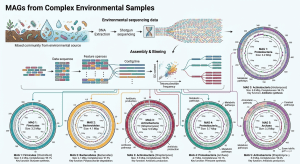
- Enables recovery of Metagenome-Assembled Genomes (MAGs) for in-depth exploration of metabolism and evolution.
- More expensive and computationally demanding, but provides far richer information.
In short:
Amplicon sequencing tells you who is there, while shotgun metagenomics also tells you what they are capable of. We have a special post on differences between shotgut metagenomics and 16S rRNA GEne sequencing: Shotgun Metagenomics Sequencing vs 16S rRNA Gene Sequencing
Typical Shotgun Metagenomics Workflow
A metagenomics project involves several key steps, from sample collection to data interpretation:
1. Sample Handling and DNA Extraction
High-quality DNA extraction is crucial. Samples may come from soil, water, gut, or any microbial habitat. Proper collection, preservation, and extraction methods minimize contamination and bias.
2. Sequencing
Sequencing platforms such as Illumina, Oxford Nanopore, or PacBio are used depending on project goals. Illumina is preferred for high-throughput short reads, while long-read platforms allow improved assembly and recovery of complete genomes. You can learn about these three sequencing technologies reading our dedicated post on genome sequencing technologies.
3. Quality Control and Preprocessing
Raw reads are checked and cleaned:
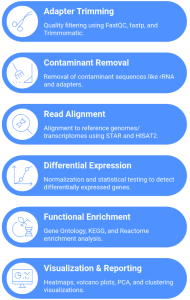
- Adapter trimming and quality filtering using fastp or Trimmomatic.
- Host read removal (e.g., human or plant DNA).
- Decontamination to ensure accurate microbial profiles.
4. Taxonomic and Functional Profiling
Two common strategies:
- Taxonomic profiling (using tools like MetaPhlAn, Kaiju, or Kraken2) identifies which species are present.
- Functional profiling (e.g., HUMAnN, eggNOG, KEGG) predicts metabolic pathways and enzyme functions.
5. Assembly and Binning
High-quality reads can be assembled into longer sequences (contigs) using assemblers such as MEGAHIT or SPAdes.
Then, binning tools like MetaBAT2 or MaxBin2 group contigs belonging to the same organism, generating Metagenome-Assembled Genomes (MAGs).
MAGs are assessed for completeness and contamination using CheckM.
6. Statistical and Comparative Analysis
Processed data are explored through:
- Alpha and beta diversity metrics to assess microbial richness and community structure.
- Differential abundance analysis to find significant taxa or pathways between conditions.
- Functional enrichment to interpret metabolic or ecological differences.
You can learn more about alpha and beta diversity on our dedicated post.
What You Can Learn from Metagenomics
Metagenomic analysis can answer diverse biological and ecological questions, including:
- Who is present? → Community composition and taxonomic profiles.
- What can they do? → Functional potential, metabolic pathways, and resistance genes.
- How do they interact? → Co-occurrence and symbiotic relationships.
- What are their genomes like? → MAGs reveal gene content, evolutionary history, and adaptation strategies.
With metagenomics, researchers can investigate microbiomes in soil, oceans, wastewater, food, and human health, providing insights that guide environmental monitoring, biotechnology, and medicine.
Use Cases and Applications
Metagenomics is now a cornerstone of microbial ecology, biotechnology, and biomedical research. Common applications include:
- Human microbiome research: profiling gut, oral, or skin microbiota and their links to health and disease.
- Environmental metagenomics: studying microbial diversity in soil, freshwater, and marine ecosystems.
- Industrial biotechnology: optimizing microbial consortia for fermentation, bioenergy, or waste treatment.
- Public health: tracking pathogens, antimicrobial resistance, or emerging viruses in metagenomic surveillance.
- Agricultural microbiology: understanding plant-microbe interactions and soil fertility.
How Tailoredomics Supports Metagenomics Projects
At Tailoredomics, we provide end-to-end support for both amplicon and shotgun metagenomics projects.
Our pipelines are designed to deliver reproducible, publication-ready results, adapted to your research goals and sequencing platform.
We can assist you with:
- Experimental design and sample preparation advice.
- Bioinformatic processing and assembly of metagenomes.
- Functional and taxonomic profiling.
- Recovery and annotation of MAGs.
- Statistical and comparative analyses.
We also provide clear reports, visual summaries, and interactive results that make it easy to interpret and publish your findings.
See our Metagenomics Services and Microbiome Profiling pages to learn more — or request a free quote to discuss your project.
Conclusion
Metagenomics has transformed microbiology, allowing scientists to move beyond cultured isolates and study microbial life in all its complexity.
Whether you are investigating microbial diversity, identifying novel enzymes, or exploring microbial ecology, metagenomic sequencing provides the tools to uncover the hidden potential of microbial communities.
With the right workflow and expertise, metagenomics becomes not just a sequencing approach — but a window into the invisible world that drives our planet’s biology.
Tailoredomics helps you every step of the way, from raw reads to insightful biological interpretation.