Introduction – What is Proteomics?
Proteomics is the large-scale study of proteins — the true molecular workhorses of life. While genomics reveals the blueprint of an organism and transcriptomics measures gene expression, proteomics provides the functional layer, showing which proteins are actually produced, how much of them exist, and how they are modified or interact in the cell.
By analyzing protein abundance, structure, and post-translational modifications, proteomics helps scientists understand how cells respond to stimuli, regulate pathways, and develop diseases. Modern proteomics services rely heavily on mass spectrometry (MS) and advanced bioinformatics tools to measure thousands of proteins simultaneously — offering deep insights into the dynamics of biological systems.
A Brief History of Proteomics
The term proteomics was first introduced in the 1990s, inspired by the success of genomics. Early proteomics experiments used two-dimensional gel electrophoresis (2-DE) to separate proteins by charge and size, followed by mass spectrometry (MS) for identification.
Over time, the field evolved rapidly with innovations like liquid chromatography-tandem mass spectrometry (LC-MS/MS) and the advent of high-resolution Orbitrap instruments, such as the Orbitrap Exploris 240 and the Orbitrap Astral Mass Spectrometer. These technologies now allow unparalleled sensitivity and resolution, detecting proteins across a vast dynamic range — from highly abundant enzymes to trace signaling molecules.
Today, proteomics extends far beyond protein identification. It quantifies abundance, reveals post-translational modifications (PTMs) like phosphorylation or acetylation, and maps protein-protein interactions to decode biological networks.
Common Proteomics Workflows
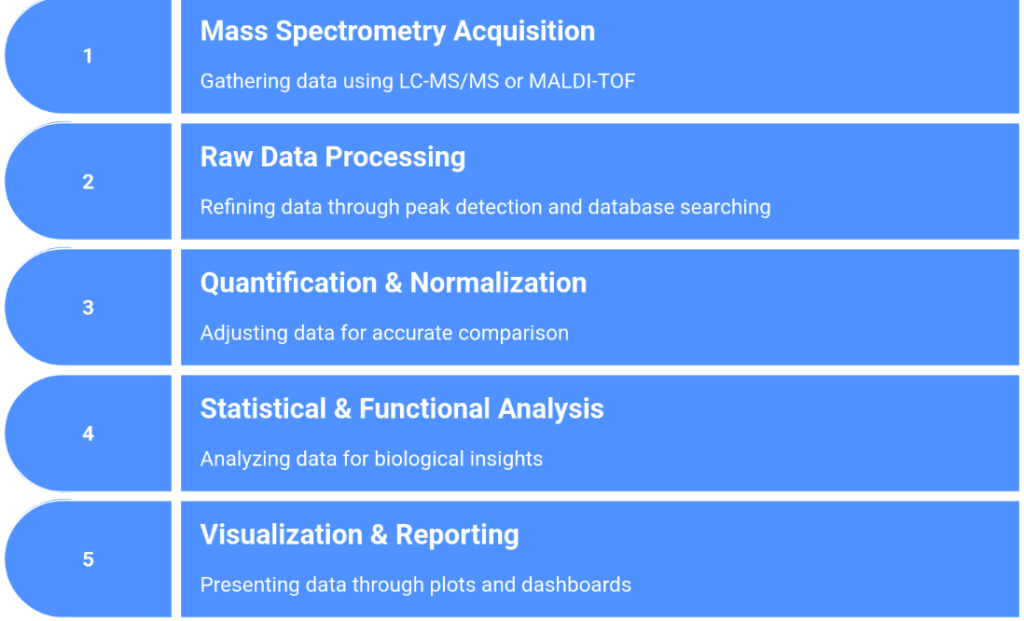
Modern proteomics analysis tools follow a systematic pipeline — from sample to biological interpretation.
1. Sample Preparation
- Protein extraction & digestion: Proteins are isolated from cells, tissues, or microbial communities, and enzymatically digested (typically with trypsin) into peptides.
- S-Trap proteomics preparation: S-Trap microcolumns or plates are now widely used for efficient, reproducible digestion and cleanup, minimizing sample loss.
- Fractionation or enrichment: Complex mixtures can be fractionated for better coverage or enriched for specific modifications (e.g., phosphopeptides).
2. Data Acquisition
- Liquid Chromatography–Mass Spectrometry (LC-MS/MS): Peptides are separated chromatographically and analyzed in a mass spectrometer.
- Instruments like the Orbitrap Exploris 240 or Orbitrap Astral Mass Spectrometer provide ultra-high resolution and mass accuracy, ideal for both discovery and targeted proteomics.
3. Raw Data Processing
- Peak detection and noise reduction extract meaningful signals from raw spectra.
- Peptide-spectrum matching is performed using tools such as MaxQuant, Proteome Discoverer, Mascot, or FragPipe.
- Advanced protein inference algorithms determine which proteins are present, ensuring accurate identification.
4. Quantification
Protein abundance can be quantified using several approaches:
- Label-free quantification (LFQ): Measures signal intensity or spectral counts across samples — cost-effective and flexible.
- Label-based quantification (TMT, iTRAQ, SILAC): Uses isotopic or isobaric tags to multiplex multiple samples with high precision.
- Targeted proteomics (PRM, SRM/MRM): Focuses on specific proteins of interest with exceptional sensitivity.
5. Downstream & Pathway Analysis
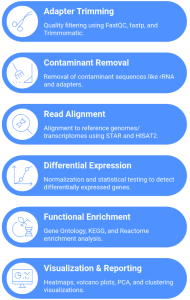
Once proteins are quantified, bioinformatic tools are applied for:
- Statistical analysis to find differentially expressed proteins.
- Proteomics pathway analysis using databases like KEGG, Reactome, or GO to uncover biological meaning.
- Network and interaction mapping to identify regulatory hubs or disease-associated modules.
Label-Free vs Label-Based Proteomics
Both approaches have distinct advantages:
Label-Free (LFQ):
- Pros: Cost-effective, scalable, compatible with any sample type.
- Cons: More variable, requires strong normalization methods.
Label-Based (TMT, iTRAQ, SILAC):
- Pros: Multiplexing up to 18 samples, excellent reproducibility, reduced batch effects.
- Cons: Costlier reagents, more complex protocols, limited multiplexing for some workflows.
Many labs combine both — using LFQ for discovery and label-based quantification for validation and precise comparisons.
Why Proteomics Complements Other Omics
While RNA tells us what could happen, proteins reveal what does happen.
Proteomics complements genomics, transcriptomics, and metabolomics by:
- Validating transcriptomics: Confirms if mRNA changes are reflected at the protein level.
- Revealing post-transcriptional regulation: Many genes have poor mRNA-protein correlation.
- Capturing modifications: Detect phosphorylation, ubiquitination, or acetylation events.
- Supporting biomarker discovery: Identifies proteins uniquely associated with diseases.
- Enabling pathway and network analysis: Shows how proteins interact in cellular signaling cascades.
Microbial and Environmental Proteomics
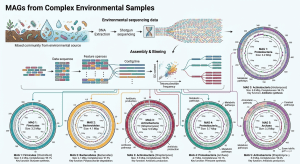
In microbiology and microbial ecology, proteomics takes a step further through metaproteomics — the study of the entire protein complement (metaproteome) from microbial communities.
Metaproteomics reveals which organisms are active and what metabolic functions they perform. For example, in soil or gut microbiome studies, metaproteomics identifies enzymes involved in carbon cycling, antibiotic resistance, or host-microbe interactions.
This layer of insight is impossible to achieve with metagenomics or metatranscriptomics alone. Wondering what metagenomics is? Check our dedicated post!
Applications of Proteomics
This technique is now a cornerstone of life sciences, with broad applications:
- Biomedical research: Uncovering biomarkers for cancer, neurodegenerative, and infectious diseases.
- Drug discovery: Identifying therapeutic targets and mechanisms of resistance.
- Microbial proteomics: Understanding metabolic strategies, virulence, and symbiosis.
- Environmental proteomics: Studying community-level protein expression in ecosystems.
- Agricultural proteomics: Improving crop resistance and monitoring plant stress.
Multi-Omics Integration
The future of biological research lies in integration. Combining proteomics, transcriptomics, metabolomics, and metagenomics gives a holistic view of biological systems — from DNA to metabolites.
At Tailoredomics, we specialize in multi-omics integration, helping researchers correlate gene expression, protein dynamics, and metabolic activity in a unified framework. If you need support with your proteomics project check our proteomics services page and contact us!

How Tailoredomics Supports Proteomics Projects
At Tailoredomics, our proteomics services transform complex datasets into clear, actionable insights. We offer:
- Experimental design consulting to ensure optimal sampling and reproducibility.
- Comprehensive proteomics analysis tools: from raw data processing to protein quantification.
- Label-free and label-based workflows, including TMT, iTRAQ, and S-Trap proteomics pipelines.
- Differential expression and proteomics pathway analysis with KEGG, Reactome, and GO integration.
- Publication-ready visualizations and detailed reports tailored to your research.
- Multi-omics integration, combining proteomics with transcriptomic or metabolomic data.
Whether you are studying human cells, microbial communities, or environmental samples, our experts help you extract biological meaning from your mass spectrometry data.