
Introduction
Microbiome studies uncover the astonishing diversity of bacteria, archaea, fungi, and viruses that inhabit every environment — from the human gut to ocean sediments. Yet, understanding how this diversity changes across conditions requires more than identifying which species are present.
That’s where alpha and beta diversity come in. These two fundamental microbiome metrics translate sequencing data into ecological insight, revealing how rich, balanced, and distinct microbial communities are within and between samples.
In this guide, we’ll explain what alpha and beta diversity mean, how they’re calculated, and how to interpret them in your microbiome research. You’ll also see how Tailoredomics applies these principles in your microbiome profiling and metagenomics projects.
1. What Are Microbiome Diversity Metrics?
Microbiome metrics are quantitative tools that summarize microbial composition and structure. After sequencing and taxonomic profiling (using pipelines like QIIME 2, DADA2, or MetaPhlAn), you obtain an abundance table where each row represents a microbial taxon and each column represents a sample.
From this data, scientists derive:
- Alpha diversity — diversity within a single sample.
- Beta diversity — diversity between samples.
Together, they describe both the internal complexity of each microbiome and how communities differ across environments, hosts, or treatments.
2. Alpha Diversity: Measuring Richness and Evenness
2.1 Definition
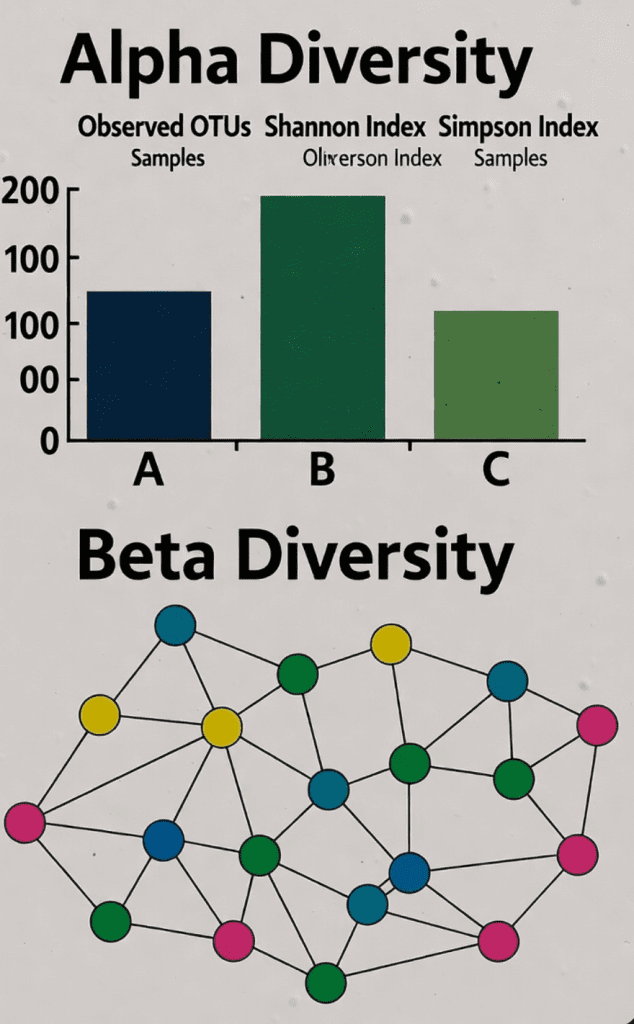
Alpha diversity reflects the diversity within a single microbial community. It combines:
- Richness — the number of taxa detected (species, OTUs, or ASVs).
- Evenness — how evenly those taxa are distributed in abundance.
A community with many equally abundant taxa shows high alpha diversity. In contrast, one dominated by a few species has lower diversity, even if many rare taxa are present.
2.2 Common Alpha Diversity Metrics
- Observed Taxa (Richness)
- Counts unique species or ASVs.
- Simple but ignores evenness.
- Chao1 Index
- Estimates true richness by accounting for rare taxa.
- Ideal when sequencing depth varies.
- Shannon Index
- Combines richness and evenness.
- Increases as community becomes more balanced.
- Sensitive to moderately abundant species.
- Simpson Index
- Emphasizes dominance by abundant species.
- Often presented as 1 – D (Simpson diversity).
- Faith’s Phylogenetic Diversity (PD)
- Considers evolutionary distances among taxa.
- Sums branch lengths in a phylogenetic tree covering observed species.
- Especially useful when taxonomy is uncertain.
2.3 How to Interpret Alpha Diversity
- High alpha diversity can indicate ecological stability, resilience, or environmental heterogeneity.
- Low alpha diversity may signal disturbance, infection, or dominance by a few resilient species.
However, context is key: in some systems (like the vaginal microbiome), lower diversity dominated by Lactobacillus is a healthy state.
2.4 Example: Gut Microbiome and Disease
In human gut microbiome studies, reduced Shannon diversity is often linked to inflammatory bowel disease (IBD). A lower diversity suggests loss of beneficial taxa and expansion of inflammation-tolerant microbes—an ecological imbalance known as dysbiosis.
3. Beta Diversity: Comparing Microbial Communities
3.1 Definition
While alpha diversity measures within-sample variation, beta diversity compares microbial communities acrross samples or groups. It answers questions like:
- How similar or different are microbial profiles across individuals or environments?
- Do treatment groups cluster separately in ordination plots?
- How does microbial structure shift with geography or health status?
3.2 Common Beta Diversity Metrics
- Bray–Curtis Dissimilarity
- Based on relative abundances.
- Ranges from 0 (identical) to 1 (completely different).
- Sensitive to dominant taxa.
- Jaccard Index
- Presence/absence-based.
- Highlights differences driven by rare taxa.
- UniFrac (Weighted and Unweighted)
- Integrates phylogenetic relationships.
- Unweighted UniFrac uses presence/absence; weighted includes abundances.
- Widely used in microbiome studies for evolutionary insight.
- Aitchison Distance
- Accounts for the compositional nature of microbiome data.
- Computed after centered log-ratio (CLR) transformation.
- Reduces artifacts from relative abundance scaling.
3.3 Visualizing Beta Diversity
Beta diversity metrics are typically visualized through ordination plots such as:
- Principal Coordinates Analysis (PCoA)
- Non-metric Multidimensional Scaling (NMDS)
- Principal Component Analysis (PCA) (for transformed data)
These plots show how samples cluster, revealing compositional patterns driven by environmental or biological factors.
3.4 Statistical Testing
To test whether clusters differ significantly between groups, researchers often use PERMANOVA (adonis in R’s vegan package) or ANOSIM, which quantify whether group membership explains variation in microbial composition.
4. Alpha and Beta Diversity Tools
A wide range of open-source tools and web platforms can compute and visualize alpha and beta diversity metrics. The choice depends on your data type (amplicon vs. metagenomic), computational experience, and visualization needs.
4.1 R-Based Tools
Phyloseq
One of the most popular R packages for microbiome analysis. It integrates taxonomic abundance tables, metadata, and phylogenetic trees, enabling easy computation of alpha and beta diversity (e.g., Shannon, Faith’s PD, Bray–Curtis, UniFrac).
It also supports ordination (PCA, PCoA, NMDS) and publication-quality visualizations.
microbiome (R package)
Complementary to Phyloseq, this package provides extensive tools for diversity, compositional transformation, and ecological analysis. It includes functions for alpha/beta diversity, core microbiome analysis, and even stability metrics.
Vegan (R package)
A general-purpose ecology toolkit widely used for diversity indices and statistical testing. It implements PERMANOVA (adonis), rarefaction, and multiple distance measures suitable for microbiome datasets.
4.2 Integrated Platforms
Mia (Microbiome Analysis in R/Bioconductor)
A modern framework that unifies workflows for microbiome data. Built on SummarizedExperiment objects, it streamlines integration with other omics data. Mia supports alpha/beta diversity computation, ordination, and statistical modeling with a modular design.
MicrobiomeAnalyst (Web Platform)
A user-friendly online interface for comprehensive microbiome data analysis. It supports both 16S and metagenomic inputs, providing interactive plots for alpha and beta diversity, differential abundance, and functional profiling—ideal for non-programmers.
QIIME 2
A widely adopted platform with plugins for alpha and beta diversity metrics (including Shannon, Faith’s PD, Bray–Curtis, UniFrac). It also supports visualization through Emperor and integrates seamlessly with downstream statistical and machine learning tools.
scikit-bio (Python Library)
For users preferring Python-based workflows, scikit-bio offers robust implementations of ecological distance metrics, ordination techniques, and phylogenetic diversity calculations.
5. Beyond Alpha and Beta Diversity: Functional Potential
While diversity metrics show who is there, they don’t reveal what microbes can do. Functional analysis bridges this gap.
5.1 Predictive Functional Profiling (Amplicon Data)
Tools like PICRUSt2, Tax4Fun, and FAPROTAX predict gene content and metabolic pathways based on 16S rRNA data. These predictions suggest potential functions—such as carbohydrate metabolism or nitrogen cycling—even without metagenomic sequencing.
5.2 Functional Annotation from Shotgun Metagenomics
When you have whole-genome metagenomic data, you can directly infer function:
- Assembly: SPAdes, MEGAHIT, or Flye
- Annotation: Prokka, eggNOG-mapper, HUMAnN3
- Pathway profiling: MetaCyc, KEGG, or GO terms
This approach provides high-resolution insights into metabolic potential, resistance genes, and pathway completeness. You can learn more about shotgun metagenomics vs 16S rRNA sequencing reading our dedicated post!
6. Practical Considerations for Reliable Diversity Analysis
To ensure accurate alpha and beta diversity results:
- Normalize sequencing depth (e.g., rarefaction, relative scaling).
- Filter contaminants and spurious taxa.
- Use compositional statistics (CLR, ALDEx2).
- Keep pipelines reproducible and transparent (QIIME 2, Phyloseq, Vegan).
Reproducibility ensures comparability across studies and research groups.
7. Applications of Alpha and Beta Diversity
Microbiome diversity metrics are used in diverse research contexts:
- Clinical microbiomics — linking gut alpha diversity to metabolic health or disease.
- Soil and agricultural microbiomes — monitoring nutrient cycles and soil fertility.
- Aquatic ecosystems — assessing pollution impact on microbial communities.
- Industrial biotechnology — optimizing fermentation and bioreactor stability.
Together, alpha and beta diversity provide the ecological foundation for interpreting shifts in microbial structure and function.
8. Tailoredomics: Alpha and Beta Diversity and Functional Insights You Can Trust
At Tailoredomics, we help researchers transform raw sequencing data into clear, reproducible insights.
Our microbiome diversity analysis services include:
- Comprehensive alpha and beta diversity profiling
- High-quality visualizations
- Integration with functional and taxonomic data
- Guidance on experimental design and interpretation
Whether you’re studying environmental microbiomes or host-associated communities, we provide tailored analyses that turn data into discovery.

9. Final Thoughts
Alpha and beta diversity are more than just numbers—they capture the ecological complexity of microbial life. By measuring richness, evenness, and compositional differences, these metrics reveal how microbial communities adapt, respond, and function in diverse environments.
From understanding gut dysbiosis to evaluating soil health, mastering these diversity measures is fundamental to microbiome research—and to unlocking the full power of microbial genomics.