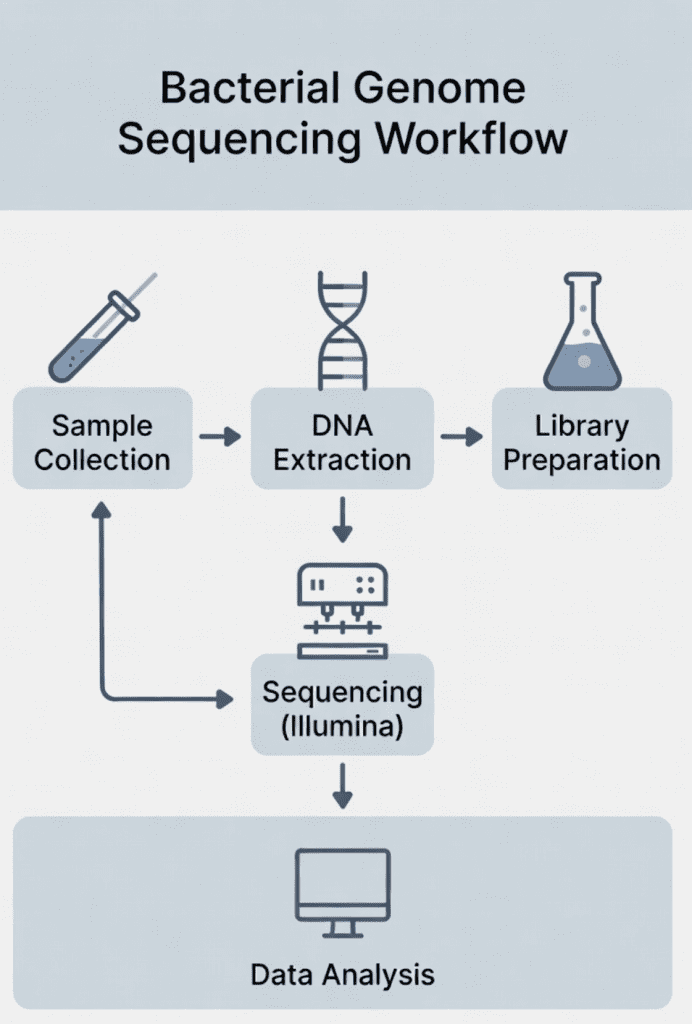
Bacterial genome sequencing has become a core tool in microbiology, biotechnology, epidemiology, and industrial research. Whether the goal is detecting antimicrobial resistance genes, understanding metabolic pathways, characterizing new species, or tracking outbreaks, the choice of sequencing technology strongly influences the quality, accuracy, and completeness of the final genome.
In this guide, we compare the three major technologies used for bacterial whole genome sequencing today — and help you decide which platform fits your project. Note: Tailoredomics provides downstream bioinformatics analysis only. We do not perform sequencing or wet-lab work. You can use any sequencing core or commercial provider and share your FASTQ, FASTA, BAM, or assembled files with us for a tailored analysis plan.
- Illumina sequencing
- Oxford Nanopore Technologies (ONT)
- PacBio SMRT & HiFi sequencing
We evaluate accuracy, read length, cost, hands-on time, assembly quality, and ideal use cases to help you choose the best platform for your bacterial sequencing project.
What Is Bacterial Genome Sequencing?
Bacterial genome sequencing (or whole genome sequencing bacteria) refers to generating the complete DNA sequence of a bacterial genome. Because most bacterial genomes are 3–6 Mbp and often contain repetitive regions, plasmids, prophages, and mobile elements, the choice of sequencing method directly affects how complete and accurate the final assembly will be.
The three dominant technologies differ mainly in:
- Read length
- Error rate
- Cost per sample
- Instrument price
- Assembly difficulty
- Turnaround time
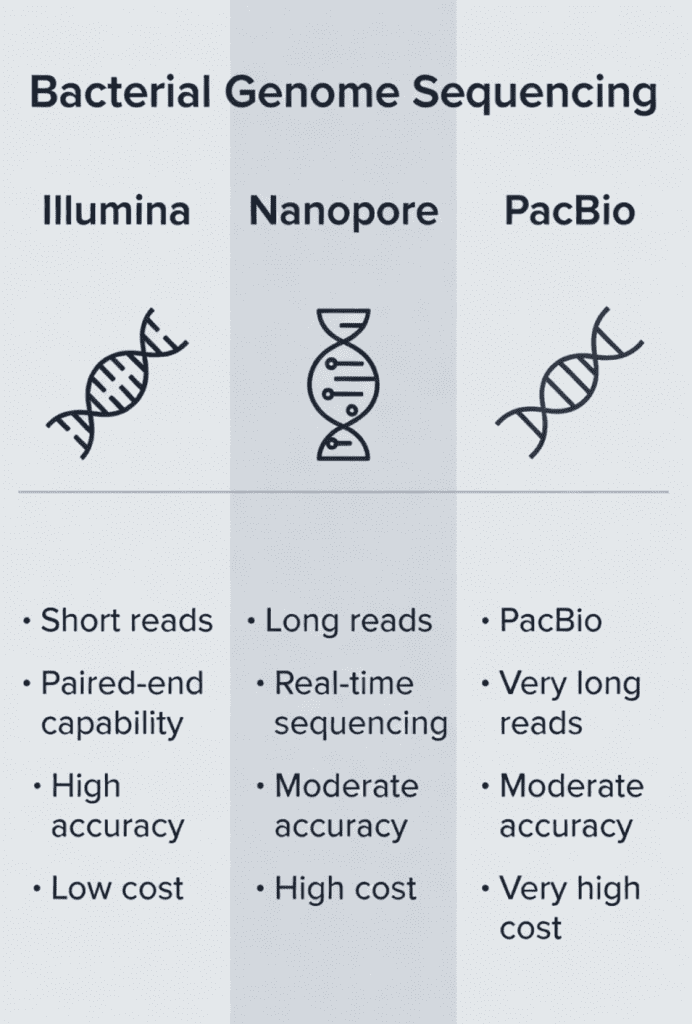
Short-read platforms (Illumina) excel in accuracy, while long-read platforms (Nanopore & PacBio) simplify assembly and resolve structural variation.
Illumina Sequencing for Bacterial Genomes
How Illumina Works
Illumina uses sequencing-by-synthesis, producing millions of short reads (typically 150–300 bp) with an extremely low error rate (~0.1%).
Advantages of Illumina for Bacterial WGS
1. Exceptional Accuracy
Illumina remains the gold standard for SNP detection, variant calls, and AMR gene identification in bacterial genome sequencing.
2. High Throughput and Low Cost
For large batches (96+ samples), Illumina offers the lowest cost per genome.
3. Well-established Pipelines
Popular tools:
- SPAdes
- Unicycler hybrid assemblies
- Prokka / PGAP annotation
- Snippy for variant analysis
Limitations
1. Short Reads → Fragmented Assemblies
Repetitive regions, rRNA operons, IS elements, and plasmids can cause:
- Contig fragmentation
- Misassemblies
- Missing plasmids
2. Difficult to Resolve Structural Variants
Genomic rearrangements, long insertions, and mobile elements remain challenging with short reads alone.
Ideal Applications for Illumina in bacterial genome sequencing projects
- Clinical surveillance (SNP-level resolution)
- AMR gene detection
- High-accuracy variant calling
- Large sample batches
- Research requiring precise error profiles
Estimated Cost (2026)
- Cost per bacterial genome: €20–60 (high-throughput)
- Benchtop instrument price: €20k–€125k
Nanopore Sequencing for Bacterial Genome Sequencing
How Nanopore Works
Oxford Nanopore Technologies (ONT) sequences DNA by detecting electrical changes as nucleic acids pass through nanopores. It produces ultra long reads, often exceeding 50 kb and even reaching 200 kb+.
Advantages of Nanopore for Bacterial Genome Sequencing
1. Long Reads Solve Complex Genomes
ONT excels at:
- Resolving plasmids
- Closing circular chromosomes
- Detecting structural variation
- Assembling rRNA operons
2. Portable and Fast
Devices:
- MinION
- Flongle (low-cost runs)
- GridION (higher throughput)
A complete bacterial genome can be sequenced and assembled within hours.
3. Affordable Initial Investment
MinION costs ~€1,000 and includes free flow cells in starter packs — making it the most accessible long-read platform for individual labs.
4. Real-Time Sequencing
Allows:
- Adaptive sampling
- Early stopping when coverage is reached
- Field-based genomics
Limitations
1. Lower Raw Accuracy (but rapidly improving)
Current ONT R10 chemistry with Q20+ and duplex basecalling reaches 99–99.5% raw accuracy, substantially better than earlier pore versions, but still below Illumina or PacBio HiFi for SNP-level work. Sufficient coverage (≥60–100×) and polishing generally yield high-quality assemblies.
2. Requires DNA Quality
High-molecular-weight DNA is essential for long reads; degraded DNA dramatically reduces read length.
3. Flow Cell Variability
Performance may vary across flow cells, affecting yield and read length consistency.
Ideal Applications for Nanopore in Bacterial Genome Sequencing projects
- Complete bacterial genome assemblies
- Plasmid sequencing and circular chromosome closure
- Rapid diagnostics
- Environmental isolates
- Hybrid assembly with Illumina
- Long-read metagenomics
Estimated Cost (2026)
- Cost per bacterial genome: €40–90
- Sequencer price: €1,000–€10,000
- Flow cell cost: €450–950

PacBio Sequencing for Bacterial Genome Sequencing
How PacBio Works
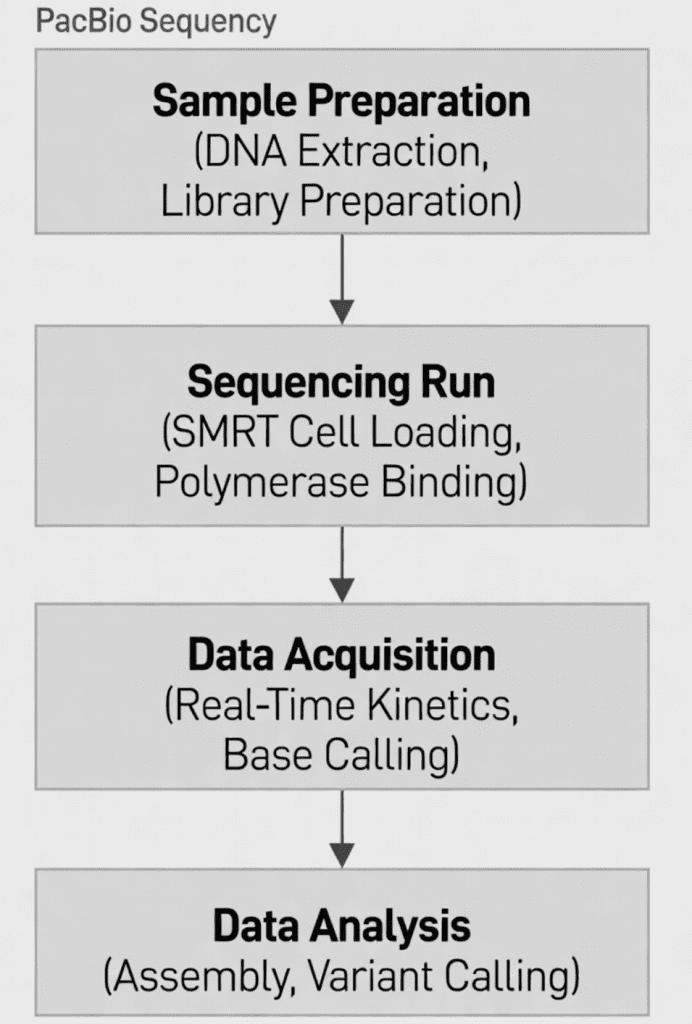
PacBio SMRT and HiFi sequencing generate highly accurate long reads (~10–25 kb) with >99.9% accuracy. HiFi reads are produced by circularizing DNA fragments and sequencing them multiple times, then generating a consensus — combining long-read length with Illumina-level per-base accuracy.
HiFi reads combine:
- Long read length
- Illumina-level accuracy
- Extremely low bias
Note (2026): PacBio has also released Onso, a short-read sequencing platform, but for bacterial WGS the main differentiator remains HiFi long reads on Revio or Sequel IIe.
Advantages of PacBio in Bacterial Genome Sequencing projects
1. Best-in-Class Accuracy (HiFi Reads)
Perfect for:
- Accurate assemblies
- Structural variant detection
- Closing genomes without Illumina polishing
2. Robust for Complex Genomes
PacBio excels in:
- Large insertions/deletions
- Plasmids and megaplasmids
- Repeat-rich bacteria (e.g., Streptomyces, Mycobacteria)
3. Consistent Output
Unlike ONT, PacBio yields are stable across SMRT cells, making it easier to plan throughput for core facilities.
4. High-Quality Assemblies Without Hybrid Methods
HiFi reads assemble into one contig per replicon in many bacteria — no Illumina polishing required.
Limitations
1. High Capital Cost
Instrumentation is expensive, making PacBio best suited for:
- Core facilities
- High-volume labs
- National sequencing centers
2. Higher Cost per Sample
More expensive than both Illumina and Nanopore on a per-genome basis, especially for small projects.
Ideal Applications
- Reference-grade bacterial genomes
- Taxonomic and phylogenetic studies
- High-accuracy plasmid sequencing
- AMR gene context mapping
- Clinical and regulatory submissions
Estimated Cost (2026)
- Cost per genome: €60–120
- Sequel IIe system price: ~€500k+
Illumina vs Nanopore vs PacBio: Which One Should You Use?
Read Length Comparison
| Platform | Typical Read Length | Max Read |
|---|---|---|
| Illumina | 150–300 bp | 300 bp |
| Nanopore | 5–60 kb | 200–500 kb |
| PacBio HiFi | 10–25 kb | ~30 kb |
Accuracy Comparison
| Platform | Accuracy | Notes |
|---|---|---|
| Illumina | ~99.9% | Gold standard for SNPs |
| PacBio HiFi | ~99.8–99.9% | Best for long-read accuracy |
| Nanopore R10 / Q20+ | ~99–99.5% | Duplex improves accuracy; polishing recommended |
Cost Comparison (per genome)
| Platform | Cost/Genome | Notes |
|---|---|---|
| Illumina | €20–60 | Cheapest for large batches |
| Nanopore | €40–90 | Flexible, portable, low instrument cost |
| PacBio | €60–120 | Highest accuracy long reads; high instrument cost |
Assembly Quality
| Platform | Assembly Outcome |
|---|---|
| Illumina | Fragmented (10–200 contigs typical) |
| Nanopore | Often single circular contig per replicon |
| PacBio HiFi | Highest quality closed genomes; minimal polishing needed |
Decision Guide: Which Platform for Which Project?
Use this table to quickly match your project goal to the most appropriate sequencing strategy. All platforms produce data that can be delivered to Tailoredomics for downstream bioinformatics analysis.
| Project Goal | Best Platform | Key Assembly Tool | Notes |
|---|---|---|---|
| Complete circular bacterial genome (closed) | Nanopore or PacBio HiFi | Flye, Canu, hifiasm | Single contig per replicon; long reads essential |
| Perfect SNP / variant accuracy | Illumina or PacBio HiFi | Snippy, DeepVariant | Illumina cheapest; PacBio if long reads needed too |
| AMR gene detection (surveillance batch) | Illumina | SPAdes + ABRicate / ResFinder | Lowest cost at scale; sufficient for most AMR |
| AMR context: gene location, plasmid, MGEs | Nanopore or PacBio HiFi | Flye + Prokka + MOB-suite | Long reads needed to resolve plasmid context |
| Rapid diagnostics / field sequencing | Nanopore (MinION) | Medaka, Miniasm | Real-time; results within hours |
| Hybrid assembly (best accuracy + completeness) | Illumina + Nanopore | Unicycler | Best balance for most research projects in 2026 |
| Reference-grade genome (publication / DB submission) | PacBio HiFi | hifiasm, Verkko | No polishing needed; NCBI-ready |
| Repeat-rich / complex bacteria (Streptomyces, Mycobacterium) | PacBio HiFi or Nanopore | hifiasm, Flye | Long reads resolve complex repeat structures |
| Large comparative genomics study (50–200 isolates) | Illumina | SPAdes + Roary / Panaroo | Cost-effective at scale; draft genomes sufficient for pangenome |
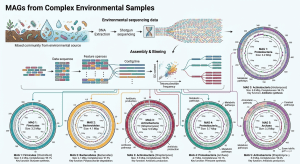
| Long-read metagenomics / MAGs | Nanopore or PacBio HiFi | Flye, metaFlye, hifiasm-meta | See our MAG pipeline guide |
If you wish to learn more about genome sequencing technologies, we recommend our dedicated post comparing Next Generation Sequencing and Sanger sequencing technologies. Check it out!
When to Use Hybrid Assembly: Illumina + Nanopore
For most bacterial research projects in 2026, a hybrid strategy combining Illumina short reads with Nanopore long reads delivers the best balance of accuracy, completeness, and cost-effectiveness.
Here is how it works in practice:
- Nanopore long reads are used to assemble a continuous draft genome, closing chromosomes and plasmids into single contigs
- Illumina short reads are then used to polish the assembly, correcting the small indel and substitution errors that remain in long-read assemblies
- The result is a genome with the structural completeness of long reads and the base-level accuracy of Illumina
The standard tool for hybrid assembly is Unicycler, which seamlessly integrates both data types. For polishing after long-read assembly, Pilon (Illumina) or Medaka (Nanopore) are widely used. To learn more about the full assembly workflow, see our Bacterial Genome Assembly Pipeline guide.
When hybrid assembly is most valuable:
- Organisms with many repetitive elements, rRNA operons, or complex plasmid content
- Projects where both completeness and SNP-level accuracy are required
- When PacBio HiFi is not available or cost is a constraint
When hybrid assembly is less necessary:
- Large surveillance projects where draft Illumina assemblies are sufficient for SNP typing or AMR profiling
- When PacBio HiFi data is available (polishing rarely needed)
- When the goal is only gene presence/absence rather than a complete closed genome
Have Sequencing Data? We Handle the Bioinformatics.
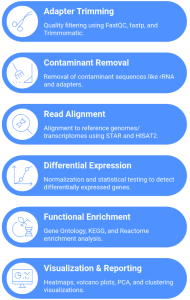
Tailoredomics provides downstream bioinformatics analysis of bacterial sequencing data — no wet-lab, no sequencing. Whether your reads came from an Illumina core, a Nanopore MinION, or a PacBio facility, we analyze your FASTQ or assembled files and deliver:
- Quality-controlled, polished genome assemblies
- Functional genome annotation (Prokka, PGAP, Bakta)
- AMR and virulence gene detection
- Phylogenomics, comparative genomics, pangenome analysis
- Publication-ready figures and reports
➜ Explore our Microbial Genomics Bioinformatics Services or contact us to discuss your dataset.
➜ Working with metagenomic data? See our Metagenomics Bioinformatics Services.
Conclusion: Which Sequencing Platform Is Best in 2026?
All three technologies excel in different areas:
- Illumina → best accuracy and cost efficiency for large batches and variant-focused studies
- Nanopore → best long reads, fastest turnaround, most flexible and affordable to access
- PacBio HiFi → best reference-grade assemblies with unmatched accuracy, no polishing required
For most bacterial genome projects in 2026:
Illumina + Nanopore hybrid sequencing delivers the best balance of accuracy, completeness, and cost for most research labs.
If only one platform can be chosen:
- Choose Nanopore for assembly completeness and accessibility
- Choose Illumina for variant accuracy and large-scale surveillance
- Choose PacBio HiFi for high-accuracy long reads and reference-grade genomes
Once you have your sequencing data, the next challenge is the bioinformatics. Our Microbial Genomics Bioinformatics Services take you from raw reads or assembled genomes to annotated, interpreted, and publication-ready results — whatever platform you used.