Introduction
Metagenomics has transformed the study of microbial communities by enabling researchers to analyze DNA directly from environmental samples. Instead of isolating organisms in culture, sequencing environmental DNA allows scientists to explore the genomic diversity of entire microbial ecosystems.
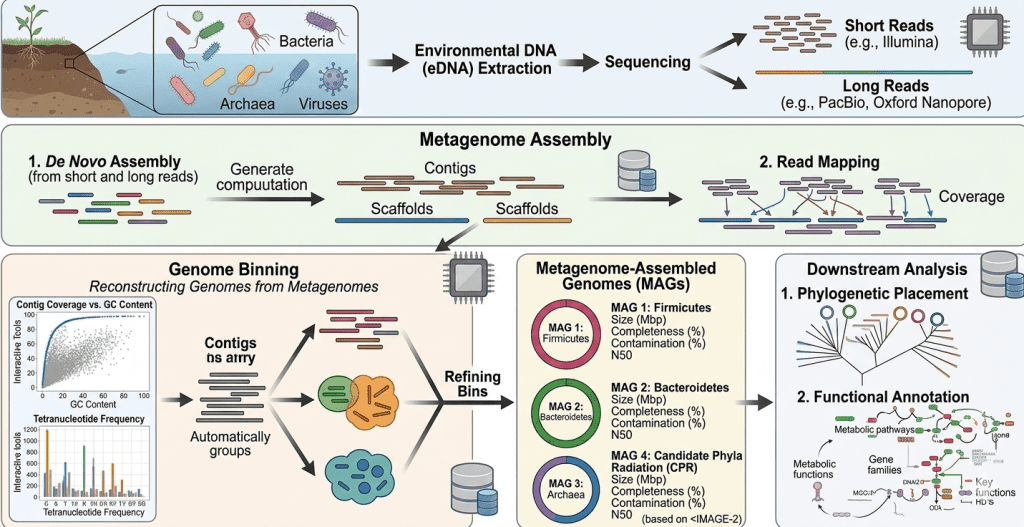
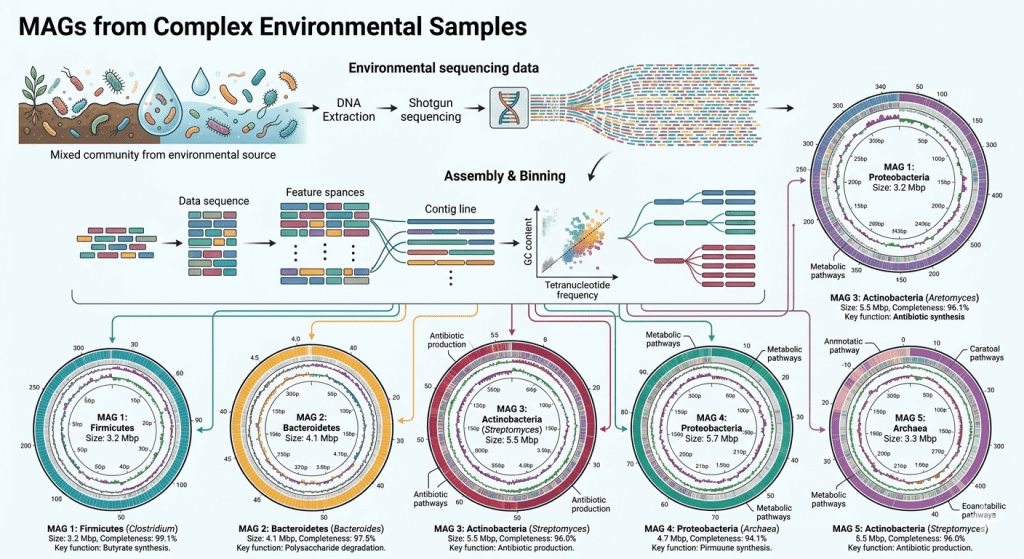
A central step in many studies is the metagenome assembly pipeline, which reconstructs genomes from mixed sequencing data. These reconstructed genomes are known as metagenome-assembled genomes (MAGs).
MAGs provide insights into the metabolic capabilities and ecological roles of previously uncultured microorganisms.
If you need support analyzing environmental sequencing data, our Metagenomics Services provide end-to-end analysis from raw sequencing reads to genome bins and functional interpretation.
Overview of a Metagenome Assembly Pipeline
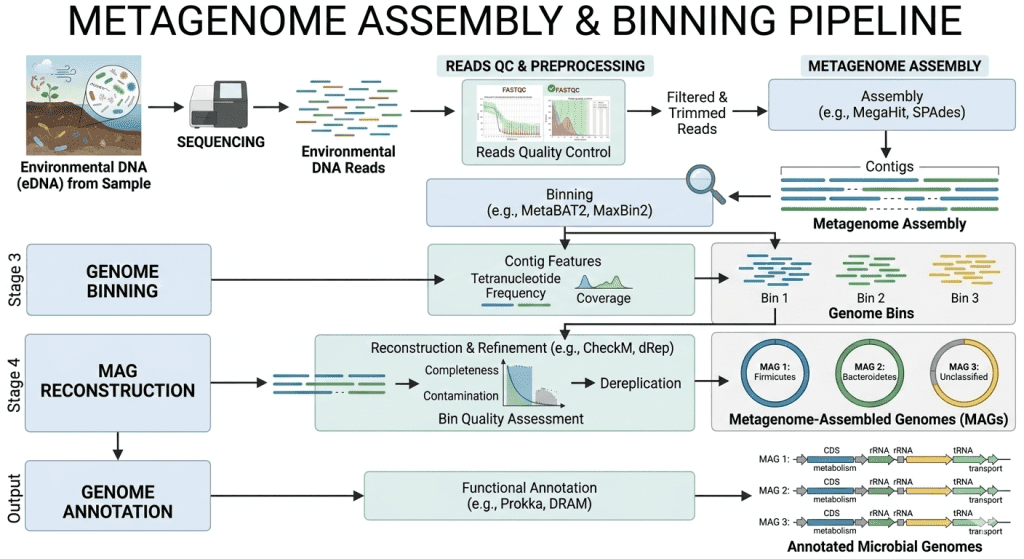
A typical metagenomics assembly workflow includes the following steps:
- quality control of sequencing reads
- metagenome assembly
- contig binning
- MAG quality assessment
- genome annotation
- functional and taxonomic analysis
Each step contributes to reconstructing genomes from complex microbial communities.
Step 1: Quality Control of Metagenomic Reads
Metagenomic sequencing generates large datasets containing reads from many organisms. Quality control removes low-quality reads and adapter sequences before assembly.
Common tools include:
Step 2: Metagenome Assembly
Metagenome assembly reconstructs longer DNA sequences from short sequencing reads. Unlike isolate genome assembly, metagenomic datasets contain sequences from many organisms simultaneously.
Popular metagenomic assemblers include:
- MEGAHIT
- metaSPAdes
- Flye (for long-read metagenomics)
Step 3: Genome Binning
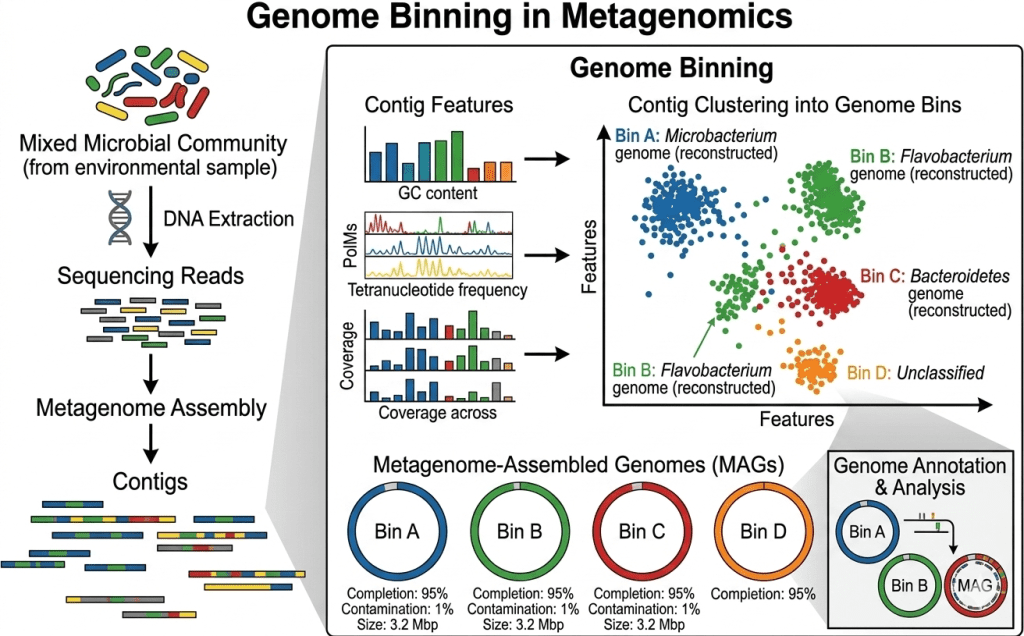
After assembly, contigs belonging to the same organism must be grouped together. This process is known as binning.
Genome binning algorithms use characteristics such as:
- sequence composition
- GC content
- coverage patterns across samples
Common binning tools include:
- MetaBAT2
- MaxBin2
- CONCOCT
The result of binning is a set of draft genomes known as metagenome-assembled genomes.
Step 4: MAG Quality Assessment
MAGs must be evaluated to determine their completeness and contamination levels.
Standard metrics include:
- genome completeness
- contamination estimates
- number of contigs
Tools such as CheckM are commonly used to evaluate MAG quality.
Step 5: Genome Annotation
Once MAGs are reconstructed, genes and functional elements must be identified through genome annotation.
Annotation tools such as Prokka or Bakta can be used to predict genes and assign biological functions.
If you are unfamiliar with this process, see our article What Is Genome Annotation?.
Applications of Metagenome-Assembled Genomes
MAGs have become essential tools in microbial ecology and environmental genomics.
Applications include:
- discovering uncultured microbial species
- reconstructing metabolic pathways
- studying microbial evolution
- identifying novel enzymes and biosynthetic pathways
Final Thoughts
The metagenome assembly pipeline enables researchers to reconstruct microbial genomes directly from environmental sequencing data. By combining assembly, binning, and annotation, scientists can uncover the hidden diversity and functional potential of microbial communities.
As sequencing technologies continue to improve, metagenome-assembled genomes will play an increasingly important role in microbiome research and microbial ecology.