Introduction
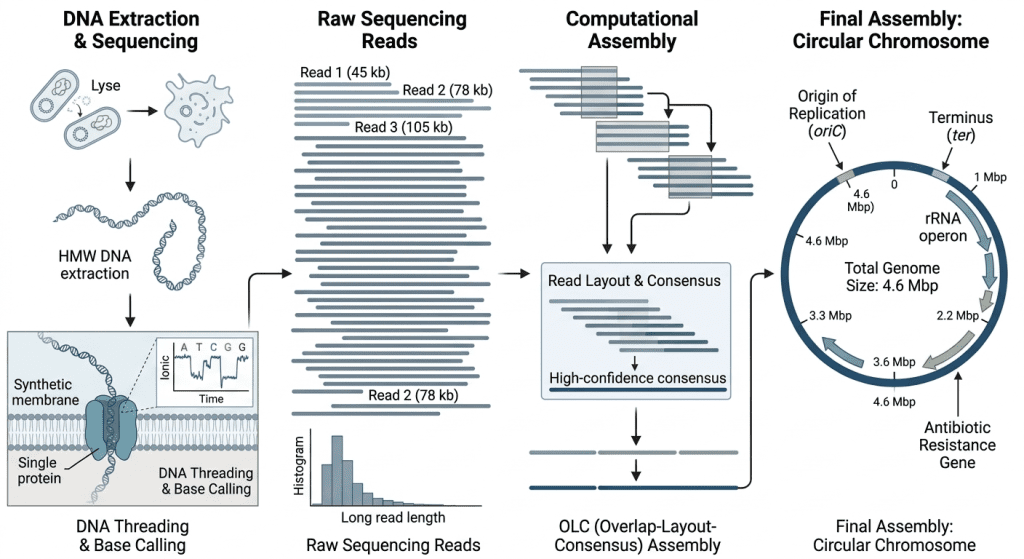
Long-read sequencing technologies have transformed microbial genomics by enabling the assembly of complete bacterial genomes from a single sequencing experiment.
Among these technologies, Oxford Nanopore sequencing has become widely used due to its ability to generate ultra-long reads capable of spanning repetitive genomic regions.
In this guide we explain how to assemble a bacterial genome from Nanopore reads, including the major steps involved in long-read assembly, polishing, and quality assessment.
If you need help analyzing microbial sequencing datasets, explore our Microbial Genomics Services.
Why Nanopore Sequencing Is Useful for Bacterial Genome Assembly
Traditional short-read sequencing technologies often produce fragmented genome assemblies because repetitive regions cannot be resolved.
Oxford Nanopore sequencing generates long reads that can span these regions, allowing the reconstruction of near-complete bacterial chromosomes.
Advantages of Nanopore sequencing include:
- long read lengths, often tens of kilobases
- ability to resolve repetitive genomic regions
- improved assembly contiguity
- portable sequencing devices
Overview of a Nanopore Genome Assembly Pipeline
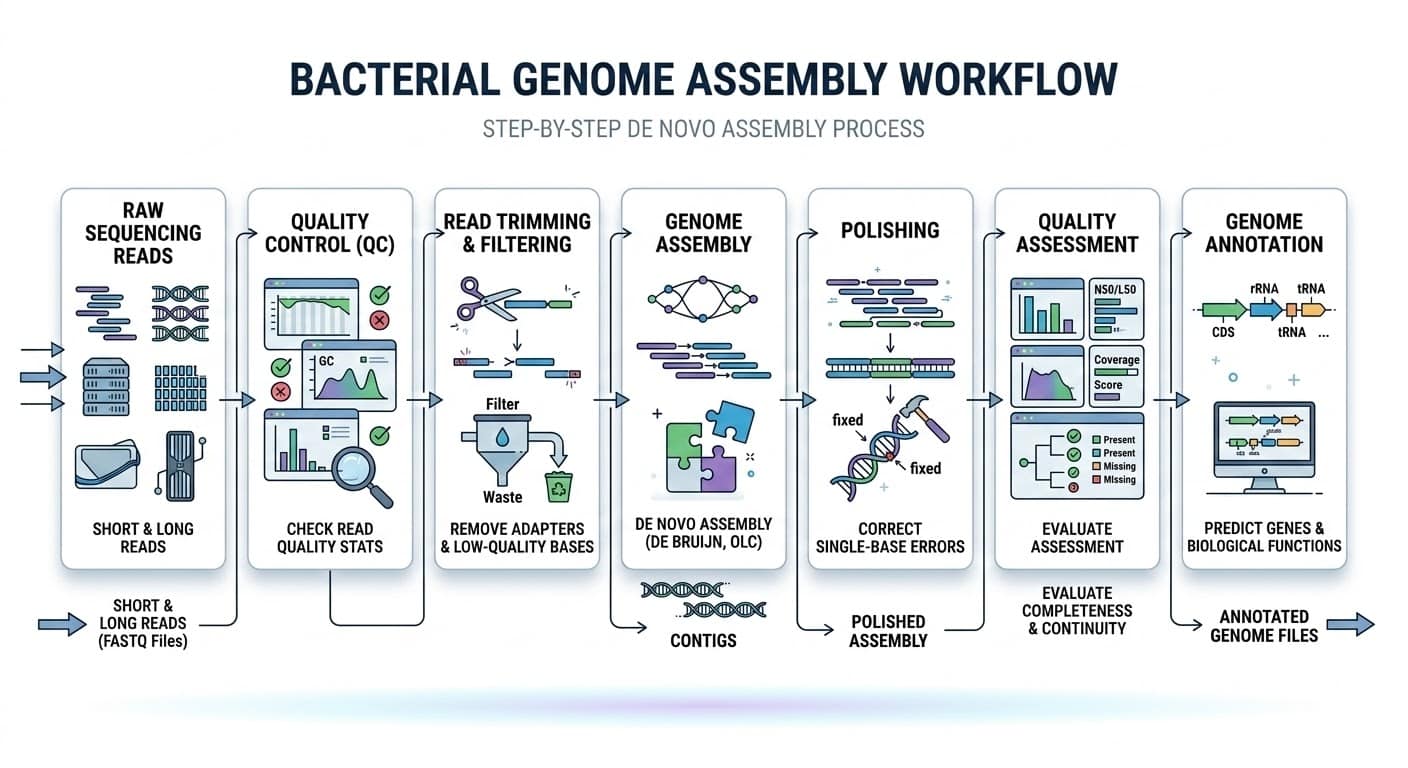
A typical Nanopore genome assembly pipeline includes the following steps:
- quality control of raw reads
- genome assembly
- assembly polishing
- genome circularization
- assembly quality assessment
- genome annotation
Step 1: Quality Control of Nanopore Reads
Raw Nanopore reads are typically stored in FASTQ format after basecalling.
Before assembly, sequencing reads should be evaluated to identify potential problems such as:
- low-quality reads
- adapter contamination
- very short fragments
Common quality control tools include:
Step 2: Genome Assembly
The next step is assembling long sequencing reads into contiguous genomic sequences.
Several tools are optimized for long-read genome assembly.
Popular assemblers include:
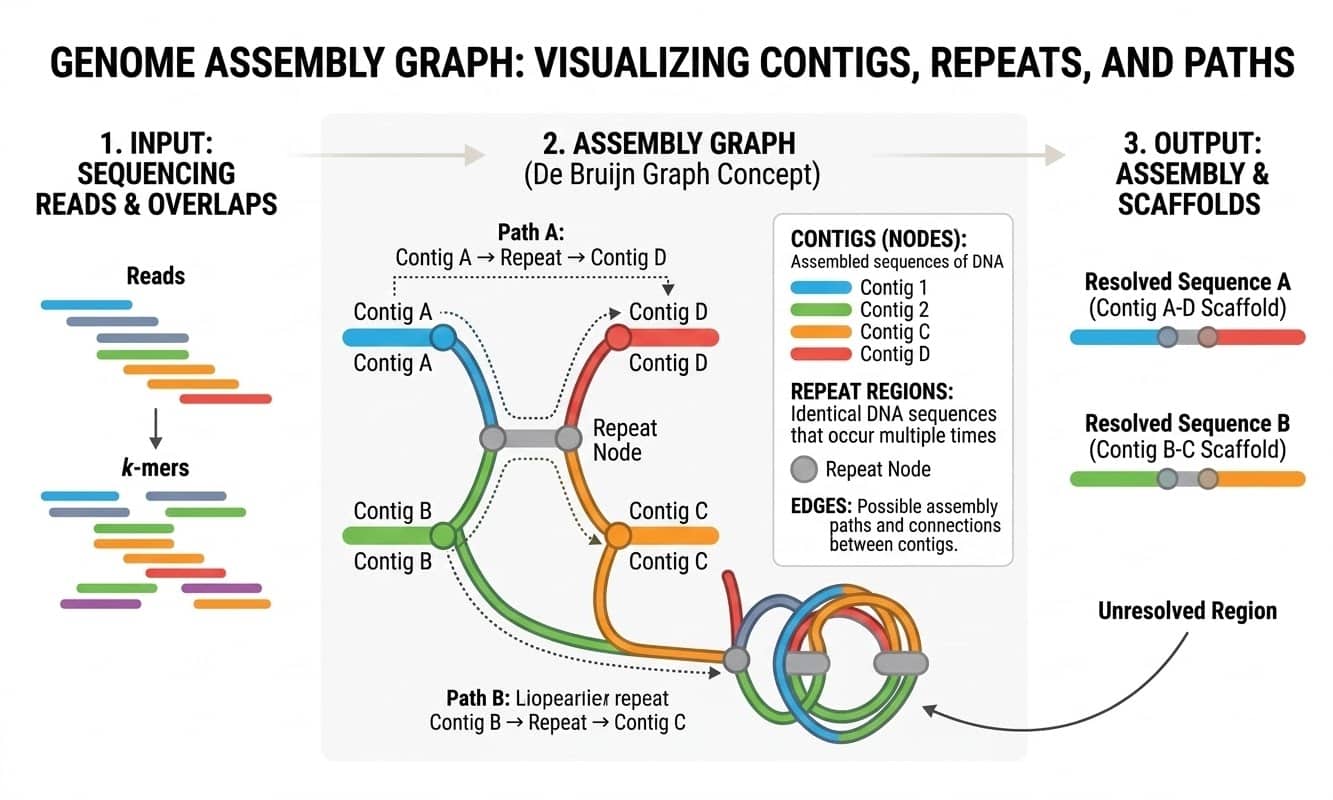
These tools construct assembly graphs that connect overlapping reads to reconstruct the bacterial chromosome.
Step 3: Assembly Polishing
Nanopore reads have higher raw error rates than short-read technologies. As a result, genome assemblies must be polished to correct sequencing errors.
Polishing improves base-level accuracy and gene prediction quality.
Common polishing tools include:
Multiple rounds of polishing are often performed to achieve optimal accuracy. If you need support with long-read assemblies, see our Microbial Genomics Services.
Step 4: Genome Circularization
Many bacterial genomes consist of circular chromosomes.
After assembly, the contig representing the chromosome may contain overlapping ends that should be trimmed to create a properly circularized genome.
Tools such as Unicycler or Circlator can assist with this step.
Step 5: Assembly Quality Assessment
Once the genome assembly is complete, its quality must be evaluated.
Key metrics include:
- genome completeness
- contig count
- N50 statistics
- contamination levels
Common evaluation tools include:
Step 6: Genome Annotation
After assembling the genome, the next step is identifying genes and functional elements.
Genome annotation tools predict coding sequences, RNA genes, and functional pathways.
Common annotation tools include:
If you are unfamiliar with genome annotation workflows, see our detailed guide: What Is Genome Annotation?.
Final Thoughts
Oxford Nanopore sequencing enables the assembly of high-quality bacterial genomes with fewer contigs and improved structural accuracy.
By combining long-read assembly, polishing, and quality assessment, researchers can reconstruct near-complete microbial genomes suitable for comparative genomics, functional analysis, and evolutionary studies.
If you need assistance assembling microbial genomes from Nanopore or hybrid sequencing data, explore our Microbial Genomics Services.